
Ahkiyyini, the Drummer of Inuit Folklore
Explore the Inuit legend of Ahkiyyini, the undead dancing spirit whose bone-drumming shakes the earth and stirs the Arctic sea.
MYTHOLOGY
Inuit Folklore
The Dancer in the Village
In the time before missionary flags fluttered on Arctic shores, an Inuit settlement huddled around the mouth of a river. Men and women here marked the cycle of the seasons with the qilaat, the frame‑drum of wood or bone covered with hide, which echoed through long winter nights. The drum had been part of their world for thousands of years, used in celebrations, to settle disputes and for ceremonies.
Drummers bent their knees, leaned forward and moved the drum in different directions while chanting songs of love, hunting and humor. In those days there lived a man who never missed a dance.
From boyhood he stood in the front row when the elders beat the qilaat; later his own arms seemed to have been shaped by rhythmic motion. He learned the shaman’s songs and knew that the drum could open the road to spirits, but he was no angakoq.
He danced because the world felt alive when the drumskin sang. The community loved him for it, and when hunters returned or when two families asked the drum to settle a quarrel, he lifted the rhythm and they laughed, forgetting their bitterness. Drumming and dancing were more than entertainment – they reminded the people that the world itself was rhythm.
Elders told children that every creature and rock possessed a tarniq, a spirit, and that when those spirits were respected, the sky god Sila sent fair weather while the sea goddess Sedna released seals and whales.
To break taboos or neglect the ceremonies meant provoking spirits and upsetting the balance of seasons. Those who died without respect for these laws were said to dwell in a grey underworld just below the earth’s crust, a place of famine and despair. Elders said the dead traveled to different realms, some beneath the sea, some above the sky, depending on the balance of their lives and the spirits who received them.
The dancer heard these teachings often, but as he grew older his passion turned into obsession. He drummed when others had set their drums aside, playing alone outside his snow house as summer fog rolled inland.
He beat his drum when the sea ice cracked and groaned, and neighbours murmured that he should rest. When he pounded harder, the drumstick splintered. Ignoring warnings, he carved another from a caribou bone and kept playing.
The Storm That Took Him
One late autumn a gale lifted from the sea. Clouds that had lain low on the horizon all week thickened and the snow stung faces, yet the dancer slipped down to the shore with his caribou‑bone drumstick and his large drum.
In defiance of the spirits he began to dance, stamping his feet on frozen stones, his voice a hoarse chant. The waves climbed higher; inland dogs whined.
Some elders believed that by beating a drum a shaman could calm or summon storms; here the storm seemed to answer the dancer’s challenge. At the height of the squall a gust snatched the drum from his hands and the wind hurled him into the surf.
Neighbors ran to the water’s edge but saw only shattered ice and swirling foam. They searched for days and found nothing but his drum, cracked on the rocks, and a length of bone that might once have been his drumstick. A lament rose in the village and then silence; people knew that a man so consumed by rhythm might not rest easily.
What Rose from the Cold
During the first dark months after his disappearance, the village heard the usual groaning of sea ice and the distant bark of seals. Then one night, when the hunters were still on the ice, a new sound came from the shore: a hollow beat like bone striking bone.
Women looked at each other, children clutched their mothers’ parkas, and the elders listened without speaking. In the dim light they saw a figure swaying among the driftwood, taller than any man and stripped of all flesh.
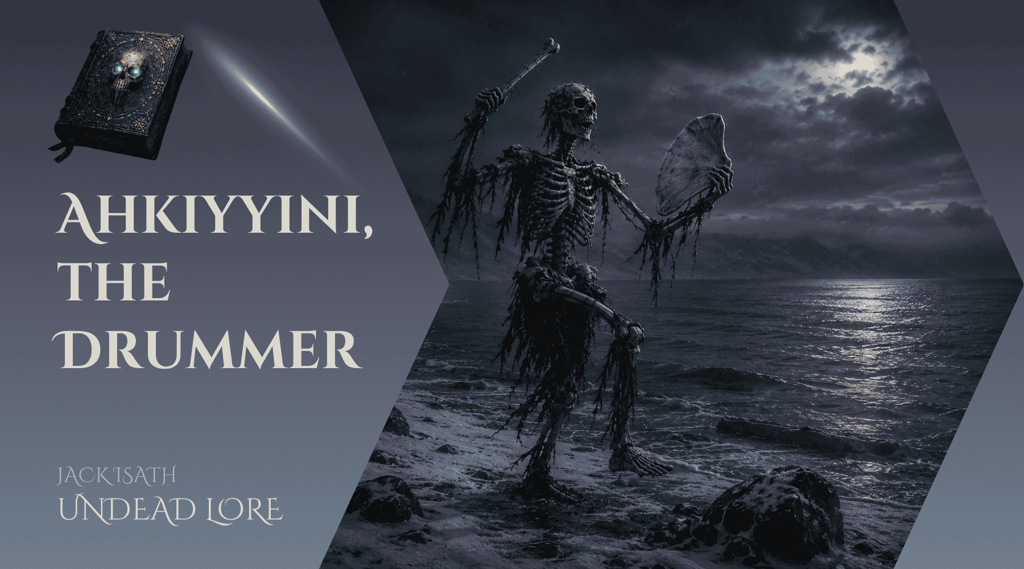
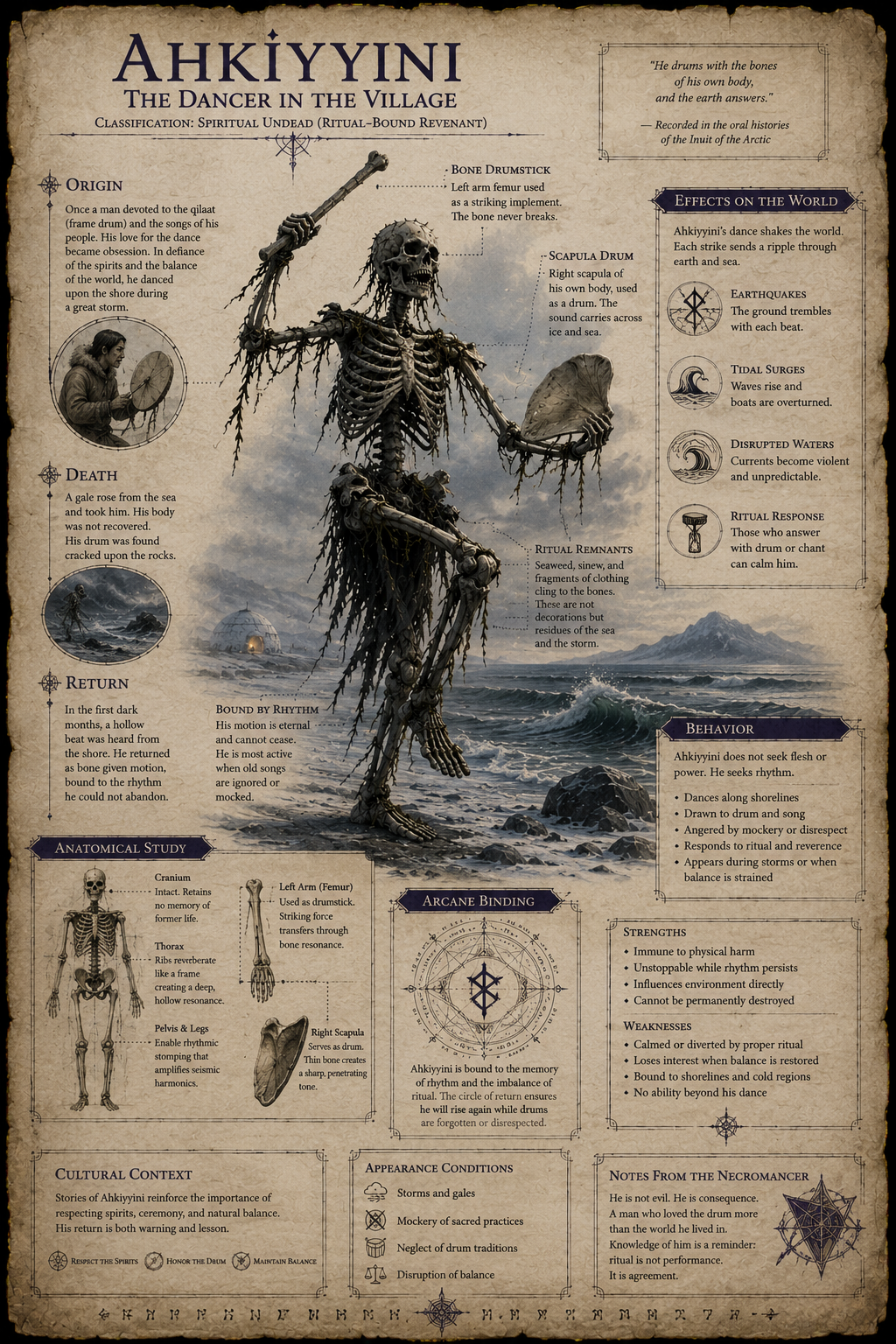
It was a skeleton, its ribs clattering and its joints still dark with seaweed, and it was dancing. The bones of its left arm were held like a stick and in its right hand it gripped its own scapula, its shoulder blade. As it beat the blade with its arm the sound echoed across the ice, and each blow seemed to vibrate through the earth.
The older people whispered the name that came to them from old tales: Ahkiyyini, the skeleton‑ghost who had loved to dance in life and now returned to make his own music. They remembered that in stories he had been always dancing when living, and in death his skeleton came back to dance a jig that shook the ground and set boats spinning in the waves.
He now made music with his own bones; his arm served as a drumstick and his shoulder blade as a drum. Each time he struck, the earth trembled and waves rose until boats moored along the shore tipped and swamped.
Some said they felt the land shiver beneath their feet. Ahkiyyini’s dancing could cause earthquakes and tidal waves.
The figure’s dance was hypnotic but dangerous. The skeleton sometimes vanished into the fog, only to reappear days later when people laughed too loudly near the shore. When hunters approached by kayak, he would dance faster, his blows stronger, and the sea would surge until the small craft rocked furiously. If the hunters beat their own drums, he danced in time and the water calmed.
Sometimes an angakoq stood at the water’s edge and sang in the shaman’s secret language, and the drumming spirit drifted away as if answering to a call from deeper realms. But when youths mocked the sound or when strangers tried to outrun the beat, Ahkiyyini’s arms moved in a blur, the earth shook and the sea overturned their boats.
In this way he taught respect for the spirits and for the ancient art of the drum.
Of Earth and Sea Shaken
Those who lived through the years of suppression when missionaries forbade drum dancing later said that Ahkiyyini’s appearances grew rarer in that era.
Perhaps he retreated because the sound that bound him to the living world fell silent. When elders revived the tradition, teaching younger generations to craft drums again and to honor the qilaat’s rhythms, stories were told of a skeleton on the shore who listened from afar and beat his shoulder blade in time. His dance then seemed less violent, as if his anger had been soothed by hearing that the drum would not disappear.
No one knows whether Ahkiyyini was finally led to the sky‑realm by a compassionate shaman, or whether he still dances along lonely coasts, ready to shake the earth when people forget the old ways. Fishermen in remote inlets still tell of nights when the wind falls silent and a hollow beat travels across the ice. They quiet their voices and place their drums carefully inside their boats.
They know that some ghosts dance not out of malice but because they cannot leave behind the rhythms that once held a community together. On such nights, elders say, it is best to listen and remember that every stroke of the drum is a thread between the living and the dead.
Undead Lore Mission
Introduce Undead Lore as a scholarly exploration of death, undeath, necromancy, and their role in myth, media, games, and culture.
© 2026. All rights reserved. Created by Nectagrity LLC