Anchimayen of Mapuche Folklore
Mapuche legend of the Anchimayen, a child spirit turned fiery omen by dark sorcery, haunting the southern hills with death and warning.
MYTHOLOGY
Mapuche Folklore; Also Anchimallén
The Child in the Ruka
In a ruka of thatched straw and smoke-darkened beams, a child was born who never had the chance to grow old. His mother sang to him over the grain and water, and his father taught him to follow the cattle paths. He learned the names of the hills and the streams. The elders of the lof said that he would learn to weave and to hoe wheat, but when the summer came, fever tightened his breath and he went silent in his mother’s arms. He was wrapped in wool, wept over, and buried at the edge of the field. For three nights a pitio called and a fox barked from the pines. The family kept watch until the mound of earth settled, believing his spirit would find the way to the land above.
Yet there was another watcher. In the dark before dawn, an old woman stood by the grave. She was not a machi who heals; she was a kalku, one who works with the wekufe, the evil forces that the Mapuche fear. Where others prayed to the Ancestors, she murmured charms over the soil. She waited until those who mourned were asleep, then opened the ground and took the small bones for her own purposes.
Unsettled Soil
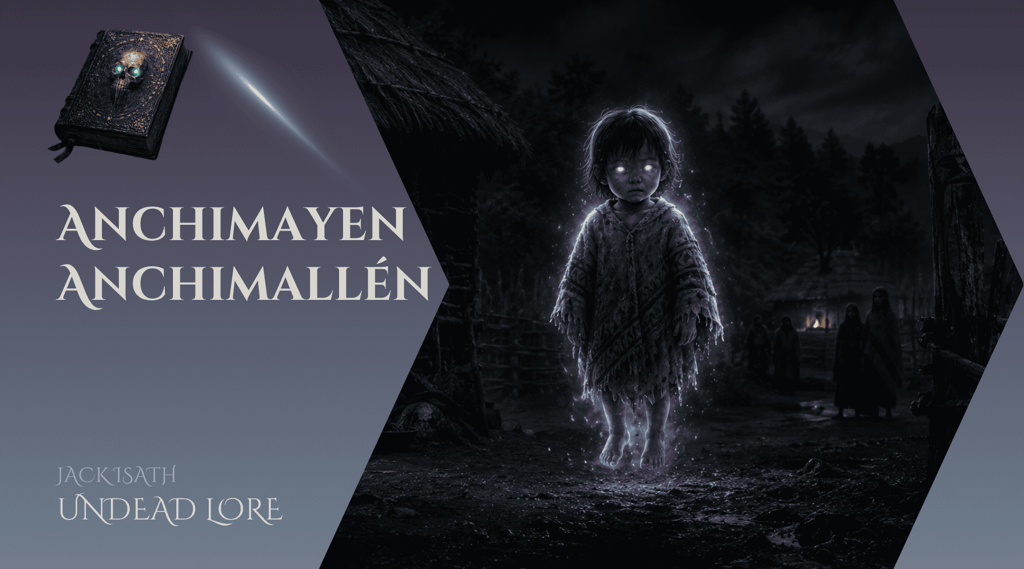
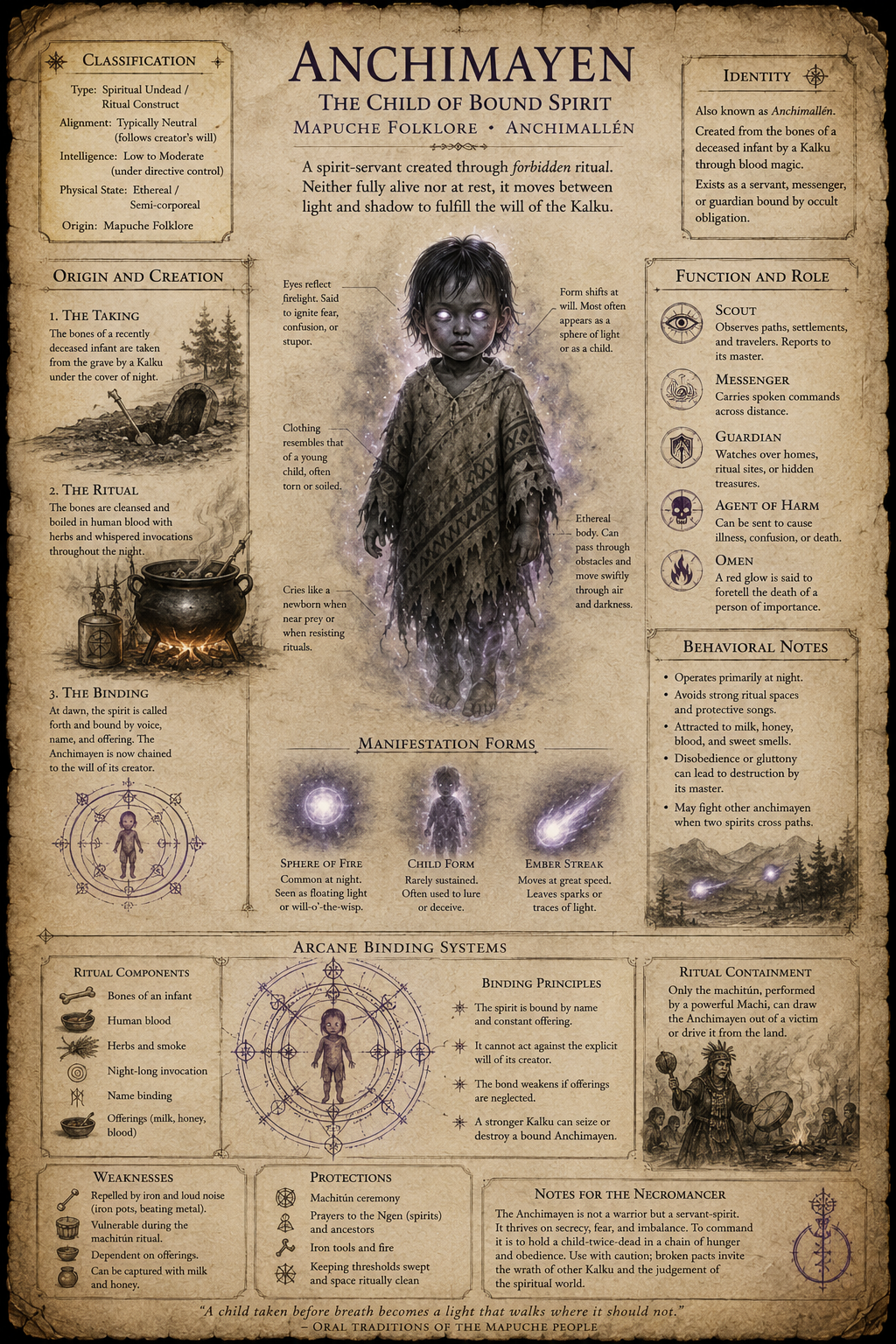
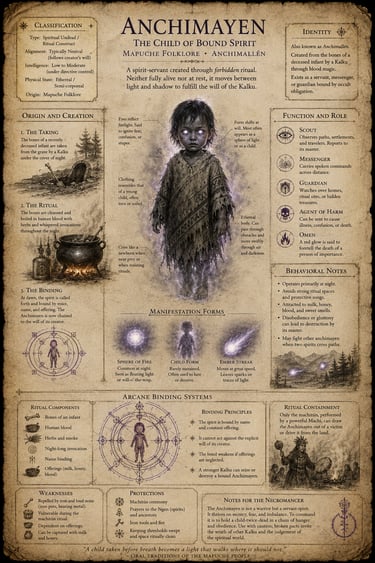
In the kalku’s hut the bones were placed beneath a blackened cauldron. She filled the pot with human blood and set it over embers. All night she chanted a lament that sounded like the cry of a newborn. When dawn touched the hills, a thin wail came from beneath the pot. She lifted the vessel, and a small creature crawled into the light. It had the stature and roundness of a child barely past infancy; its skin was gray and its eyes reflected the fire. When it looked upon the world it could shift its form at will.
The kalku fed it with warm milk and drops of honey mingled with blood, for that was what such beings crave. The creature obeyed her voice as if she were its mother. Its purpose was to serve and to guard; it would do good or ill according to the will of the one who held its leash. When the bones of a child are raised in this manner, the Mapuche call the result an anchimayen. Some say that the kalku created many of them to stand watch around her hut; others whisper that the little ghosts wander because their spirits were caught by a witch and forced to do her bidding.
Of Light and Obedience
The anchimayen seldom kept the shape of a child for long. Most often it appeared as a sphere of fire that floated above the earth and shone like a centella. During the day such a sphere could be seen without brightness; only at night did it reveal its radiance. Sometimes two such lights would meet in the dark meadow and clash, sparking and circling like rival fireflies. People who saw them said that they fought each other, scattering embers before disappearing into the air.
Those who have heard the anchimayen say that it cries like a newborn. When an unwary traveller drew near, its light would flare, leaving the person stunned, blind or stuttering. It fed on milk, blood or honey, and if its owner neglected to set out these offerings, it might wander to another house lured by sweet smells. Some cunning men tried to capture one by placing bowls of milk and honey on a threshing floor, for it is said that if you steal an anchimayen and feed it well, it will guard your animals and your wealth. When raised by a kind hand, it stands valiantly against thieves and is passed down from one generation to the next, bringing fortune to the household. When its flame glows red, the elders whisper that a great leader will soon die.
In the hands of the kalku, the anchimayen became a messenger of harm. She sent it across the hills to inflict illness or death. Those who saw a sudden flash flitting over the fields or in the branches of a tree knew that misfortune would follow. Sometimes it perched on the thatched roofs of rucas like a burning star. The Mapuche believed that only the ritual of machitún, led by a powerful machi, could draw it out of a victim’s body and send it back to its master.
An Omen Beneath the Stars
Years after the boy’s death, his village celebrated the harvest. As drums sounded and songs rose to Antu the Sun and Küyen the Moon, a red light flared above the fields. It hovered, then darted over the roof of the lonko’s house. Those who knew the stories fell silent. The elders beat their spurs against iron pots and shouted to drive the spirit away, for the noise of metal is said to frighten these beings. Yet the glow lingered, and the next morning the lonko was found lifeless in his bed. People remembered how, when the light turned crimson, it signaled the impending death of a person of stature.
The machi was called, and she gathered the community to perform the machitún. They sang and drummed through the night. The anchimayen shrieked within the air, resisting the pull of the ceremony. Only when the machi and those with strong spirits encircled the afflicted house did the little ghost flee. The kalku, furious at the loss of her servant, searched for another child to claim.
In later years people claimed to see the same kind of fiery spheres on distant nights, and some wondered if they might be globes of lightning; yet the elders insisted that they were spirits bound by ancient wrongs. They reminded the young that the anchimayen was once a child like any other, taken before his time and made to serve forces of darkness. They warned that greed and negligence could doom such a servant: “For being gluttonous, the anchimayen loses its life,” they said, because a stolen spirit that wanders toward honey or milk might be caught by another, and then the original owner will kill it in punishment.
Even now, far from the ruka where the boy drew his first breath, travellers who cross the southern hills speak of lights that drift between the trees and vanish when approached. They hear a thin cry on the wind and feel the hair rise at the nape of their neck. Whether the glow is the echo of a soul bound to a kalku or a trick of weather, the story has been told to warn and to remember: do not disturb the dead, do not trust those who twist their bones, and if a burning sphere turns red above your roof, prepare yourself with courage and song.
Undead Lore Mission
Introduce Undead Lore as a scholarly exploration of death, undeath, necromancy, and their role in myth, media, games, and culture.
© 2026. All rights reserved. Created by Nectagrity LLC