Are Vampires Undead? History, Myth, and More
Vampires are usually undead, but myth, history, and modern media complicate the answer. Explore how the idea evolved and why it still shifts.
PHILOSOPHY
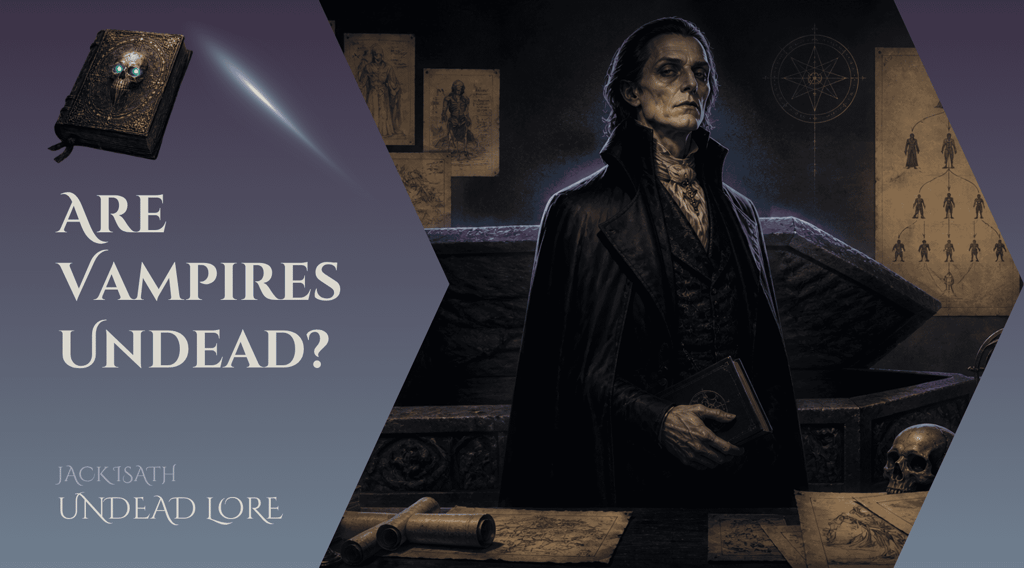
In the oldest and most influential European sense, yes: the vampire is usually a dead person who returns bodily from the grave, harms the living, and fits the ordinary meaning of the undead as something "returned from or as if from death."
Dictionaries still preserve that core definition, and the dominant folklore behind the Western vampire treated it as a revenant, not a merely strange species. But the label widened over time. Some traditions already allowed for "living vampires," and modern fiction often recasts vampires as infected humans, cursed immortals, hybrids, or a separate race entirely.
The shortest accurate answer is this: in folklore and in the main line running from village revenant to Dracula, vampires are undead; in modern media, that answer is still common but no longer universal.
Are Vampires Undead?
If "undead" means a being that has died and somehow returned, the vampire sits very comfortably inside the category. Merriam-Webster defines undead as "returned from or as if from death," especially in stories about vampires and zombies, and defines vampire first as the reanimated body of a dead person that rises at night to drink blood. That is the cleanest definitional baseline, and it matches the broad encyclopedia tradition as well.
The complication is that vampire is narrower than undead in some ways and looser in others. Narrower, because not every undead thing is a vampire. Looser, because the word "vampire" now gets used for very different monsters that share feeding, immortality, or parasitic traits without sharing literal death and return. In other words, "undead" is a category of ontology, while "vampire" has become a category of behavior, image, and symbolism as well. That is why folklore answers the question more firmly than pop culture does.
The comparison matters because a vampire is best understood as a specialized revenant. A revenant is simply one who returns. A vampire is the revenant that feeds, infects, or drains vitality, often while retaining more personality and intention than a zombie and more bodily persistence than a ghost. That middle position helps explain why vampires are so adaptable in fiction. They can be corpse, spirit, seducer, plague-carrier, noble predator, or tragic immortal, all while still feeling recognizably "vampiric."
The diagram above maps the article's core claim. The classic vampire belongs on the corporeal-undead branch. Many modern exceptions move it into the countermodel branch without erasing the older meaning.
Folklore Before Dracula
Long before the count in a cape, southeastern Europe preserved a dense family of return-from-the-grave traditions. What English later called the vampire was often a translation layer placed over local names and local fears. In Slavic materials one finds vampir, upir, and related forms; in Romania one meets strigoi, moroi, pricolic, and varcolac; in Greece the vrykolakas appears as a grave-risen tormentor; and in the lands of modern Serbia and the wider Balkans the returned dead were often treated as corporeal beings that left and reentered the grave on a schedule. The umbrella term came later, after Western readers started absorbing these local variants into one composite monster.
A key point often gets lost here: folklore vampires were not always elegant blood aristocrats. They could be swollen corpses, troublesome kin, village afflictions, livestock attackers, or noisy, poltergeist-like dead. Some Romanian materials even preserve a distinction between beings that are vampiric while still alive and those that become vampiric after death. That detail matters because it shows the tradition itself was already more complex than the simple formula "vampire equals undead corpse," even though that corpse-model remained dominant.
The Greek case is especially useful because it reminds us that not every local "vampire" was primarily a blood drinker. The vrykolakas could be interpreted as a revenant tied to interrupted ritual cycles of death and burial, and scholars of Greek folklore have treated it as part of a wider symbolic system rather than as a mere monster catalog entry. The thing that unites it with the Slavic and Romanian material is not one exact feeding habit but the persistence of the dead in social space after burial.
The term nosferatu deserves caution. It entered Anglophone vampire discourse through Emily Gerard's nineteenth-century essay on Transylvanian superstition and later became famous through Stoker and cinema, but the word's etymology is uncertain and scholars do not treat it as a secure ancient master-term for all Romanian vampire belief. It is better read as part of the literary afterlife of folklore than as a clean folk category in its own right.
Grave Panics and Exhumations
The folklore turned historical in the eighteenth century because states, doctors, priests, and military officials began writing down cases that villagers treated as matters of urgent public danger. Peter J. Bräunlein describes documented vampire cases between 1724 and 1760 on the Habsburg frontier, where unusual deaths, undecayed corpses, and fears of nocturnal assault moved from rumor into administrative record. The vampire became not just a folktale figure but a problem for governance, medicine, and law.
Two Serbian cases became especially famous. The 1725 Kisiljevo case of Petar Blagojević, recorded in Ernst Frombald's letter and published in the Wienerisches Diarium, is historically significant because it contains the earliest known use of the word vampire in this documentary chain. A few years later, the Medveđa affair centered on Arnold Paole and on the deaths that followed in 1731 and 1732. By then the matter had escalated into a larger European controversy.
The Medveđa material shows why the vampire was so persuasive to contemporaries. Ádám Mézes notes that officials reconstructed a sequence of "vampirization," heard witness testimony about prior attacks, exhumed fifteen corpses, and confirmed several as vampires according to the standards of the moment. Villagers and investigators looked for particular signs: lack of decay, swelling, blood in the mouth, internal organs that seemed intact, and liquid or "fresh" blood. Corpses thought dangerous were then staked, beheaded, burned, or reduced to ash, with the remains sometimes scattered. What later readers treat as superstition was, to those involved, a grim attempt at public health and communal defense.
Paul Barber's forensic reading helps explain why these signs were so convincing. Bloating, postmortem discoloration, blood-stained fluid at the mouth and nose, apparent movement when pierced, and even noises forced out by trapped gases are all consistent with decomposition under burial conditions. In Barber's account, the traditional techniques for killing a vampire often make mechanical sense if one assumes the object of fear is a swollen corpse thought to be active. The old villagers were wrong about cause, but often keen observers of effect.
The panic eventually provoked elite skepticism. Maria Theresa's court physician, Gerard van Swieten, urged the crown to act against exhumation and corpse-desecration accusations, and Klaniczay argues that the vampire controversy helped destabilize the older magical universe even as it briefly flourished inside it. The vampire panic, in other words, belongs to the history of Enlightenment as much as to the history of superstition.
From Polidori to Dracula
The literary vampire did not simply copy folklore. It refined, selected, eroticized, and socialized it. John William Polidori's The Vampyre, published in 1819, is widely treated as the moment the vampire becomes an aristocratic literary predator rather than a village corpse. Instead of a rude, swollen revenant, Polidori gives literature a charismatic elite parasite. That shift still governs an enormous amount of vampire fiction.
Sheridan Le Fanu's Carmilla adds another decisive layer. Britannica notes that the story popularized the female vampire and became an important precursor to Stoker. It also intensifies the connection between vampirism, intimacy, secrecy, and erotic threat. By the time the vampire reaches the late nineteenth century, it has become less a village anomaly and more a figure for desire and invasion.
Then comes Bram Stoker and Dracula. Stoker did not invent the vampire, but he consolidated the template. Britannica's vampire survey notes that many popular vampire traits, including methods of survival and destruction and the association with aristocracy and eastern Europe, were solidified in this novel and in its later screen afterlives. Johnson's comparison of Count Dracula with folkloric vampires puts the point neatly: Dracula works because Stoker gathers attributes from many revenant traditions into one concentrated figure.
The screen then finished what the novel began. Nosferatu carried the Stoker pattern into film, even through legal controversy, and the movie vampire became one of the twentieth century's most exportable visual ideas. Literature had turned the revenant into a personality. Cinema turned that personality into an image.
Timeline sources: the eighteenth-century entries are grounded in Tournefort's travel record, the early Habsburg case literature, and later scholarship on the frontier panic; the literary and cinematic entries follow standard literary histories and public-domain bibliographic records.
The timeline shows the real arc of the tradition. The vampire begins as a local returned dead, passes through bureaucratic panic and literary redesign, and ends as a flexible modern myth capable of carrying horror, romance, satire, action, and metaphysical drama.
Modern Media and Symbolic Meanings
Modern media keeps asking the old question in new costumes: does a vampire have to be dead first? The answer now depends on the franchise. Some worlds stay close to folklore. Others keep the hunger but discard the grave. The modern survey below is where the classic answer starts to fracture.
Table Note: D&D explicitly labels vampire spawn and vampires as Undead and ties vampiric creation to death and burial; Marvel defines Blade as half-human and half-vampire; the Witcher reference materials say vampires are born, not undead or transformed humans; Britannica and Stephenie Meyer describe Twilight vampires as daylight-capable, nontraditional immortals; official AMC, Netflix, and World of Darkness materials frame Interview, Castlevania, Buffy, and Vampire: The Masquerade as modern reworkings of the template rather than strict returns to village folklore.
This is also where the vampire's symbolic range becomes clearest. In folklore, the vampire often expresses death gone wrong: a bad burial, a dangerous corpse, a dead relative who refuses to remain dead. In the eighteenth-century cases it absorbs disease and contagion, since whole villages read chains of sudden death through the logic of vampirization. In the nineteenth century it takes on sexuality and aristocratic predation, especially once Polidori and Stoker convert the peasant revenant into a socially elevated hunter. By the late twentieth century, writers and game designers turn vampirism inward, toward appetite, conscience, trauma, and social masking.
That symbolic accumulation explains why the modern answer is unstable. A zombie needs reanimation. A ghost needs disembodiment. A lich needs chosen necromantic survival. A vampire only needs to feel like predatory life after death, or, in more recent versions, predatory life beyond ordinary humanity. Folklore keeps the ontology strict. Modern media often keeps the mood and discards the corpse. That is the real argument underneath the question.
FAQ and Source Notes
Are vampires always undead?
No. In classical European folklore and in the Dracula tradition, they usually are. In several modern franchises, they are hybrids, transformed immortals, or a separate species, so the label survives while literal undeath weakens or disappears.
Is Dracula technically undead?
Yes. Stoker's count belongs to the dominant Western vampire line in which the creature survives after death, feeds on blood, and depends on a set of anti-undead protections and vulnerabilities.
Are strigoi and vrykolakas really vampires?
They are better treated as local revenant traditions that later got pulled into the broad Western vampire umbrella. The overlap is strong, but the exact behavior and symbolism can vary from region to region.
Why do stakes, burning, and exhumation appear so often?
Because the old vampire was imagined as a body in a grave. The ritual response aimed to locate, immobilize, test, and finally destroy that body. Barber's forensic reading suggests many of these actions grew from the visible realities of decomposition, even when people misunderstood what they were seeing.
Source Note: This article relies mainly on dictionary definitions, folklore scholarship, early modern case histories, public-domain literary history, and official or franchise-adjacent modern media materials. The requested article scope and emphases also follow the supplied brief.
Undead Lore Mission
Introduce Undead Lore as a scholarly exploration of death, undeath, necromancy, and their role in myth, media, games, and culture.
© 2026. All rights reserved. Created by Nectagrity LLC