
Aswang, The Woman of Panay
A grieving midwife in colonial Panay becomes an aswang, feeding the darkness within as Philippine folklore turns terrifyingly real.
MYTHOLOGY
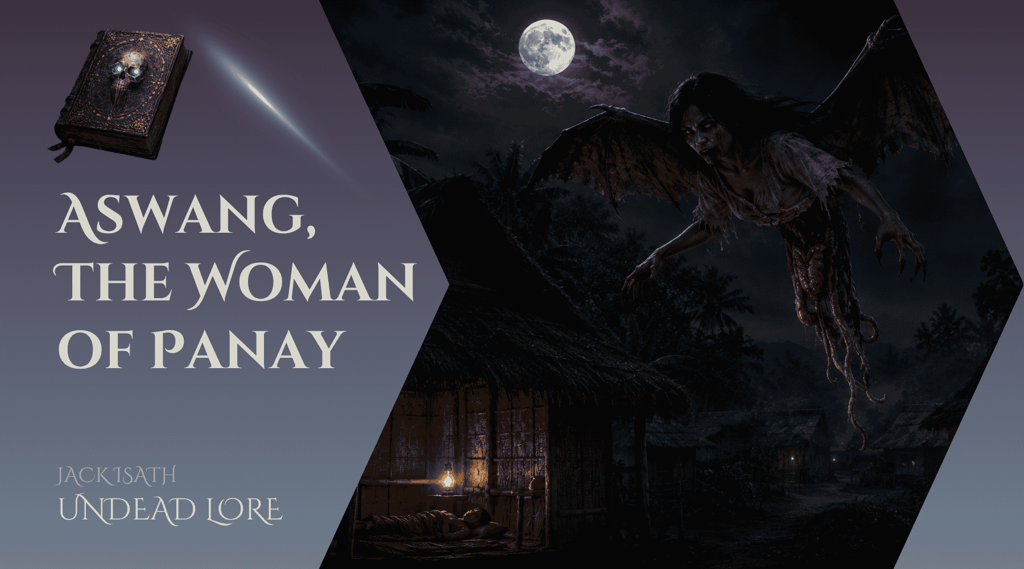
Philippine Folklore
The Woman of Panay
Before the missionaries wrote their careful reports of customs they did not understand, there was a village of nipa‑roofed huts by the rice fields of Capiz. In one of those huts lived a woman who had been a midwife since she could remember. She knew the calendula and ginger that soothed a woman in labor, and she knew how to measure the moon’s shadow on a pregnant belly. People trusted her because their children survived in her hands. She had two daughters of her own and a son who was born weak and did not live long. When the child died she wrapped him herself and took him to the hill before dawn, whispering prayers so his spirit would not wander. Her husband joined the galleons and did not return. For many years she continued her quiet work and the villagers saw nothing strange in her manner.
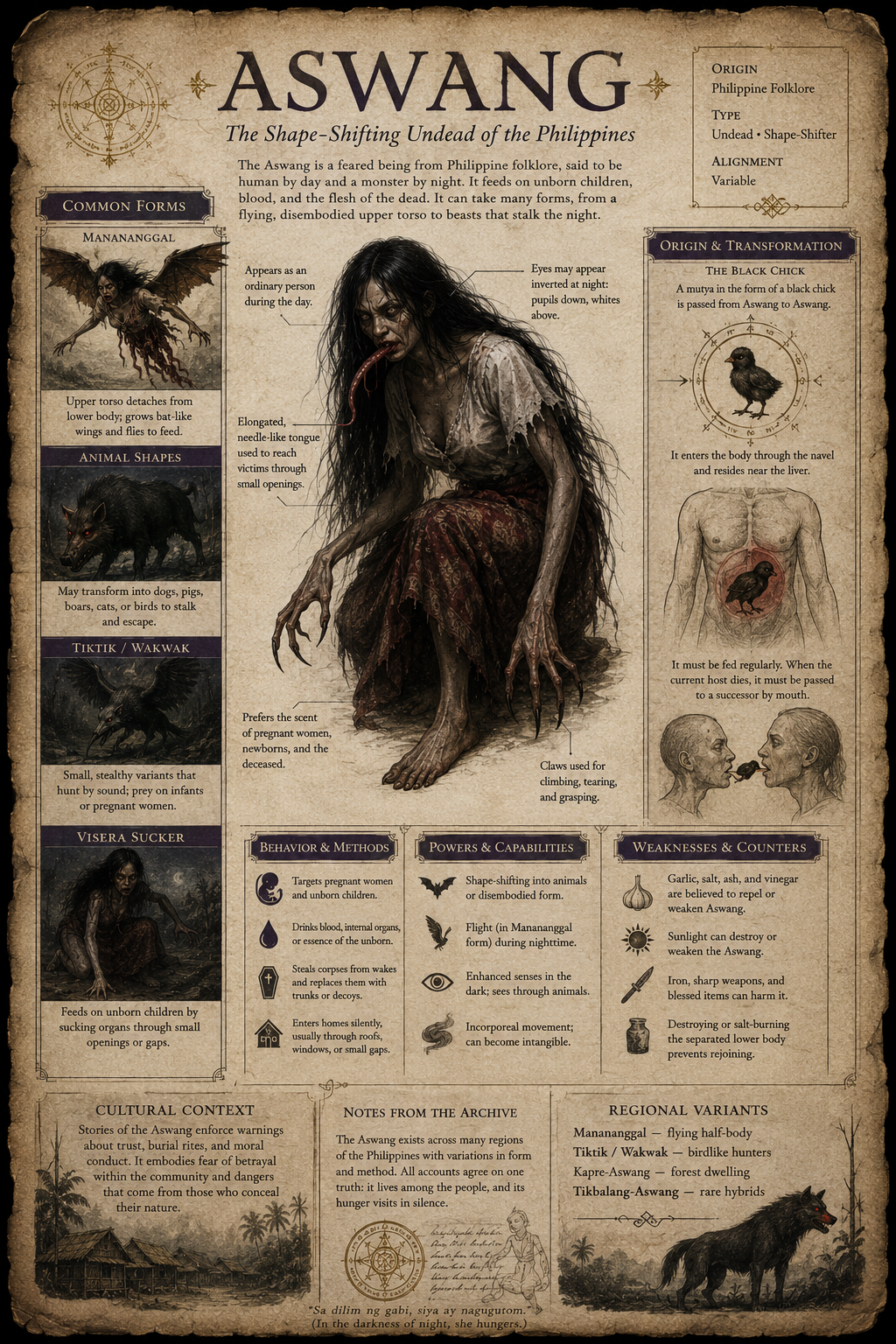
As time passed, new men arrived with crosses and another language. They wrote down rumors of spirits that drank blood and stole bodies, but in her village the talk was about a drought, fever and the curse that followed. When a fever took two of her pregnant clients, people began to look at her askance. One evening a younger midwife whispered to her of a charm that could make a healer stronger than death. The charm, she said, was passed in secrecy through women of their craft, a small black chick that entered through the navel and nested near the liver. With it came a promise that one could never die of old age, but also a duty to feed it. To obtain it a fertilized egg was held against the belly until the chick slipped inside. When the time came, the owner would pass it mouth to mouth to a successor. The older woman listened and pretended to scoff, but she remembered the promise.
Rain failed, rice dried in the paddies, and hunger visited. The woman’s eldest daughter married a fisherman who was lost at sea. The younger became sick and died with the same convulsions that others whispered about. People saw the once‑steady midwife pacing the fields at night. In despair she took the egg and pressed it against her skin as the younger midwife had told her. The shell softened and disappeared, and she felt a flutter inside. Afterwards she could not eat as before; her mouth filled with a taste like iron. A week later a stray dog came to her door. She stared at the animal and, without knowing how, she saw through its eyes. The dog whined and lay down at her feet. That night she went to the river and stood under the moon; in the reflection her eyes appeared inverted, pupils down and whites above. When she looked again her reflection was gone.
The Night of the Long Tongue
She learned to move silently among the houses on moonless nights. In daylight she still greeted neighbors and offered decoctions; only the children noticed that her shadow sometimes moved slower than her body. At night hunger sharpened. Her tongue elongated, becoming thin and needle‑like like the stalk of a coconut frond. Sliding along rafters of bamboo, she pressed her mouth to the thatched roof above a sleeping couple and threaded her tongue between the slats until it found the woman’s womb. She drank a warm essence that sated the fluttering chick inside her. In the morning the couple awoke to find their baby gone before birth, and they wrapped garlic cloves and salt around their bed, for they knew such things warded the unseen. The midwife avoided those houses that smelled of ginger and coins.
Her hunger was not only for unborn life. On some nights she found the wake of a newly dead villager. She sat in a dark corner and waited until the watchers nodded. When all were asleep, she loosened the bamboo poles of the coffin and slid the corpse out with care. She replaced it with a banana tree trunk carved to resemble the body so the relatives would not notice until morning. Outside, she dragged the corpse into the tall grass and fed on it like a carrion bird, the chick inside humming with contentment. She wiped her mouth clean before dawn and was there to offer condolences when the body was found and the banana trunk discovered.
Sometimes she left no bodies behind. The chick within her granted strength and shape‑shifting. She could loosen her joints and sprout wings like a large bat, or turn into a huge dog or boar whose eyes burned red. Her skin darkened and stretched; the bones cracked but did not break. When fishermen saw a pig the size of a man standing on two legs near the mangroves, they threw rocks, but the creature leapt away with unnatural speed. Other times she detached her upper body from her lower half, leaving the waist and legs standing empty in the bushes, and she flew toward the roofs with entrails dangling like roots. If she failed to return and rejoin her lower body before sunrise she would wither, so she hid it well. People learned to scatter salt and ash on any torso they found without a head or arms, for the salt burned and prevented the halves from becoming whole again.
Things Whispered and Done
The villagers whispered different names for such a creature: some said she was a viscera‑sucker, a woman who discards her lower body and flies to suck the hearts of fetuses; others called her a vampire or weredog, for at times a huge hound prowled and howled at a sound only it heard. Elders told of followers of Asuang who were cursed never to touch sunlight because they tried to steal fire from a god. Regardless of the name, they agreed that an aswang could be male or female and that it appeared as ordinary folk by day, living quietly, even piously, in the heart of a village. That is why suspicion often fell on those who were single, widowed or childless. Some said the midwife gained her power by swallowing a mutya, a stone charm, and must pass it to a relative before she could die. Others believed she simply offered too many prayers to an old god and was answered. In truth the black chick inside her pulsed with a life of its own.
Those who feared the unseen took measures. They hung bulbs of garlic by their doors and smeared coconut oil along the lintels. They kept stingray tails and whips by the beds to strike at any shadow that came too close. Pregnant women slept with their sisters, and sometimes a husband would stay awake through the night, listening for the telltale sound of the tik‑tik bird. Legends said that the nearer the sound, the further away the creature actually was, and when the noise seemed distant it might be right above the rafters. Dogs and roosters were kept because animals sensed when the aswang approached. During wakes, relatives took turns watching over the body so no ghoul could replace it with wood or banana trunk. In Capiz, people told strangers not to speak the name of the creature loudly, lest it hear and come.
The midwife learned which houses to avoid. She could not cross a line of salt poured across a threshold. Holy water stung her skin. When she tried to enter a house guarded by two brothers reciting prayers, she felt an invisible wall and retreated. She fed instead on chickens and goats, leaving entrails strewn in the yard. The villagers thought foxes or civets had come. In daylight she helped with chores and looked with concern at women whose stomachs had flattened overnight, but at night she returned to the rafters. The chick inside her grew heavy.
The Passing of the Chick
Years stretched on. The midwife saw her neighbors’ grandchildren marry. Her own hair turned white but she did not stoop with age. Stories of XDP, a strange sickness causing men to twist and jerk uncontrollably, were whispered, and some associated those contortions with the aswang’s transformations. Spanish clerics wrote of a demon that preyed upon the people and fed on blood, calling it a superstition. Travelers came to Capiz to see the birthplace of the monster. Meanwhile the hunger within the midwife did not wane. She kept the chick’s demands satisfied, and in exchange she remained unburied.
One night, as she prepared to detach her body for the hunt, she felt an ache she had not known. Her stomach cramped and the chick within writhed like a stone turning. She realized that her time was ending. If she did not pass the chick, she would be trapped between life and death, unable to move on. She thought of her daughters, gone long ago, and of the young midwife who had told her of the charm. Only one person remained to whom she could give the chick—her granddaughter, a child who had been away in another village but had returned to care for her. The old woman beckoned the girl close and opened her mouth. The girl, seeing the dark object thrust toward her, screamed and ran. The chick fell to the mat and scurried under the bamboo slats, hiding.
At dawn the midwife lay on her sleeping mat, eyes open but unseeing. She felt the chick under the floor. She could hear its faint scratching. She could not die because she had not passed it. The villagers found her that way, neither alive nor dead. They remembered the stories of black chicks and realized what she had become. They poured salt and holy water around her mat and called for the babaylan. The shaman chanted and blew ginger smoke until the chick crept out, blinded by the light. With a quick motion the babaylan snatched it and dropped it into a jar of vinegar and ashes, and the chick dissolved. The old woman exhaled once, and her body slackened. They buried her at the edge of the rice field, the grave lined with stones. No banana trunk was found there.
Long after, people in the village told the story of the midwife who became an aswang. They spoke of her kindness by day and of the feasts she held at night. Some say she still walks on windy evenings, now only a rustle among banana leaves. Others swear they have heard the distant call of the tik‑tik and, remembering the lessons of their elders, they place garlic and salt under the bed and listen until morning.
Undead Lore Mission
Introduce Undead Lore as a scholarly exploration of death, undeath, necromancy, and their role in myth, media, games, and culture.
© 2026. All rights reserved. Created by Nectagrity LLC