
Banshee of Irish and Scottish Folklore
Explore the banshee of Irish folklore through the story of Aoibhinn, keening traditions, death omens, and ancestral memory.
MYTHOLOGY
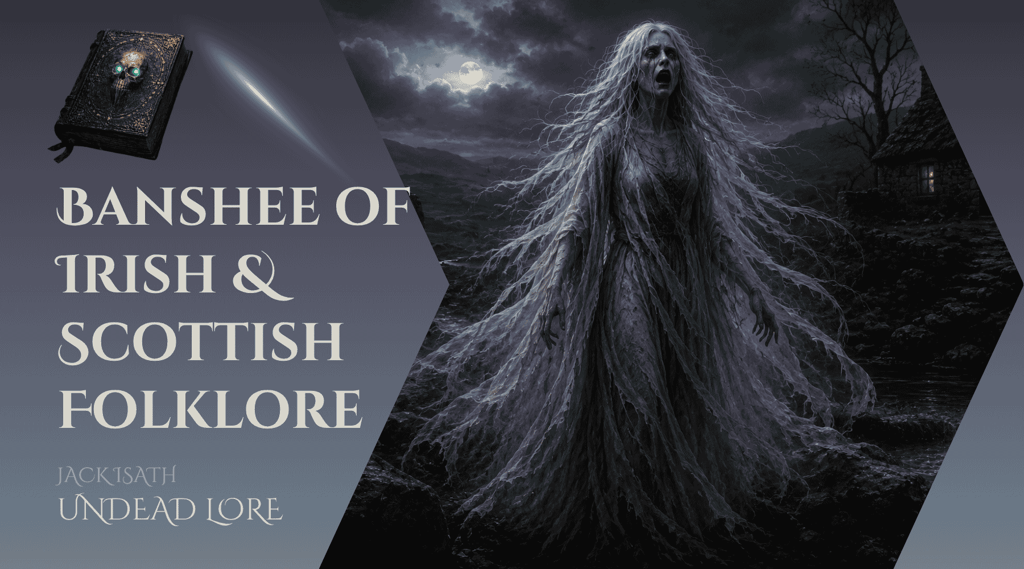
Irish & Scottish Folklore
The Woman of Crag‑Liath
On a limestone height above the River Shannon there was once a house of musicians and poets. The women of that place were expected to lament as well as to laugh, and one among them learned the art of the keen. She was called Aoibhinn in life. In the long winter nights she would sit with the elders and absorb the old funeral songs, for in those days paid keeners stood by the dead and wept for days on end.
Aoibhinn’s gift was a wail that could carry across the valley, and she was sought whenever a body lay out in the house, her hair unbound and grey cloak wrapped against the wind. People said she knew the fair‑mound near Crag Liath better than any mortal; she gathered herbs by its stones and spoke softly to the tufts of grass that grew over it. Her lamentations were not a performance but a duty. In life she loved her clan and honored the old ways. When cattle sickened or a child was born, she was called; when a man died she sang the soul to its rest.
The Death that Bound Her
Aoibhinn married a fisherman and bore a son. One autumn flood carried the currach and child down the river. She threw herself into the cold water and followed, but the weight of her cloak dragged her under. Local men found her body at dawn tangled among reeds; she had died with her hands still grasping a piece of the child’s blanket.
Some whispered that the fairies took her because she had strayed too often near their mounds, others that grief itself drowned her. Whatever the cause, Aoibhinn’s spirit did not rest. Some said Aoibhinn had crossed into the company of the Aos Sí, while others believed grief and devotion had rooted her spirit to the family she served. In time she came to be spoken of as one of the bean sídhe, the women of the mounds who lament before death comes.
Her grave lay close to the house she had served, and on the night of her burial the family heard a strange keening outside the window, a cry that none among them could utter. They took it for the first of many signs.
Warnings on the Field and the Ford
Years later, when warriors gathered on the plain of Clontarf, it was said that a woman of the fairy mound came to the High King. Brian Boru was an old man by then, yet he would not retreat.
Aoibhinn, now a creature of the sidhe, stood beside his bed in the grey before dawn and told him that he would not see another sunset. She had become one of the bean sídhe—women of the barrow—attached to his house. By then her hair had lengthened until it streamed past her cloak like waterweed, and her eyes were reddened from centuries of weeping.
At a place remembered now only as Crag Liath, people later remembered seeing her and twenty‑five others washing bloodied garments in the lake before a battle. In other places she appeared as an aged hag with hair like sea‑wrack and bleared eyes, a monstrous washer at the ford who scrubbed away flesh and spoke of slaughter to come.
Whether as a grey‑cloaked woman combing her hair or as a crouching washerwoman by the water, her presence meant that someone of the clan would soon die. If several banshees were heard together, it was said, the loss would be of a leader or a king.
The Window and the Road
Centuries passed and the family lands changed hands, yet the spirit remained. In the winter of 1642, as Lady Ann Fanshawe lay in a guest chamber of the O’Brien castle, a wail woke her.
She drew back the curtain and saw a face pressed to the glass—pale skin, eyes hollow with tears, hair red as autumn leaves. Three times the apparition cried “A hone” and then was gone. The next morning a messenger brought news that a kinsman had drowned in a distant river. Local people said the ghost was the wife of a peasant who had been murdered and buried under that window long ago, and that she had become the banshee of that house.
In 1776 another branch of the family heard the same lament at an old church; an old woman with white hair and a black cloak sat upon the wall, rocking as she keened. A raven struck their window in the night; by morning word came that Ross Lewin had died unexpectedly in Dublin.
Such warnings were not confined to Ireland. A man named Farrell, working in America, once heard a scream and saw a white deer in the yard; that night his cousin at home died. Those who heard the cry were often servants or travelers, not the person whose death was foretold. The sound itself changed with place and ear: in Leinster it was so sharp that it could shatter glass; in Tyrone it was like boards struck together; in Kerry it resembled low singing. Yet in all accounts the cry rose and fell for minutes and left those who heard it with the same knowledge.
The Keening that Endures
In later years some in the Church said the banshee was nothing but barn‑owl or vixen screeching in the night. Others saw in her an echo of the keeners whose profession had died out by the mid‑twentieth century when clerics discouraged the practice of women wailing over the dead.
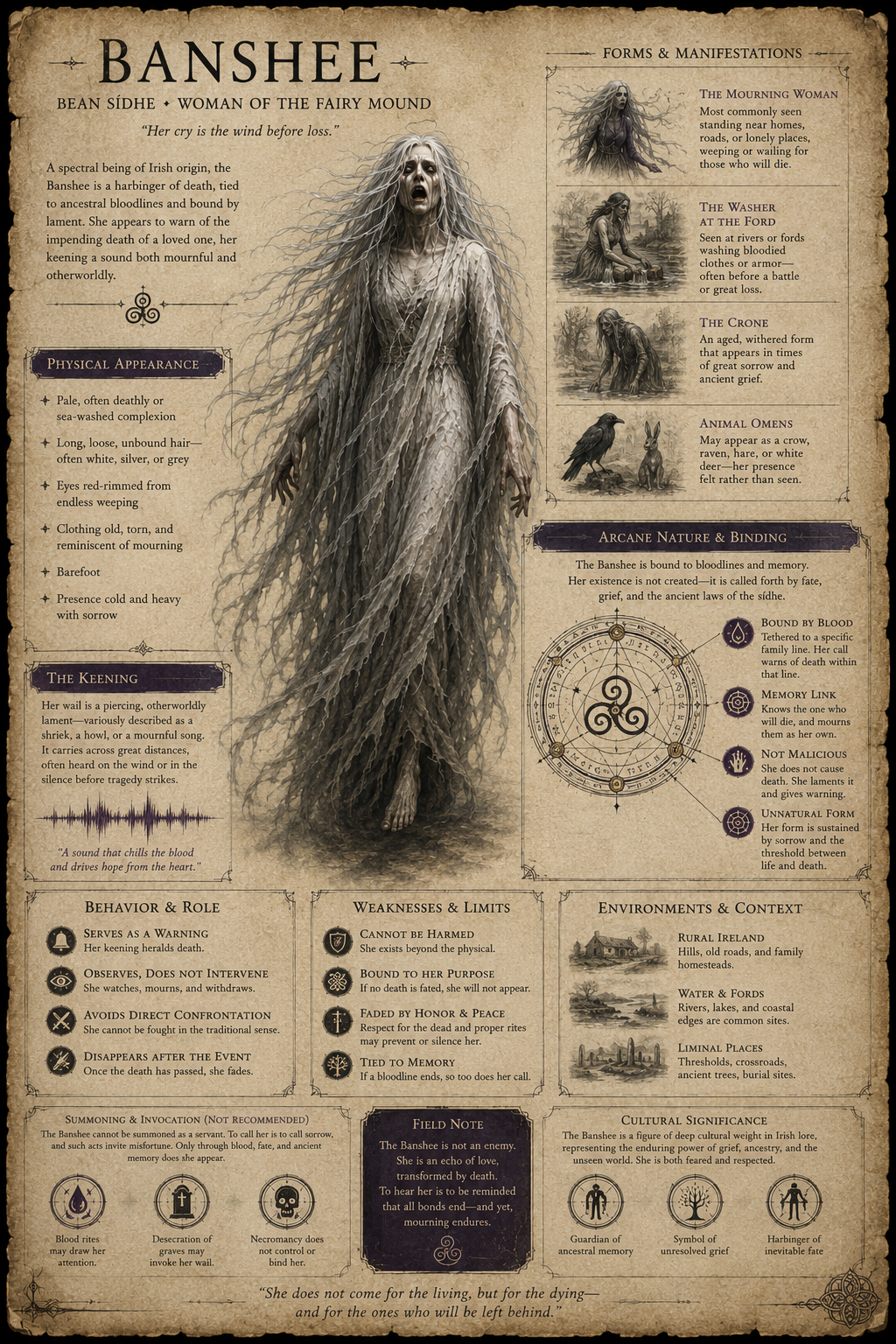
The banshee is still described as a solitary spirit who does not cause death but mourns it beforehand. She is said to take different shapes: at times a crouching crone with wrinkled face; at others a stately woman in green dress; occasionally a maiden with long red hair, or even a crow or hare that watches from a hedgerow. Her eyes are always inflamed from weeping, and she is often seen combing her unbound hair with an ivory comb. Those who pass a silver comb on the road still leave it untouched for fear of the banshee.
She may be heard tapping on a window or knocking at a door; she may travel with a fluttering sound, leaving only mist behind when she vanishes. She follows the descendants of the families she loved, even when they cross oceans, and she continues to keen outside their homes when one of their number is near death.
Her cry is not a curse but a warning born of sorrow, a remnant of an older world where women’s voices carried the grief of the living. In this way Aoibhinn, the woman of Crag Liath, still walks between the mounds and the world of men, her lament the last link between the family and the earth they sprang from.
Undead Lore Mission
Introduce Undead Lore as a scholarly exploration of death, undeath, necromancy, and their role in myth, media, games, and culture.
© 2026. All rights reserved. Created by Nectagrity LLC