Iratus, Lord of the Dead
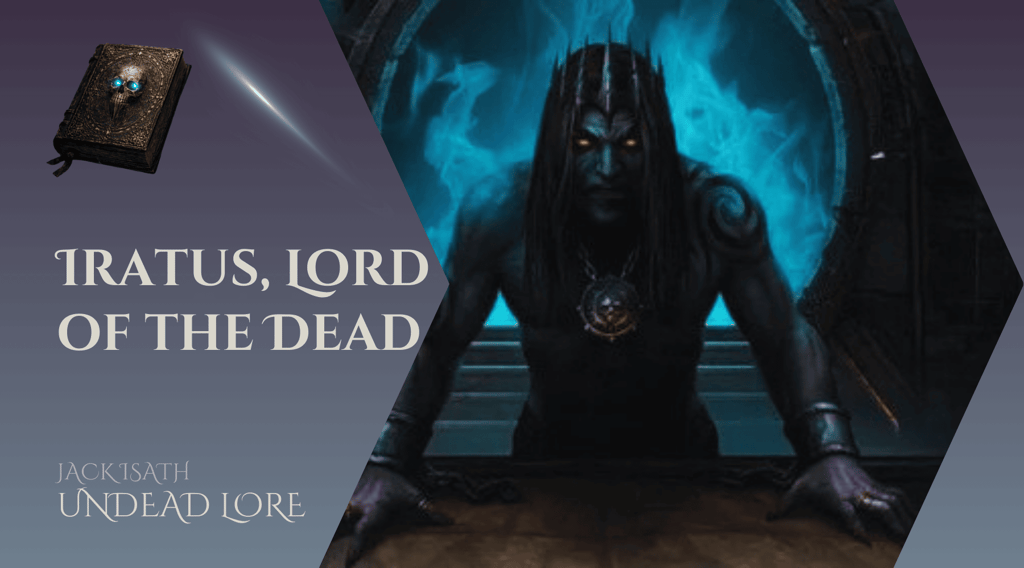
Iratus, Lord of the Dead, is an immortal necromancer whose undead conquest defines the game Iratus: Lord of the Dead.
CHARACTERS
Canonical Overview
Iratus, Lord of the Dead.
Origin and setting
Iratus originates in the dark fantasy setting of Iratus: Lord of the Dead, where the events of his story unfold primarily within an extensive underground dungeon complex beneath the lands of the living.
Affiliation or faction
Iratus operates independently. He commands an expanding host of undead minions created and maintained through necromantic processes rather than belonging to any existing political or religious faction.
Ontological status
Undead. Iratus is an immortal necromancer who persists beyond physical death.
Key canonical events defining his arc
Iratus’s near-conquest of the world in antiquity, his defeat and sealing by heroes, his prolonged dormancy within a dungeon prison, and his eventual release through human excavation activities define the central trajectory of his narrative.
The Story as It Unfolds
Millennia prior to the events of the game, Iratus was an exceptionally powerful necromancer whose influence extended across much of the world. His ambition approached total domination, but his campaign was ultimately halted by a coalition of heroes. These figures succeeded in killing him and entombing his remains within a heavily secured dungeon prison designed to prevent any return.
Despite this apparent victory, Iratus’s mastery over death proved sufficient to preserve his consciousness beyond physical destruction. Unable to act, he entered a prolonged state of dormancy during which he reflected on the failures that led to his defeat and awaited an opportunity for release.
That opportunity arose unintentionally when human excavators breached the wall of his burial chamber while expanding underground tunnels. This act restored Iratus’s awareness and allowed his necromantic powers to begin reconstituting themselves. Although still partially bound by the dungeon, he regained the capacity to act through summoned and constructed undead servants.
From this point forward, Iratus’s objective became the systematic destruction of the dungeon prison and a gradual ascent toward the surface world. His campaign is structured as a methodical reclaiming of power rather than a sudden resurgence, emphasizing preparation, refinement, and attrition.


Philosophy and Motivation
Iratus’s philosophy is defined by an explicit rejection of life as a desirable or meaningful state. Canon sources depict him as regarding life itself as a disease, with death representing correction rather than loss. This belief underpins both his necromantic practices and his strategic choices.
His motivations are neither reactionary nor emotional. Iratus does not seek vengeance for his prior defeat, nor does he express regret or longing for his former life. Instead, his actions consistently reflect a desire to impose a permanent solution to what he perceives as the fundamental flaw of existence. Conquest, in this context, is framed as enforcement rather than ambition.
Iratus’s long dormancy further reinforces his patient and analytical disposition. His return is characterized by deliberate escalation, careful experimentation, and an emphasis on systems that minimize unpredictability.
The Nature of Their Undeath or Transformation
Iratus’s undeath is complete and stable. Unlike necromancers who remain biologically alive while manipulating death magic, Iratus exists entirely beyond the living state. His physical body is no longer the locus of his power. Instead, his agency is expressed through necromantic constructs, ritual infrastructure, and bound servants.
This transformation alters his role from direct participant to architect and commander. Iratus rarely engages opponents personally. Instead, he exerts control through layered systems of minion creation, enhancement, and deployment. Undead servants function as extensions of his will rather than independent entities.
What is lost in this transformation is any dependence on mortal limitations such as physical vulnerability or temporal urgency. What is gained is continuity of purpose and immunity to conventional defeat. His prior destruction serves as evidence of failure rather than finality, reinforcing the durability of his chosen path.

What This Character Communicates to Us
Iratus functions as a representation of necromancy taken to its logical extreme within game narrative. He is not portrayed as corrupted by dark power, nor as tragically transformed. Instead, he embodies necromancy as an ideological endpoint, where death is normalized, systematized, and stripped of moral ambiguity.
Within the broader context of undead media, Iratus occupies a rare position as a fully autonomous necromancer protagonist. The narrative does not challenge his worldview internally. Conflict arises externally from the persistence of the living world rather than from doubt or internal contradiction.
This positioning allows Iratus to serve as a focal point for examining themes of control, permanence, and the instrumentalization of death without reliance on redemption or downfall narratives.
Lessons for Character Creation
Iratus demonstrates the effectiveness of aligning gameplay systems tightly with narrative identity. His role as a necromancer is reinforced through mechanics that emphasize construction, resource management, and long-term planning rather than moment-to-moment spectacle.
His character arc avoids escalation through emotional stakes, instead relying on structural progression. Power increases through refinement rather than transformation, allowing consistency across the entire experience.
The character’s endurance is rooted in clarity of philosophy. His beliefs remain stable, and narrative tension is generated through opposition rather than internal change.
A Practical Lesson About Life
Iratus’s story reflects a broader pattern in which prolonged isolation and unchecked intellectual certainty can lead to absolutist conclusions. His rejection of life emerges not from immediate trauma but from extended contemplation without contradiction.
The narrative illustrates how systems built to eliminate uncertainty often do so by eliminating variability entirely, replacing complexity with control.
Final Reflection
Iratus, Lord of the Dead, is presented as a necromancer whose undeath represents resolution rather than loss. His return is not a resurrection of identity but a continuation of purpose interrupted by force rather than failure.
Within Iratus: Lord of the Dead, he remains consistent in method, belief, and intent. The world changes around him, but his trajectory persists, emphasizing inevitability over drama and permanence over progression.
Undead Lore Mission
Introduce Undead Lore as a scholarly exploration of death, undeath, necromancy, and their role in myth, media, games, and culture.
© 2026. All rights reserved. Created by Nectagrity LLC