Necromancer and Lich: Malin Keshar
Biography of Malin Keshar from Battle for Wesnoth, tracing his descent into necromancy under Darken Volk in the Descent into Darkness campaign.
CHARACTERS
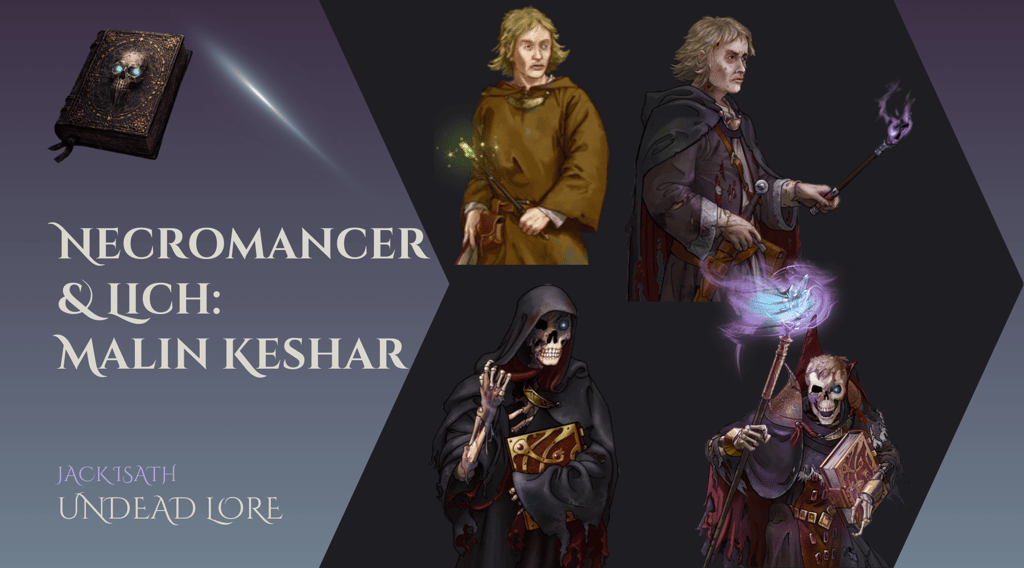
Malin Keshar is introduced as a human apprentice mage living in a rural province of the Kingdom of Wesnoth. He is the son of a woman depicted as deeply concerned with his future and safety. His early magical education is informal and limited, constrained by his family’s isolation and lack of access to formal institutions of magical study.
Malin’s ontological status changes over the course of the campaign. He begins as a living human spellcaster and later adopts necromantic practices that align him with undead forces. By the end of Descent into Darkness, he is functionally positioned as a necromancer commanding undead units, though he is not explicitly depicted as becoming undead himself.
His most significant affiliation is with Darken Volk, an established necromancer who serves as Malin’s mentor and primary influence during his transformation.
The Story as It Unfolds
Malin Keshar’s story begins with his desire to study magic beyond what his isolated upbringing allows. His interest in arcane knowledge is portrayed as earnest and pragmatic, driven by curiosity and the belief that magical skill could improve his circumstances. This pursuit places him at odds with his mother, who fears both the dangers of magic and the political instability of the surrounding region.
As external threats increase, including raids and military pressures affecting his homeland, Malin’s initial studies prove insufficient to protect those around him. These early failures establish a recurring pattern in the campaign: conventional or restrained approaches to magic are shown to be inadequate under escalating conditions.
Malin’s encounter with Darken Volk marks a decisive turning point. Volk introduces necromancy as a practical discipline capable of producing immediate and reliable results. Under Volk’s guidance, Malin learns to raise and command the dead, initially as a tactical necessity rather than an ideological commitment. Each subsequent conflict reinforces the effectiveness of necromancy compared to the alternatives previously available to him.
Over time, Malin’s reliance on undead forces becomes normalized within the campaign structure. His progression is reflected mechanically through access to increasingly powerful necromantic units and spells. Narrative dialogue indicates a growing emotional and ethical distance between Malin and his former human attachments, culminating in confrontations that sever his remaining ties to his past life.
The campaign concludes without a definitive resolution to Malin’s long-term future. He survives as a necromancer with established command over undead forces, but his position within Wesnoth’s political or moral order remains ambiguous.
Philosophy and Motivation
Malin Keshar’s actions are consistently framed around utility and outcome rather than doctrine. Canon sources depict his motivation as centered on achieving results in situations where failure carries immediate and irreversible consequences. His adoption of necromancy is justified within the narrative as a response to repeated demonstrations that less extreme methods are insufficient.
There is no explicit indication that Malin seeks necromancy for domination, cruelty, or philosophical opposition to life. Instead, his decisions reflect a prioritization of control, predictability, and scalability in the face of persistent threat. Darken Volk’s influence reinforces this framework by presenting necromancy as a disciplined and intellectually coherent system rather than a transgressive act.
Malin’s diminishing concern for social approval or moral judgment is implied through his dialogue and choices. His focus narrows toward mastery of power and survival, with little indication that he anticipates or values reintegration into human society.
The Nature of His Transformation
Malin’s transformation is operational rather than metaphysical. He does not undergo a single moment of corruption or revelation. Instead, his identity shifts through repeated use of necromantic methods that replace earlier forms of magic and problem-solving.
What changes most significantly is Malin’s relationship to death. Corpses become resources, and his loss becomes reversible within the constraints of necromantic practice. This shift alters his role from a reactive defender to a proactive controller of the battlefield. The trade-off presented by canon is a gradual erosion of personal relationships and conventional moral boundaries.
What remains intact is Malin’s rationality and agency. He continues to plan, adapt, and pursue objectives with consistency. Necromancy expands his capacity to act while narrowing the social and ethical frameworks within which those actions are evaluated.
Narrative Function Within The Battle for Wesnoth
Malin Keshar functions as a case study in escalation within the Wesnoth setting. His story illustrates how systemic pressures, when combined with asymmetric power systems, can drive individuals toward increasingly extreme solutions without requiring inherent malice.
The campaign positions necromancy as an efficient but isolating discipline. Through Malin, the narrative explores how effectiveness can displace legitimacy as the primary criterion for decision-making. His arc contrasts with more traditional heroic narratives in the franchise, which often emphasize loyalty, sacrifice, and institutional alignment.
Malin’s lack of a definitive ending allows him to persist as an unresolved figure within the setting. This ambiguity reinforces the campaign’s focus on process rather than judgment.
Legacy and Canonical Limits
Malin Keshar remains one of the more detailed portrayals of a necromancer’s origin within The Battle for Wesnoth. However, his presence outside Descent into Darkness is minimal. Later campaigns and materials do not significantly expand on his fate, nor do they establish him as a recurring antagonist or leader within the undead factions.
As a result, Malin’s legacy is primarily interpretive. He is frequently cited in discussions of necromancy within the Wesnoth community as an example of gradual transformation driven by circumstance rather than innate alignment. The absence of further canon development leaves his long-term impact open to speculation.
Appearances
Undead Lore Mission
Introduce Undead Lore as a scholarly exploration of death, undeath, necromancy, and their role in myth, media, games, and culture.
© 2026. All rights reserved. Created by Nectagrity LLC