
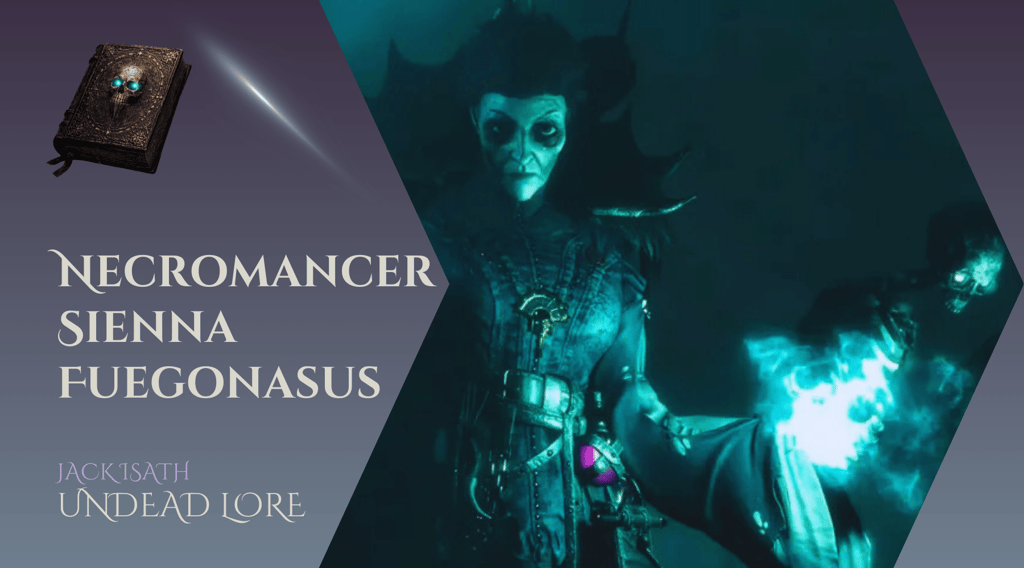
Necromancer Sienna Fuegonasus
Encyclopedic analysis of Sienna Fuegonasus’s necromancer path in Vermintide 2, tracing canon events, motivations, and consequences.
CHARACTERS
Canonical Overview
Sienna Fuegonasus, Bright Wizard of Aqshy; later Sienna Fuegonasus, Necromancer.
Origin and setting
Sienna Fuegonasus was born in Estalia during the late Imperial period of the Warhammer Fantasy setting. Her story unfolds primarily within the Old World during the events leading into the End Times, as depicted in Warhammer: Vermintide 2.
Affiliation or faction
Sienna is a member of the Ubersreik Five, a group of heroes opposing the Skaven and Chaos forces during the End Times.
Her Status
Living. In her Necromancer career, Sienna remains alive but adopts necromantic practices associated with the Wind of Death (Shyish).
Key canonical moments defining her arc
Key events include her early training as a Bright Wizard, her history involving her twin sister Sofia Fuegonasus, the destruction of the town of Siernos, the later killing of Sofia, the events surrounding the Tower of Treachery, and Sienna’s eventual adoption of necromancy as a formal path during the End Times.
This establishes Sienna Fuegonasus as a living human wizard whose arc culminates in the sanctioned but controversial use of necromantic magic.

The Story as It Unfolds
Sienna Fuegonasus is introduced as a Bright Wizard whose affinity for Aqshy is marked by both exceptional talent and persistent struggles with magical excess. Her early life is shaped by her relationship with her twin sister, Sofia Fuegonasus, who pursues necromancy rather than the sanctioned colleges of magic.
The central inciting incident of Sienna’s later arc occurs in the Estalian town of Siernos, where Sofia is arrested and condemned as a necromancer. Upon arriving at the execution, Sienna intervenes violently, destroying the town with fire and enabling Sofia’s escape. This event establishes a pattern in which Sienna responds to perceived injustice with overwhelming force rather than restraint.
Following Sofia’s escape, the sisters diverge further. Sofia resumes necromantic activities, targeting rural communities near Bilbali. Sienna eventually confronts her again, and this time kills Sofia, reportedly by immolation. This act resolves the immediate threat posed by Sofia but does not end her influence on Sienna’s life or decisions.
During the End Times, the magical landscape of the Old World shifts significantly with the resurgence of Nagash and the increased accessibility of Shyish. In this context, Sienna transitions into necromancy herself, adopting practices previously associated with her sister. Her Necromancer career represents the culmination of earlier conflicts rather than a sudden ideological reversal.
Philosophy and Motivation
Sienna’s actions are consistently framed by a belief in decisive intervention when faced with perceived threats or injustices. Canon sources depict her as deeply uncomfortable with prolonged cruelty and suffering, but also prone to impulsive solutions that prioritize immediate resolution over long-term consequence.
Her use of necromancy is justified within the setting as a pragmatic response to escalating catastrophe. The End Times are characterized by mass death, continuous warfare, and the erosion of traditional safeguards around magic. In this environment, necromancy is presented as a tool that offers control, predictability, and strategic efficiency.
Sienna’s fear of losing control over herself and others is repeatedly implied through her history with addiction to magic and her conflicted relationship with Sofia. Her choices reflect an attempt to impose order on circumstances she perceives as otherwise unmanageable.
The Cost of Their Power or Path
Sienna does not become undead, but her transition into necromancy represents a significant transformation in method and ethical posture.
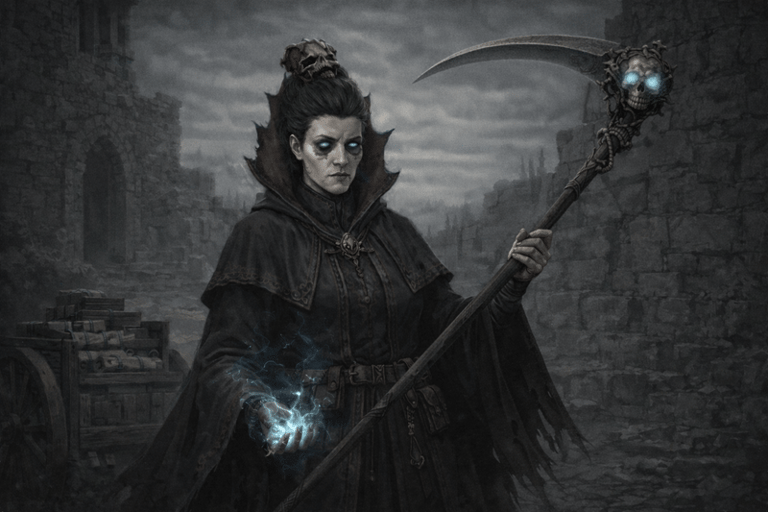
Necromancy alters Sienna’s agency by shifting her role from direct destruction to indirect command. Rather than relying on explosive force, she binds and directs the dead, delegating violence through controlled intermediaries. This preserves her capacity to act while reducing reliance on uncontrolled magical output.
What is lost is the symbolic separation between Sienna and the practices she previously opposed. By adopting necromancy, she abandons the remaining moral distinction between herself and her sister’s path. What is preserved is her underlying intent to oppose greater threats, though expressed through increasingly utilitarian means.
The path buys Sienna operational control and strategic flexibility, at the cost of further entanglement with morally corrosive magic.
What This Character Communicates to Us
Sienna Fuegonasus persists as a notable character because her story embodies the tension between sanctioned authority and forbidden efficacy. Her arc illustrates how institutional boundaries can erode under prolonged crisis, particularly when those boundaries appear insufficient to address systemic collapse.
The character externalizes a recurring cultural concern within fantasy narratives: the transition from regulated power to instrumental power during existential threat. Her necromancer path reflects discomfort around the idea that effectiveness may require ethical compromise.
This framing allows Sienna to function as a point of reference for discussions about escalation, justification, and the normalization of previously unacceptable practices under extreme conditions.
Lessons for Character Creation
Sienna’s durability as a character arises from the continuity between her early traits and her later transformation. Her necromancer career is grounded in established relationships, prior actions, and documented failures, rather than introduced as an abrupt divergence.
The arc embraces tragedy by allowing earlier attempts at resolution to create the conditions for later compromise. Her philosophy is communicated through repeated behavioral patterns rather than explicit exposition, and reinforced by changes in gameplay role, visual design, and narrative framing.
For writers and designers, Sienna demonstrates the effectiveness of long-form character arcs that reward attention to earlier narrative seeds and allow transformation to emerge from accumulated consequence.
A Practical Lesson About Life
Sienna’s story highlights a recognizable pattern in which prolonged exposure to crisis leads individuals to favor control-oriented solutions over restorative ones. As familiar methods fail to resolve ongoing problems, more rigid or ethically ambiguous approaches may appear increasingly justified.
The narrative draws attention to how unresolved personal history, particularly involving family or identity, can shape later decision-making under pressure.
Final Reflection
Sienna Fuegonasus’s necromancer story represents a progression rather than a rupture. Her adoption of necromancy follows logically from her history, relationships, and the deteriorating conditions of the End Times. The character remains consistent in intent while altering method.
As a result, Sienna occupies a stable place within Warhammer fantasy’s broader exploration of power, responsibility, and compromise. Her story concludes not with resolution, but with continuation, reflecting a world in which survival increasingly demands uncomfortable choices.
Undead Lore Mission
Introduce Undead Lore as a scholarly exploration of death, undeath, necromancy, and their role in myth, media, games, and culture.
© 2026. All rights reserved. Created by Nectagrity LLC