
What is a Vampire?
A clear, research-driven definition of vampires, tracing myth, folklore, and modern media to explain vampirism as an undead system.
PHILOSOPHY
Canonical Definition and Taxonomy
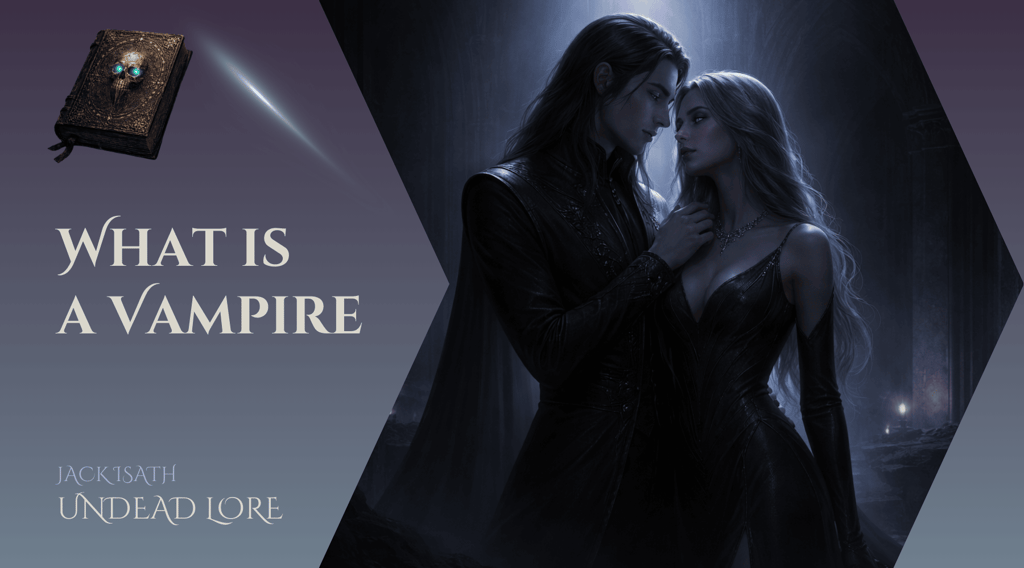
A vampire is commonly defined as a preternatural being that preys on humans by consuming blood or another vital essence, and is frequently framed as “undead,” meaning it persists after death through reanimation or post-mortem revival.
Across folklore and modern fiction, the “vampire” category tends to converge around three functional traits: continued post-mortem existence, predation on the living (often via blood or life-force extraction), and a recurring relationship between the vampire’s activity and communal illness, death clusters, or perceived spiritual contamination.
In folklore studies and modern genre usage, “vampire” often overlaps with broader terms like “revenant” (a returning dead being), but can be distinguished by:
A sustained dependency on the living (blood, vitality, essence)
A repeatable pattern of harm that is socially intelligible as a drain on life rather than a single haunting.
The Oxford English Dictionary’s definition explicitly ties the “usual form” of the belief to a reanimated corpse that harms by sucking blood, which separates the archetype from purely spectral dead.
Contrast to Zombies
Zombies in modern definitions are often characterized by diminished free will and subordination to an external force or overwhelming drive, which organizes them around control or compulsion rather than deliberate predation sustained by life-force extraction.
Contrast to Ghosts
Ghosts are typically framed as a dead person’s soul or spectre, capable of return but not necessarily embodied, which places them on the incorporeal end of the undead spectrum.
Contrast to Ghouls
Ghouls are classically associated with cemeteries and cannibalism or corpse consumption (rather than a structured blood or essence economy), which puts them in a different predatory category even when they share funerary terrain.
What “vampirism” is as a condition. Across sources, vampirism can be modeled in four non-exclusive ways:
It can be treated as:
Undeath (a dead body persisting and acting)
A curse or religious sanction (frequently linked to excommunication or moral disorder)
A contagion-like condition (spreading through attacks or victim death)
Parasitism (a being that must feed on the living to continue).
Historical discourse often blends these categories rather than isolating them.
Mythological and Folkloric Origins
A consistent historical through-line is that vampire beliefs emerge within broader traditions of the restless or improperly managed dead, especially in contexts where a corpse’s condition, burial integrity, or post-mortem status becomes socially suspect. Encyclopedia Britannica notes that tales of vampiric beings include ancient Greek antecedents and medieval European narratives of walking corpses connected to plague and vitality-drain fears.
In Greek contexts, a major driver of vampire-like outbreaks is the belief that those dying under excommunication do not decay properly, which can escalate into nocturnal disturbances and community responses that blend religious remedy with corpse-treatment. Rodd’s account (summarizing earlier sources) describes narratives in which an excommunicated body remains intact and swollen, and communal solutions may involve extraordinary corpse handling alongside ecclesiastical revocation of excommunication.
A widely circulated nineteenth-century English-language account of Romanian belief (Emily Gerard) formalizes a model with “living and dead” vampires and treats vampirism as both a predatory and transmissive condition: those killed by a vampire may become vampires after death, creating a chain of harm that can be interrupted through corpse-directed remedies.
Later editorial commentary attached to Gerard’s text also notes that the word “nosferatu,” as Gerard presents it, has a contested status in Romanian linguistic evidence, indicating that some vocabulary in the modern vampire canon may be mediated, mis-transcribed, or systematized by outsiders.
Modern scholarship frequently points to the eighteenth century as a key transmission corridor into Western Europe, when reports of “vampire” incidents in Eastern Europe were circulated through military contact and print culture during periods of instability and disease.
A University of Virginia account summarizes how disease, political upheaval, and the circulation of stories by soldiers contributed to a “viral” period of vampire fear and reporting in the 1700s.
Academic discussion of the investigative record also highlights the role of forensic-style documentation, including autopsy reports titled visum et repertum (“seen and discovered”), which frames “vampire” incidents as quasi-legal and quasi-medical events rather than purely oral tradition.
Asian parallels as comparative, not interchangeable. “Vampire” is often applied as a translation label to Chinese jiangshi in global popular culture, but scholarship cautions that it shares limited core commonality with the Western blood-drinking undead; the term’s literal meaning is “corpse,” and the cinematic codification of the creature in Hong Kong media commonly functioned closer to “zombie-adjacent” than “vampire-adjacent.”
Creation and Spread of Vampirism
In many traditions, vampirism is not a separate biological species but a feared post-mortem outcome: a dead person becomes a returning predator under specific conditions (religious sanction, improper rites, social deviance, or perceived bodily anomalies at exhumation).
Greek narratives strongly emphasize institutional spiritual status (excommunication) as a mechanism that alters decay and social peace, meaning vampirism can operate as a sanction logic: the community’s relationship to the sacred order is mirrored in a corpse’s failure to decompose.
This pattern aligns with broader folk logics where deaths that violate norms (improper burial, contested rites, “bad deaths”) generate dangerous dead, which then justify counter-rituals or reburial practices.
Gerard’s description explicitly frames a transmissive chain in which victims killed by a vampire become vampires after death unless the cycle is broken through intervention at the grave.
A modern historical account from UVA also emphasizes that, in periods of disease, vampire beliefs functioned as an explanatory system for why illness appeared to spread through families and communities, reinforcing a contagious logic even when the proposed mechanism was supernatural.
Scholarly summaries of the disease-vampire linkage emphasize that no single disease fully “explains” vampire mythology, but epidemic conditions and symptoms resembling classic vampire traits (biting as transmission, altered sleep patterns, light sensitivity, aggression) offered culturally legible anchors for vampire narratives in certain times and places. UVA’s discussion highlights rabies and pellagra as two diseases that show recurring points of contact with later vampire characterization, while still noting the limits of single-cause origin claims.
In the nineteenth-century New England context, “vampire” belief becomes explicitly entangled with tuberculosis (“consumption”), where sequential illness in a household was attributed to the dead draining the living, prompting exhumation and the burning of the heart or body as a remedy.
Nature of vampiric undeath
In the “usual form” described by the OED, the vampire is a reanimated corpse that seeks nourishment or harm through blood-sucking, especially from sleeping people. This frames vampirism as a functional contradiction: a dead body exhibiting intentional predation and ongoing effect on the living.
Preserved vitality inside a dead body. A recurring historical trigger is the discovery of an “undecomposed” or anomalously preserved corpse, interpreted as evidence of continued activity. Forensic explanations show how normal decomposition can generate appearances that match vampire reports: skin shrinkage can make hair and nails appear to have grown, and other post-mortem changes can produce “fresh” looking blood or swelling.
Barber’s forensic analysis frames vampire lore as a “folk-hypothesis” built to account for puzzling, frightening, but real phenomena associated with death and decomposition, especially before modern forensic knowledge became widespread.
Reports of sounds or physical signs from graves (groans, swelling, blood) recur in folklore and early modern testimony, and forensic discussion notes that such reports map to burial depth, gas buildup, and other post-mortem processes that are more plausible than they first appear to non-specialists.
Folklore varies widely on whether the vampire is a fully continuous person (retaining memory, personality, and intention) or a degraded revenant animated by a malign force. Modern fiction typically shifts toward higher continuity because it supports long-term character arcs, social structures, and political behavior.
This drift is visible in the historical behavior of the archetype: older accounts emphasize community harm and corpse-management, while later narratives increasingly attribute strategy, manipulation, and interior conflict to the vampire.
Hunger and Sustenance Economy
Encyclopedia Britannica treats blood consumption (or the consumption of another “essence,” including bodily fluids or psychic energy) as central to vampire mythology, which positions feeding as both survival mechanism and identity marker.
The OED reinforces the same operational core by defining the vampire as seeking nourishment or doing harm through sucking blood.
Where vampirism is transmissive, feeding becomes the axis of control: it determines who is prey, who becomes a subordinate vampire, and how quickly a vampire population can expand. Gerard’s chain model (“killed by a vampire” leading to post-mortem vampirism) establishes a simple rule-set that naturally produces escalation unless constrained by detection and intervention.
Some accounts of vampires emphasize prevention and neutralization more than the vampire’s internal experience of hunger, while modern systems often center hunger as a stabilizing constraint: the vampire must feed, feeding creates risk, and risk invites social retaliation. This model aligns with the way historical communities used “vampire burials” and apotropaic interventions as a containment response.
In Gothic and post-Gothic literature, feeding is frequently mapped onto desire, coercion, and power. A contemporary academic analysis of Dracula and Carmilla frames vampirism as intertwined with sexuality, desire, and dominance, treating the bite and feeding act as a metaphorically charged exchange rather than only a predatory act.
Constraints, Weaknesses, and Containment
In both folklore and modern narrative systems, vampires are typically defined not only by their predatory advantages but by a counterweight of constraints that makes them containable by communities, institutions, or specialized hunters. Historically, containment often takes the form of corpse-based interventions and ritual correctness rather than “combat” as a primary solution.
Archaeological and historical overviews of apotropaic burial practices list methods intended to neutralize dangerous dead, including decapitation, staking, prone burial, restraint or mutilation, stoning or weighing down the body, and cremation in contexts where Christianity had made cremation atypical.
Gerard’s account of Romanian practice presents a familiar cluster of remedies: opening the grave, staking, firing into the coffin, decapitation, garlic placement, and heart extraction and burning, with ashes strewn over the grave.
New England vampire belief documents similar intervention logic, where a suspected vampire’s body is exhumed and the heart or body is burned as an apotropaic remedy, explicitly tied to tuberculosis-era household decline.
Greek accounts in Rodd strongly connect the vampire-like corpse problem to religious status, especially excommunication, and portray remediation through ecclesiastical action (revocation, prayers) alongside physical handling of the body. This frames the vampire’s persistence as a symptom of broken spiritual jurisdiction rather than only a biological or magical anomaly.
Many traditions regulate when the dangerous dead may move (night, pre-dawn windows, cockcrow limits). In later media, sunlight becomes an iconic lethal weakness, but this appears as a relatively modern codification. A film-study teaching text and popular film historiography both attribute the “sunlight kills the vampire” rule to Nosferatu (1922), describing it as a formative cinematic innovation that differs from Stoker’s earlier treatment.
A comparative folklore analysis also notes that Stoker’s Dracula can be seen in daylight without being destroyed, indicating that “sunlight as instant death” is not a universal rule across the canon.
Cultural Evolution and Worldbuilding Applications
Early vampire traditions often function as explanations for clusters of death, epidemic fear, and the uncanny condition of corpses. UVA’s historical summary explicitly frames the vampire’s roots as demonic and strongly associated with disease, with hysteria rising in periods of upheaval.
Forensic interpretation adds that vampire lore is an internally coherent explanatory theory for decomposition anomalies, which helps explain why “evidence” at exhumation could feel persuasive to communities without modern forensic context.
The nineteenth century introduces a durable shift: the vampire transitions from a rural corpse-threat to a socially strategic figure. Oxford reference material on Polidori’s The Vampyre (1819) treats it as a foundational moment in English fiction that launched a long-standing vampire craze, supporting the emergence of the vampire as a character with social presence rather than only a burial problem.
Twentieth-century fiction extends this shift toward interiority. Britannica describes Interview with the Vampire (1976) as pivotal for popularizing vampires as relatable protagonists grappling with the moral implications of immortality and feeding.
Vampires across the eras routinely operate as multi-purpose metaphors:
Disease and contagion during epidemics
Taboo desire and coercive intimacy in Gothic literature
Power dynamics (including domination and social control) in modern reinterpretations.
Comparison to other undead as system design. As a reusable archetype for creators, vampires are especially durable because the system is modular:
A vampire can be defined by:
Dependency (blood or life-force)
Persistence mechanism (undeath, curse, contagion)
Constraints (timing limits, sacred jurisdiction, physical neutralization).
This produces a self-balancing predator that can support personal-scale horror, social horror (infiltration, aristocratic predation), or political horror (immortality enabling long-term control), without requiring the mindlessness often associated with zombies or the incorporeality often associated with ghosts.
Worldbuilding Principles that Generalize Well
A “vampire” system becomes coherent when it answers a small set of stable questions grounded in attested tradition:
What counts as valid evidence of vampirism at death and exhumation (anomalous preservation, swelling, blood)
How vampirism spreads (post-mortem outcome, victim-to-vampire chain)
What social institutions adjudicate it (church sanction, local courts, military authorities)
What containment toolset exists (staking, burning, decapitation, garlic, ritual reversal).
These elements are repeatedly documented across European contexts, from Transylvanian belief summaries to Greek excommunication narratives to New England tuberculosis-era practices.
Undead Lore Mission
Introduce Undead Lore as a scholarly exploration of death, undeath, necromancy, and their role in myth, media, games, and culture.
© 2026. All rights reserved. Created by Nectagrity LLC