Why Study The Undead
Why study the undead across myth, games, and media. Explore how undeath reveals meaning, power, memory, and response to death.
PHILOSOPHY
Why Study the Undead?
Across history and culture, there are stories of the undead recur with remarkable consistency. This suggests that tales of life after death or return from death serve a deep function.
Death on its own is final and silent; it offers no agency, no explanation, no continuation of narrative. In storytelling, finality often feels insufficient. If life’s meanings, promises, and injustices end with the grave, then something important goes unresolved.
The undead emerge as a structural response: a way for a story, or a society, to continue the unfinished business of life. They carry forward the burdens, memories, and powers that should have died with a person. In that sense, death alone is not enough – narrative threads must be picked up, debts paid or exposed, and memories given voice.
In Story
One finds that death without closure creates narrative tension. When a beloved hero, despised villain, or other character perishes, the story cannot simply stop; the consequences of that death must still unfold.
Undead figures embody those consequences. They personify memory without agency, obligation without consent, power without life, guilt without absolution, even history that cannot be buried.
In myth and folklore, a dead warrior can rise as a draugr or revenant to protect or avenge his lost honor; a murder victim might haunt the living as a ghost demanding justice; hungry ghosts are spirits of the unrequited who wander in endless desire.
In Culture
Across cultures, improper burials or violent deaths were thought to create unclean spirits: for example, in Eastern Europe a wrongly buried corpse risked becoming a vampire – an “unclean spirit possessing a decomposing body” doomed to drain the living’s blood.
These beliefs led societies to elaborate taboos and rituals (nails in graves, prone burials, iron stakes) precisely to ensure that the dead would remain dead. Such customs reveal a fear that without them the dead might literally rise to manifest unresolved affairs.
Moreover, undead creatures carry the symbolic weight of life’s unfinished threads. They often embody aspects of the living’s own unresolved guilt or unfulfilled promises.
Reasons Undeath Persists After Death
Consider how the undead come to be. What is the cause for unfinished business in the world of the living as the dead come to pass.
Memory without Agency
A ghost or specter often represents someone’s memories or emotions that refuse to rest. These spirits cannot act freely, yet they remind the living of what was left undone. As one critic observes, “Ghosts at their definition are an aftermath”: they “have always represented the unresolved, be it grief, guilt, unfulfillment, or injustice”.
Whether a lovesick phantom or a vengeful hound of the underworld, the undead in folklore insist that the past is not finished with the present.
Obligation without Consent
The undead carry on duties or promises involuntarily. In myth, an oath-bound soldier might fight on after death, or a bride may become a ghost until a marriage wrong is set right. A haunted soldier’s armor or a binding curse on a corpse exemplifies forceful continuation of one’s obligations beyond the grave.
Such stories suggest we fear the idea that one’s responsibilities (to family, country, honor) might outlast one’s life, imposing on the living.
Power without Life
Vampires, liches, and similar undead enjoy abilities that far exceed human limits like seductive charm, terrible strength, and magic yet they do so at the cost of losing what makes life meaningful. They are immortal or ageless, but eternally stunted.
Unlike heroes who grow, learn, or find transcendence, these creatures persist without growth. Their existence speaks to a fear that ultimate power or escape from death might turn one into something less than human.
Guilt without Absolution
Many undead tales revolve around guilt left unexpunged. A ghost often symbolizes what the living cannot forgive or forget: a parent who killed a child, a murderer who fled justice, a lover who abandoned a promise.
By refusing to die, these undead ensure that their wrongdoing, or their suffering, remains an open wound for the living. In the archive of the dead, undeath is proof that one’s sins or sorrows demand recognition.
History that Cannot Be Buried
On a larger scale, undead may carry collective memory. Drowned pharaohs of myth, rebellious spirits in ancient battlefields, or cities rising as ghostly ruins all suggest that societies cannot wholly discard their pasts.
For example, Haitian vodou originally saw zombification as the embodiment of the memory of slavery – “embodied and perpetually alive” recollections of injustice. Even without resorting to voodoo, ghosts of wars or colonialism appear in modern media, insisting that those histories cannot be forgotten.
In summary
When death would leave meaning unresolved, stories conjure the undead to tie it together. They serve as living proofs of failed closure, haunting neither fully alive nor fully dead.
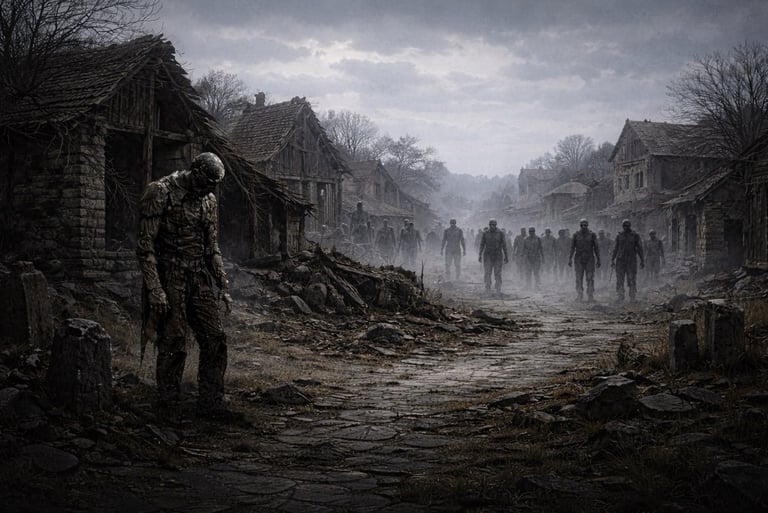
Indeed, mythic and folk traditions around the world are rich with undead that arise from precisely these failures of closure.
Pre-Christian Greek tribes believed the restless neniƒde and lemures (wandering shades) roamed if rituals were neglected.
Norse lore warns of the draugr, a corpse bound to guard its grave if its will was not honored.
In China, the jiangshi is a corpse so caught between worlds that it must “hop” about searching for life force.
In each case, a cultural rule emerges: careful rites, remembrance or containment prevents the dead from returning. These tales encode a moral architecture of undeath. Societies debate what must rest and what, for a given sin or injustice, might demand a return.
Undeath in Literature and Philosophy
By the nineteenth century, European literature had woven these motifs into the Gothic. Polidori’s Vampyre (1819) and Stoker’s Dracula (1897) introduced the intelligent undead who flirt with autonomy, while Mary Shelley’s Frankenstein (1818) portrayed reanimation as a perverse curse driven by grief and wrath.
These novels “established tropes of reanimation and abomination” that linger in our collective imagination. In Frankenstein’s creature, or Ruthven in The Vampyre, one sees horror and pathos intermixed: a being granted a second life it never wanted.
Twentieth-century horror then turned the undead into social metaphors. Richard Matheson’s I Am Legend (1954) and George Romero’s Night of the Living Dead (1968) reimagined zombies not as voodoo magic but as contagious pestilence, mirroring fears of disease and societal collapse. Romero himself admitted using flesh-eating undead to critique the emptiness of consumer culture.
In this way, the undead in literature often raise questions:
What if the worst parts of humanity persisted beyond death?
What if history itself were never allowed to fade?
Existential and philosophical readings have noted that the undead embody the deepest human anxieties. If mortal death threatens to render life meaningless, then belief in any form of persistence is psychologically appealing.
Reincarnation, ghosts, or immortal undead are, in part, responses to the terror of nonexistence. As psychiatrist Irvin Yalom observes, the “desire for psychological ‘immortality’ is the default response to existential anxiety”.
Ironically, undead offer only a false immortality: unchanging, inert, even stagnant. A ghost’s existence is halted on the edge of time, a vampire is trapped in endless repetition. These figures are anti-transcendence meaning that undead life is often a curse, not a blessing.
They remind us that ultimate escape from death might be worse than death itself.
Games and Interactive Systems
The undead have found a unique home in games, where their structural properties neatly solve many design problems. Because zombies, skeletons, and ghouls are not truly human, players can fight them without moral hesitation while also calling to attention the antithesis to life, death.
Critics note that players feel “no guilt” in dispatching these creatures and even view sending a shambling corpse “to the afterlife” as merciful. This ethical distance lets game worlds rain carnage without impacting the player’s conscience while providing a deep and meaningful adversary for in-game conflict.
In narrative terms
An undead villain can spill the heroes’ blood and still serve the story: the player can continue on without sorrow. Mechanically, undead are extremely practical.
Early levels in many games introduce zombies or skeletons as onboarding enemies: their appearance (rotting flesh or bones) and slow, predictable behavior teach combat safely. Castlevania and even Super Mario famously open with reanimated foes. Because undead are often mindless, designers can script them easily and spawn them in large numbers.
A simple “basic concept” like a zombie permits countless variations – fast zombies, armored skeletons, plagues of rats – without complex new AI. Games exploit this by using hordes of undead to pressure players: weak foes can swarm, forcing resource management and spatial tactics.
The dread of endless reanimation becomes tension: players must learn crowd-control abilities, area of effect attacks, or backtrack to chokepoints, turning endless waves into strategic puzzles despite their relative weakness alone.
Narratively, games also cast undead as memory-keepers. Undead monsters “often embody memory and unresolved history, and give weight to death in narrative”. A ruined city infested with skeletons suggests a fallen empire; a beloved ally turned zombie enacts the hero’s personal tragedy.
The trope of “death without closure” drives drama: encountering undead allies forces characters (and players) to confront loss directly. At the same time, games deliberately use the undead’s iconography for quick understanding.
A horde of zombies or a haunted crypt immediately telegraphs danger, and players “instinctively know what to expect” and how to fight it. In short, zombies and ghosts are legible opponents that teach and challenge simultaneously.
Overall, undead in games straddle horror and empowerment. They provoke disgust and fear but also allow catharsis because players can physically blast or hack at these creatures without remorse.
As one analysis summarizes, undead “tread the line between horror (as freakish others) and empowerment (as guilt-free enemies)”, keeping players engaged even through endless waves or challenging powerful bosses.
Modern Reflections on Undead
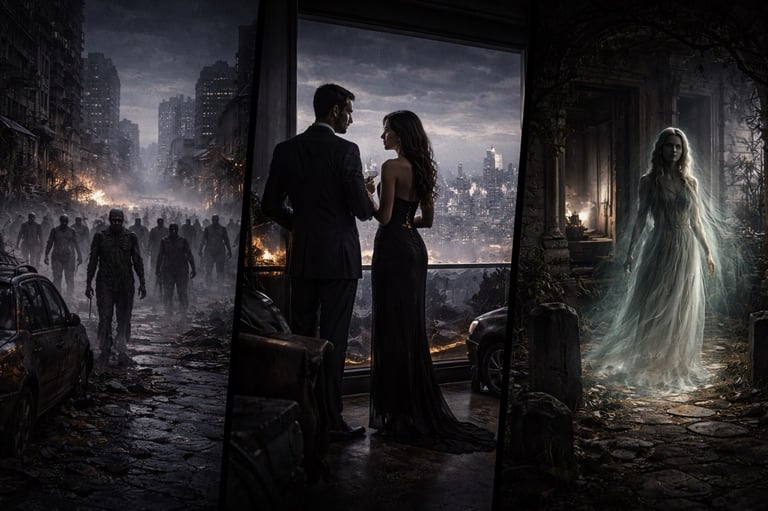
In contemporary culture, different undead archetypes highlight different anxieties.
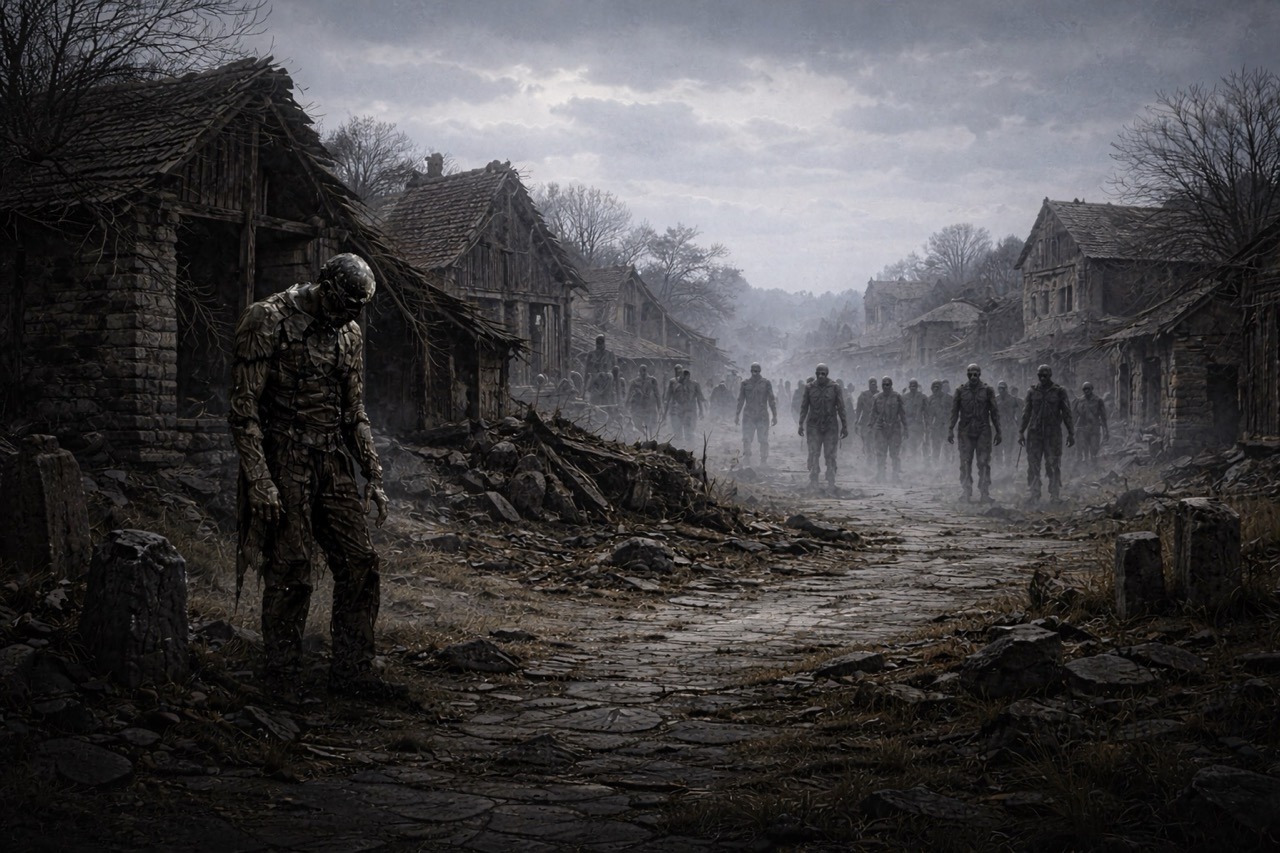
Zombies in film and TV often stand for mass threats and societal ills. In Romero’s lineage and today’s apocalypse stories, the dead-come-back plague signifies disease, social breakdown, consumerist mindlessness or other collective fears.
Vampires usually represent elite immortality of the powerful outsiders who cheat death. They marry glamour and horror: we’re both attracted to and repulsed by the idea of living forever at another’s expense. In vampire tales, the undead aristocrat preys upon the living’s fear of both dying and being subsumed by forces beyond their control.
Ghosts are more personal. They typically haunt intimate spaces like family homes, lovers’ rendezvous, and graveyards carrying private grief or guilt. As critic Wen-yi Lee notes, in Gothic literature “ghosts… have always represented the unresolved” aspects of life: “grief, guilt, unfulfillment, or injustice”.
Modern ghost stories (from The Sixth Sense to social justice narratives) leverage this: the undead here speak of past sins or sorrows the living refuse to let go. Each undead motif signals a way humans try to manage mortality.
Zombies externalize our fears of uncontrollable events (epidemics, war, economic collapse).
Vampires dramatize the dilemma of power and immortality: we desire them yet dread their price.
Ghosts remind us that personal loss and memory bind the dead to us.
In games, as noted, undead let us practice combat and mastery of systems in an ethically risk-free way while also being powerful enough to become to greatest villains of epic proportions such as the case with the Lich King in Blizzard's World of Warcraft.
What the Undead Teach the Living
If stories of the undead endure, it is because they mirror how we live with death. They show that the true unease is not merely death itself, but the loss of agency and continuity it threatens.
In raising the dead in myth or metaphor, humans assert that life’s meaning cannot simply vanish. We express our fear that if death were absolute, our deeds, commitments, and identities might vanish too.
Thus we create the undead: figures who must carry on what we fear we cannot finish. This persistence of undead motifs reveals our attitudes toward legacy and responsibility. We fear leaving debts unresolved and we fantasize control over them beyond the grave.
In literature, necromancy or haunting is literally a refusal to accept limits. When a culture depicts empires keeping soldiers as skeleton legions or rulers as immortal vampiric tyrants, it is dramatizing the impulse to perpetuate power and avoid accountability even after death.
Conversely, tales of destroying the undead often symbolize the need to properly lay things to rest: to face history’s mistakes, to atone for wrongdoing, to allow the natural cycle of life and death to proceed.
In the final analysis, the undead are not about literal belief in zombies or ghosts. They are metaphors for how we confront death’s definition of us. Death is our constant boundary; it defines the limits of life’s narrative. When stories refuse to end at that boundary, it is because we cannot either.
The undead persist because we persist in guilt, memory, fear, and hope. Ultimately, every ghost, revenant or vampire underscores this truth: Death defines us. Undeath reveals how we respond to that definition.
Undead Lore Mission
Introduce Undead Lore as a scholarly exploration of death, undeath, necromancy, and their role in myth, media, games, and culture.
© 2026. All rights reserved. Created by Nectagrity LLC