
Bal-Bal, The Corpse Thief of Filipino Folklore
Explore the Bal-Bal of Philippine folklore, the corpse thief of the night, through regional myths, wake rituals, and haunting lore.
MYTHOLOGY


Filipino Folklore
The Bird and the Man
In the country around Lake Lanao, when the rice fields were still tended by hand and the houses were low and thatched with palm, there lived a fisherman whose life was governed by the cycles of water and moon. He rose before the first light to cast his nets, sang to his children in the evenings, and joined the men of his village in caring for the dead when a soul passed from the world. His name has not been kept, but the elders recall that he was one of those who never missed a wake, standing at the foot of the mat to fan the flies and whisper prayers for the journey of the departed. One night, while walking home by the river’s edge, he saw a small bird with a bright throat sitting upon a stone. The bird, known among the Maranao as the laasan, darted toward him and vanished inside his open mouth while he was yawning. He staggered, coughed, and tasted the tang of iron. From that night onwards he began to feel a heaviness that food could not ease. During wakes he could not help but yawn, and the elders whispered that this was an ill sign.
He kept his burden to himself. He still attended to his nets and paddled his boat out each day, but he found his eyes drawn not to the moon on the water but to the houses where someone lay dying. The smell that rose from a body laid out for mourning reached him before the wind carried the smoke of cooking fires. Stories say that he could smell death the way a dog smells meat. His neighbors, who had long trusted his presence at their vigils, began to notice that he stood closer to the bier than he should, and that his breath had turned sour. When they spoke his name, he turned away as if ashamed. The old women who watched over the dead saw the laasan in their dreams and knew that something inside the fisherman was changing.
The Passing
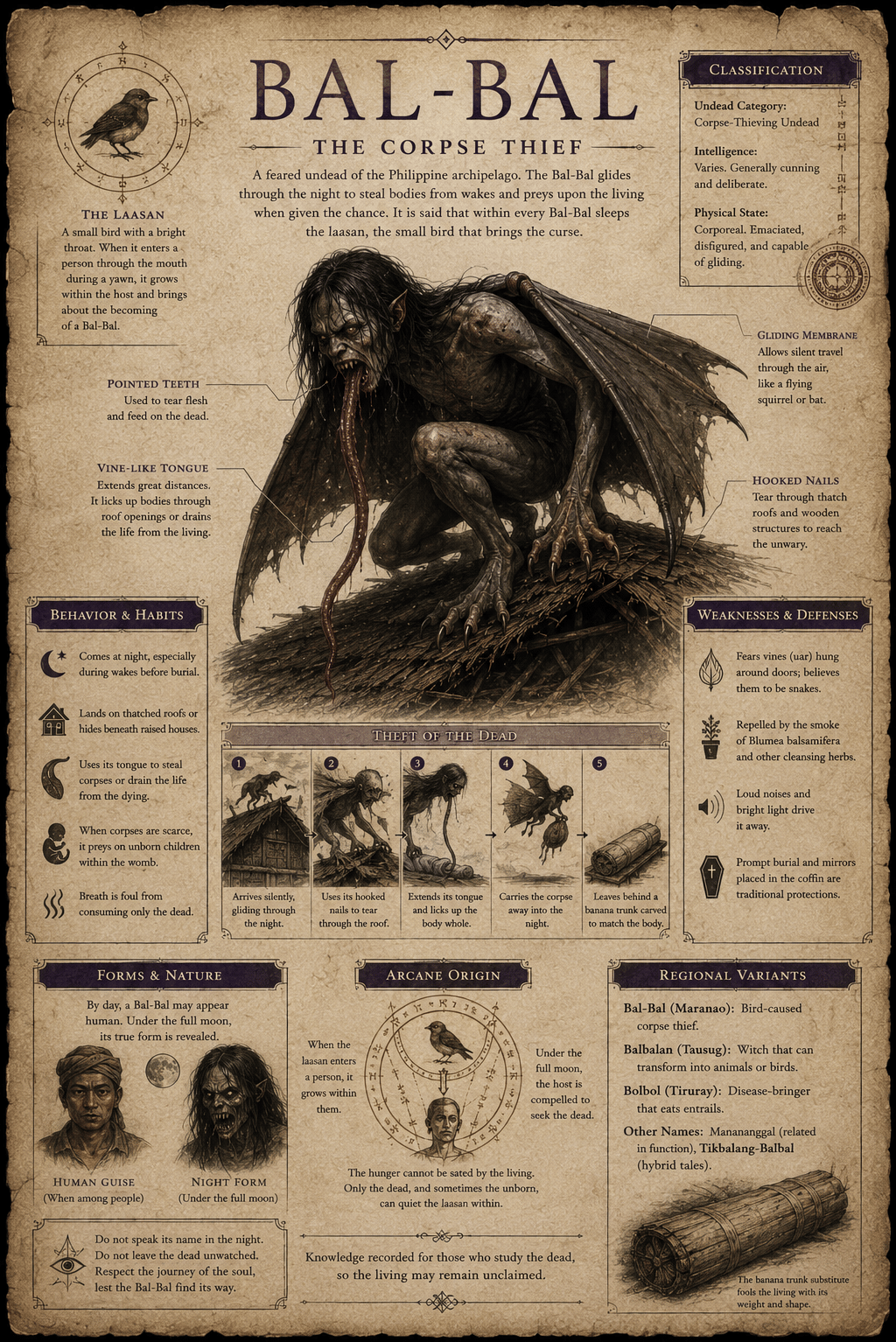
A fever came that the village healer could not break. He lay on his mat, head covered, sweating through the nights. They burned leaves of sambong and other herbs, as is the custom to ease the sick and to sweeten the air. On the third evening he died quietly. According to the practice of his people, his relatives tore down the walls of his house, carried his body to the clearing among the trees, and made ready to cover him with earth. Before the appointed hour, the body was laid out in the open for the last vigil. The elders whispered of what the Tagbanua of distant Palawan feared: a creature that came from the Moro country, sailing through the air like a flying squirrel. They called it the bal‑bal. It was said to be man‑like in form with curved nails that could tear up thatch roofs and a long tongue that could reach down and lick up bodies. Though they had never seen one, the thought of it kept them awake.
Around midnight the men drifted outside for a smoke, and for a few heartbeats there was no one at the corpse’s side. A shadow, gliding as a bat glides between trees, dropped onto the thatched roof and, with hooked nails, ripped a hole through the straw. A long tongue, thin as a vine and strong as rope, snaked down through the opening, wrapped about the body, and lifted it up through the roof into the night. Skin, flesh and bone were drawn up, leaving no trace. In its place lay a banana stalk, carved to the same shape and weight as the man. Only when the watchers returned did they see that the corpse had no fingerprints and that the weight of the bier was wrong. They beat on pots and shouted, but the thing that had come was already gone. In the morning, with no body to lay to rest, they buried the stalk and prayed.
The Corpse Thief
What happened to that fisherman is told in many places. Among the Tagbanua of Palawan the bal‑bal is believed to arrive before a corpse is buried, to glide like a flying squirrel or bat and land on thatched roofs. It uses curved claws to tear through straw, and its long tongue licks up a body as one might drink water. After feeding, it leaves behind a banana trunk which is so like the deceased that only the absence of fingerprints betrays the exchange. In the stories from Hiligaynon‑speaking country, it has pointed teeth and hooked nails that open roofs, and when no mirror is placed in the coffin it substitutes a banana trunk to keep the weight the same. Those who have heard its breath say that it smells foul from eating nothing but the dead.
The bal‑bal goes where wakes are held. Sometimes it waits beneath a raised house, sometimes it lands quietly on the roof, and sometimes it slips under the bed and uses its tongue to draw out the life of a dying person. Once the victim is dead it takes the body away. When bodies are scarce it turns its tongue towards the unborn child inside a mother, for there is a tale that it preys on the foetus when corpses are hard to find. In some tellings, people attribute this behavior to bal-bal, while others assign it to different forms of aswang.
In the Tiruray country it is known as the bolbol, a creature that spreads disease and eats entrails. Everywhere it goes it is said to fear vines hung around doors; some elders of Mindanao decorate their houses with uar vines because the bal‑bal thinks the vines are snakes. In Palawan they burn branches of Blumea balsamifera at the bedside and make loud noises, for light and sound are said to drive it away. Prompt burial is seen as the surest protection.
Not all bal‑bal remain in monstrous form. In some places it is believed that they walk among people by day and only become corpse thieves when the full moon drenches them. When night comes they leave their human semblance and reveal disfigured bones. Others say that if you whisper the creature’s name it will seek you out. The stories of the Tausug speak of the balbalan, a witch who can transform into a cat, a dog or a bird. Among the Maranao the change is explained by the laasan: when that bird enters a person it grows within them until, under the light of a full moon, they are compelled to feed on corpses and even on unborn children. People watch the faces of mourners for the compulsive yawning that betrays one who is harboring a laasan.
The Vigil
In villages where the bal‑bal is feared, the living keep vigil in ways passed down through generations. During a wake the family does not leave the body unattended. Pots and pans are kept at hand to bang, and torches are left burning. A mirror may be placed on the chest of the dead, for the creature is said to be frightened by its own reflection. Thorny branches are laid under the house so that anything crawling underneath will be scratched and retreat. Fathers of newborns make noise in the first nights after birth, for the creature is thought to hover over infants to frighten them into sickness. When a corpse must be buried, mourners move quickly; the Tagbanua tear down the dead person’s house and carry the body to the earth before sunset. The Cuyonon say that when the bal‑bal replaces a body with a banana stalk the substitute has no fingerprints. Those who have seen such an exchange do not speak of it without lowering their voices.
Once, in a village not far from the sea, a child’s grandmother noticed a man at a wake who yawned again and again. She told her sons to watch him. When they confronted him he laughed and said he was only tired. They placed a mirror on the chest of their dead and hung vines about the posts. Later that night they heard something scrape the thatch and beat their pots until dawn. In the morning the body was still there. The yawning man had gone. Some said he had gone to another place where people did not know his face; others said the vines had frightened the thing inside him. The old woman kept the mirror she had used on a shelf above her cooking hearth as a reminder that vigilance, more than any blade, kept the dead from being taken.
What Remains
The fisherman who swallowed the laasan is remembered only through the story of what he became. In life he cared for nets and neighbors; in death he was carried away by a tongue that had grown inside him. His transformation explains why the Tagbanua fear a creature said to come from the Moro country and why they beat gongs when someone dies. The habits of the bal‑bal—its gliding flight, its curved nails and long tongue, its habit of leaving a banana trunk where a body should be—are recounted in whispers around wakes. People still hang vines and burn sambong because an old story warns that these small things keep the corpse thief away.
No one claims to have destroyed a bal‑bal. The creature’s continued presence is marked by the empty coffins and the banana trunks buried in place of bodies. It is possible, elders say, that the corpse of the fisherman still lies in some cave or mountain where the creature retreats when dawn comes, bones picked clean and tongue still hungry. The telling of his tale reminds the living to watch over their dead, to bury them without delay, and to be wary of yawns during a wake. As long as wakes are held in the open air and the smell of death drifts across the fields, the bal‑bal will remain part of the night.
Undead Lore Mission
Introduce Undead Lore as a scholarly exploration of death, undeath, necromancy, and their role in myth, media, games, and culture.
© 2026. All rights reserved. Created by Nectagrity LLC