Lich Sandro the Great
Explore the canon history of Sandro the Great, a lich necromancer whose manipulation, artifacts, and undeath shape Heroes of Might and Magic.
CHARACTERS
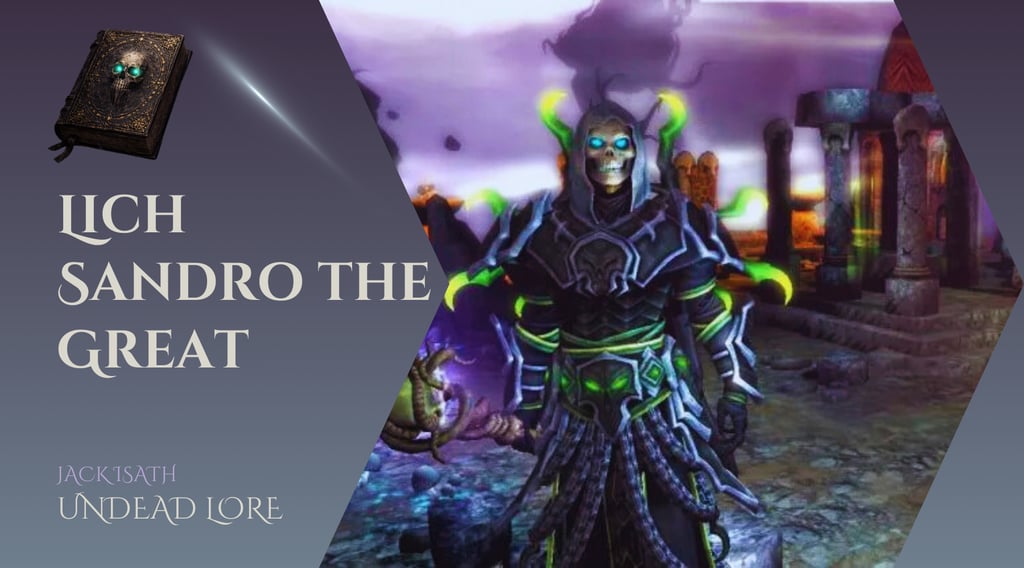
Sandro the Great is a recurring lich necromancer and principal antagonist within the Heroes of Might and Magic franchise. Introduced as a necromancer aligned with the forces of undeath, Sandro emerges across multiple titles as a long-term manipulator whose actions shape major conflicts rather than resolve within a single campaign. He is most closely associated with the necromantic artifacts known as the Cloak of the Undead King and the Armor of the Damned, which function as instruments of large-scale undead control rather than personal weapons. Sandro’s narrative arc spans Heroes of Might and Magic II, Heroes of Might and Magic III, and Heroes of Might and Magic IV, where he is depicted less as a ruling figure and more as an enduring strategic threat whose plans persist beyond individual defeats.
Origins and Early Depictions
Sandro first appears in Heroes of Might and Magic II as a necromancer antagonist operating in opposition to the living factions of the setting. In these early depictions, he is presented primarily through campaign narration and scenario framing rather than detailed characterization. His role centers on interference and manipulation, positioning him as a behind-the-scenes actor who engineers conflict to advance necromantic objectives rather than openly seeking territorial rule.
Canonical sources from Heroes of Might and Magic II portray Sandro as a figure focused on the acquisition and consolidation of undead power. His actions are consistently tied to the strategic use of necromancy, including the raising and control of undead forces at scale. Notably, early canon does not provide a defined mortal origin, personal history, or transformation narrative for Sandro. This absence of backstory establishes him as an already-formed antagonist, with undeath treated as a functional state rather than a biographical turning point.
Official manuals and in-game narration reinforce this presentation by emphasizing Sandro’s role and methods over his past. He is introduced as a known necromantic presence within the world, allowing later titles to build upon his continuity without revisiting or redefining his origins.
Rise as a Necromancer
In Heroes of Might and Magic II, Sandro’s activities expand beyond localized antagonism into broader strategic interference. Campaign narratives depict him as a necromancer who advances his position through indirect means, favoring political destabilization and manipulation of rival factions over sustained territorial control. Rather than leading armies in prolonged conventional campaigns, Sandro repeatedly positions other powers into conflict, creating conditions favorable to necromantic expansion without exposing himself to decisive retaliation.
This approach is reinforced through scenario objectives and in-game text, which consistently frame Sandro as an instigator rather than a sovereign ruler. His influence is exerted through intermediaries, shifting alliances, and calculated deception. These methods allow him to benefit from the destruction of opposing forces while remaining structurally insulated from their consequences.
During this period, Sandro is also associated with the pursuit of artifacts connected to necromantic dominance. While not all such artifacts are obtained within Heroes of Might and Magic II, campaign material establishes his long-term interest in tools that amplify undead control at scale. These early pursuits form the foundation for his later association with relics that enable mass animation and battlefield-wide necromantic effects.

Transformation into a Lich
By the time of Heroes of Might and Magic III, Sandro is explicitly identified as a lich, marking a formal transition from living necromancer to undead spellcaster. Canon sources do not depict the ritual or circumstances of this transformation. Instead, lichdom is presented as an established condition, consistent with the series’ broader treatment of liches as necromancers who have already achieved immortality through undeath.
In this context, lichdom functions as a narrative mechanism that explains Sandro’s persistence across generations and conflicts. His undead state removes conventional limitations of lifespan and succession, allowing his plans to unfold over extended periods without interruption. The transformation is framed pragmatically rather than symbolically, emphasizing continuity of agency and strategic memory rather than personal cost or metaphysical consequence.
In-game character descriptions and campaign narration in Heroes of Might and Magic III reinforce this status by treating Sandro as a stable, recurring figure rather than a character undergoing change. Lichdom is thus established as an enabling condition for his long-term role within the franchise rather than as a focal narrative event.
Role in the Restoration of Erathia
During the events of Heroes of Might and Magic III: The Restoration of Erathia, Sandro operates as a central but largely indirect antagonist. Rather than presenting himself as a claimant to rule, he manipulates the broader geopolitical conflict surrounding Erathia’s collapse and attempted restoration. Campaign narratives depict him as exploiting the chaos of war to advance necromantic objectives that extend beyond the immediate struggle for the throne.
Sandro’s actions during this period involve the deliberate engineering of large-scale warfare. By encouraging conflict among living factions, he creates the conditions necessary for extensive corpse generation, which in turn fuels necromantic armies. This strategy allows him to expand undead forces without relying on a stable territorial base, reinforcing his preference for systemic disruption over governance.
Across the base campaign and relevant expansion material, Sandro is portrayed as a continuing threat whose influence persists even when temporarily thwarted. His defeat in individual scenarios does not resolve his broader agenda, establishing him as a recurring antagonist whose significance lies in sustained interference rather than a single climactic confrontation. This positioning solidifies his role as a long-term destabilizing presence within the Heroes of Might and Magic narrative rather than a self-contained villain confined to one campaign.
Artifacts and Necromantic Strategy
Sandro’s operational methods are most clearly defined through his association with a small number of necromantic artifacts that function as force multipliers rather than personal symbols of authority. Chief among these are the Cloak of the Undead King and the Armor of the Damned, both introduced and mechanically formalized in Heroes of Might and Magic III. In canonical artifact descriptions, these items are designed to alter the structure of battle outcomes by increasing the quantity and persistence of undead forces rather than enhancing individual combat prowess.
The Cloak of the Undead King enables the automatic raising of fallen enemies as undead after combat, converting battlefield casualties into a renewable strategic resource. The Armor of the Damned imposes debilitating effects on opposing forces, reducing their ability to respond effectively once engagement has begun. Campaign dialogue and scenario text consistently frame these artifacts as tools intended for large-scale necromantic efficiency, reinforcing Sandro’s emphasis on accumulation and control rather than decisive singular victories.
Together, these artifacts reflect a strategic philosophy centered on mass animation, attrition, and inevitability. Sandro’s reliance on them underscores his preference for systems that scale over time and across conflicts, allowing him to benefit indirectly from wars he does not openly command.

Later Campaigns and Defeat
In Heroes of Might and Magic IV, Sandro continues to appear as an antagonistic presence whose defeat is presented as situational rather than absolute. Campaign narratives depict his plans being disrupted or temporarily neutralized, but they avoid depicting his permanent destruction. This treatment is consistent with his established status as an undead spellcaster whose continuity does not depend on conventional survival.
The events of Heroes of Might and Magic IV emphasize the fragmentation and shifting power structures of the setting rather than the resolution of long-standing antagonists. Within this framework, Sandro’s setbacks function as interruptions to specific schemes rather than as an endpoint to his influence. Official storyline summaries reinforce this ambiguity by focusing on immediate outcomes of campaigns without conclusively addressing his ultimate fate.
As a result, Sandro’s later appearances maintain his role as a persistent background threat. His continued relevance is implied through the absence of definitive closure, aligning with the franchise’s broader pattern of treating major necromantic figures as enduring elements of the world rather than disposable villains.
Characterization and Methods
Across multiple titles, Sandro is characterized by a consistent preference for manipulation over direct rule. Canon sources depict him as operating through intermediaries, engineered conflicts, and indirect pressure rather than openly governing territory or commanding unified states. His presence is often felt through the actions of others, positioning him as an architect of circumstances rather than a visible authority figure.
This reliance on proxies allows Sandro to pursue long-term objectives while minimizing personal exposure to failure. Undeath further enables this approach by removing temporal constraints, permitting strategies that unfold over decades or longer without loss of continuity. His plans are structured to survive individual defeats, with each conflict contributing incrementally to broader necromantic goals.
Notably, canonical material does not frame Sandro’s actions in ideological or philosophical terms. His motivations are presented as practical and instrumental, focused on the expansion and maintenance of necromantic power rather than the promotion of a moral or metaphysical doctrine. This absence of explicit ideology reinforces his depiction as a functional antagonist whose significance lies in method and persistence rather than declared belief.
Undeath and Its Consequences
By Heroes of Might and Magic III, Sandro is depicted as a lich rather than a living necromancer, placing him within the franchise’s category of undead spellcasters whose continued agency is not constrained by human lifespan. This status enables multi-generational planning in practical terms, since Sandro can pursue long arcs of acquisition and disruption without succession, institutional legitimacy, or personal preservation becoming limiting factors.
Lichdom also reduces Sandro’s vulnerability to political failure in the conventional sense. Where living rulers can be removed through assassination, rebellion, or inheritance crises, Sandro is depicted as an antagonist whose setbacks are more often framed as interruptions of specific operations than as permanent removals from the setting’s strategic landscape. This contributes to his recurring use across titles and campaigns, where his role is less dependent on holding territory and more dependent on sustained access to necromantic leverage.
Across Heroes III and references carried into Heroes IV, Sandro is also presented as comparatively detached from conventional faction loyalty as a political identity. He is consistently aligned with necromantic power structures, but his actions are depicted as instrumental and portable, with allegiance operating as a vehicle for influence rather than as a stable national or dynastic commitment.
Narrative Function Within the Franchise
Sandro functions within the franchise as a recurring antagonist used to maintain continuity across separate wars, regions, and campaign structures. He is most prominently positioned in Heroes of Might and Magic III: The Shadow of Death, where multiple campaigns revolve around his schemes and the attempts of other heroes to stop him. His recurrence supports an overarching pattern in which necromancy is depicted as a systemic threat that persists across political changes, rather than as a single localized villainy tied to one ruler or one conflict.
Within this structure, Sandro’s role contrasts with the series’ frequent turnover of kings, queens, and military leaders, whose authority often rises and collapses within a single succession war or regional crisis. Sandro is used instead as a durable connective element, reappearing through campaign framing, artifact-driven plots, and long-term manipulation rather than through stable governance. Where many campaigns resolve through regime change or territorial restoration, Sandro’s story function more often emphasizes ongoing necromantic continuity, with conflict serving as fuel for future undead expansion.
Legacy
Sandro is widely treated in franchise documentation and later reference material as one of the most persistent antagonistic figures associated with Heroes of Might and Magic III, particularly due to his centrality in The Shadow of Death campaigns and his close association with defining necromantic artifacts. His name continues to recur in later lore discussions and reference contexts, including later games that invoke him directly or indirectly through naming and artifact references.
Canon materials across the Heroes II–IV period also avoid presenting a definitive, final ending for Sandro in a way that would conclusively remove him from the setting’s long-term threat landscape. Instead, campaign outcomes tend to depict defeats as scenario-bound resolutions, leaving his broader status and future activity structurally open.
Appearances
Sandro’s core appearances across the requested scope include:
Heroes of Might and Magic II (campaign and scenario framing; manual-supported character context)
Heroes of Might and Magic III and expansions, with major focus in The Shadow of Death campaigns (including campaigns centered on Sandro)
Heroes of Might and Magic IV (recruitable Necromancer hero; referenced rather than positioned as a primary campaign lead in commonly cited summaries)
Undead Lore Mission
Introduce Undead Lore as a scholarly exploration of death, undeath, necromancy, and their role in myth, media, games, and culture.
© 2026. All rights reserved. Created by Nectagrity LLC