
Liche Master Heinrich Kemmler
Canonical biography of Heinrich Kemmler, liche master of Warhammer Fantasy, detailing his origins, undeath, campaigns, and narrative role.
CHARACTERS
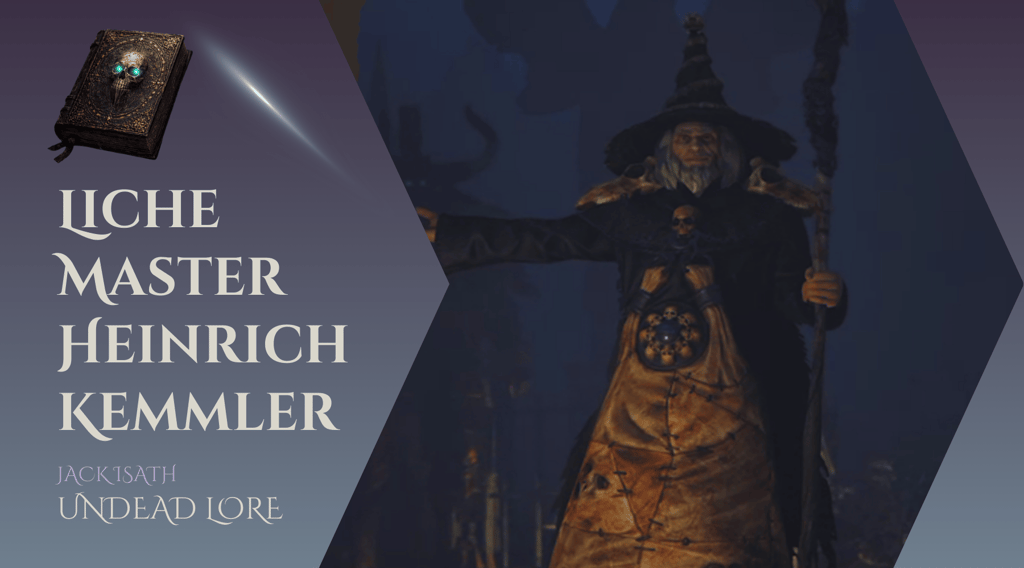
Liche Master of the Barrow Legion
Heinrich Kemmler, commonly titled the Liche Master of the Barrow Legion, is a necromancer and undead spellcaster within the setting of Warhammer Fantasy. He originates from the Old World, with his activities primarily centered in Bretonnia and the Grey Mountains. Kemmler is associated with necromantic cults, independent undead hosts, and long-standing opposition to both the Empire and Bretonnian authorities. He is most consistently depicted as an undead being, having achieved lichdom through necromantic means, though his physical form and degree of corporeality vary across appearances.
Kemmler’s activities span much of the late Imperial period of Warhammer Fantasy history, with particular prominence in eras characterized by instability along the Empire–Bretonnia frontier. He is historically relevant within the setting due to his repeated role as the architect and commander of large-scale undead forces, most notably the Barrow Legion, and for his involvement in several significant military and arcane conflicts involving Bretonnia, Imperial border regions, and rival necromancers.
Heinrich's Story as It Unfolds
Heinrich Kemmler is first recorded as a living human necromancer active in the Old World, operating outside the sanctioned Colleges of Magic. His early life is not extensively documented in canon sources, but he is consistently portrayed as having pursued necromancy in defiance of Imperial law, which strictly forbids the practice. Over time, his activities drew the attention of witch hunters and military authorities, leading to repeated efforts to apprehend or destroy him.
Kemmler’s entry into advanced necromancy culminated in his pursuit of immortality through undeath. At an unspecified point, he succeeded in transforming himself into a lich, preserving his consciousness and magical capability beyond physical death. This transformation marked a decisive shift in both his longevity and operational scope, allowing him to endure defeats that would have otherwise ended his career.
Following his transformation, Kemmler established a base of power in the barrow mounds and ancient burial sites of Bretonnia. From these locations, he raised large numbers of undead warriors, binding them into a coherent military force known as the Barrow Legion. This army was composed primarily of skeletal warriors and other reanimated dead drawn from ancient burial grounds, many of which predated Bretonnian settlement.
Kemmler’s activities brought him into repeated conflict with Bretonnian nobles and military orders, particularly the knightly hosts tasked with defending the realm from supernatural threats. He was also opposed by Imperial forces and witch hunters operating along the border regions. Despite suffering multiple defeats in battle, Kemmler was not permanently destroyed, repeatedly returning through necromantic means or escaping final annihilation due to the nature of his undeath.
Throughout his recorded history, Kemmler remained an independent actor rather than a subordinate of larger undead powers, though his actions occasionally intersected with broader necromantic movements and rival undead figures. Canon sources consistently depict him as a persistent threat whose defeats resulted in temporary setbacks rather than definitive conclusions. His ultimate fate remains unresolved within the core Warhammer Fantasy canon, with his continued existence implied through recurring appearances and references rather than a confirmed final destruction.

His Philosophy and Motivation
Canon sources consistently depict Heinrich Kemmler as a practitioner of necromancy whose actions are governed by a preference for durability, control, and autonomy rather than territorial rule or political legitimacy. His repeated return after defeat demonstrates a sustained prioritization of persistence over victory, suggesting that survival and continuity of will are central to his approach. Kemmler does not seek recognition from existing institutions, nor does he attempt to legitimize his power through alignment with sanctioned magical authorities.
His use of undead forces reflects a practical view of death as a resource rather than a boundary. The dead are employed as obedient instruments, valued for their reliability and immunity to fear, fatigue, or dissent. This consistent reliance on skeletal armies drawn from ancient burial grounds indicates a preference for forces that can be maintained indefinitely without logistical dependency on living populations. Command structures within his forces are depicted as rigid and unilateral, with Kemmler exerting direct magical control rather than delegating authority.
Kemmler’s repeated engagement in necromantic campaigns following setbacks implies a belief in attritional inevitability. Battles are not treated as decisive endpoints but as stages within a longer process of erosion against living opponents. His actions suggest an understanding of power as cumulative and self-renewing when rooted in undeath, rather than contingent on popular support, alliances, or material infrastructure. Across canon appearances, obedience is treated as a condition enforced through magic rather than loyalty, reinforcing a worldview in which control is absolute and resistance is temporary.
The Nature of His Undeath
Heinrich Kemmler is depicted as having achieved lichdom through advanced necromantic practices, resulting in the preservation of his consciousness and magical capability beyond physical death. This transformation allows him to continue acting within the world despite the destruction of his corporeal form, though his physical manifestations vary across depictions. His undeath removes biological constraints such as aging, illness, and mortal injury as limiting factors in his activity.
Kemmler retains his identity, memory, and spellcasting aptitude following his transformation, indicating continuity of intellect and intent. His ability to command undead forces is enhanced rather than diminished by lichdom, allowing for sustained concentration and repeated reconstitution of power bases. However, undeath also imposes constraints. His reliance on necromantic energies and prepared sites limits his operations to environments where the dead can be readily accessed and controlled. Periods following defeat are marked by reduced direct influence until his power is re-established.
Operationally, lichdom alters Kemmler’s role from that of a transient outlaw to a persistent strategic threat. Defeats no longer result in permanent removal but instead reset his presence within the setting. This allows for long-term planning unconstrained by personal mortality, while also making his influence episodic rather than continuous. His undeath enables recurrence but does not grant unchecked expansion, resulting in cycles of emergence, opposition, and withdrawal that define his historical activity.
What This Character Communicates Within Warhammer Fantasy
Within Warhammer Fantasy, Heinrich Kemmler functions as a recurring embodiment of necromancy operating outside centralized undead empires or divine authority. His presence reinforces the setting’s portrayal of necromancy as a destabilizing force that persists through individual will rather than institutional continuity. Unlike figures who command vast domains or serve as avatars of cosmic death, Kemmler exists as a localized but enduring disruption.
Kemmler’s repeated returns emphasize Warhammer Fantasy’s treatment of undeath as resistant to resolution. His inability to be permanently removed through conventional means reflects a broader narrative tension in which forbidden magic cannot be fully eradicated, only suppressed. This positions him as a reminder that necromancy remains an ongoing condition of the world rather than an anomaly confined to singular events.
In contrast to necromancers who pursue domination, conquest, or apocalyptic transformation, Kemmler’s role is defined by persistence and recurrence. He does not reshape the world but continually reasserts himself within its margins. This distinguishes him from undead lords whose narratives culminate in large-scale climactic outcomes. Kemmler instead represents the durability of illicit power structures and the difficulty of achieving finality when death itself is no longer absolute within the setting.

Lessons for Character Construction
Heinrich Kemmler’s durability within the lore arises from a structural design that avoids narrative finality. He is constructed as a character whose defining trait is persistence rather than progression toward a terminal outcome. His repeated defeats do not invalidate his presence because his undeath reframes loss as interruption rather than conclusion. This allows him to reappear without requiring escalation beyond established capabilities, preserving continuity across editions and campaigns.
Kemmler’s escalation is supported by consistency rather than transformation. His power does not increase through sudden revelations or ideological shifts but through repeated application of the same methods across time. Necromancy, once established as his primary mode of action, remains unchanged in principle even as circumstances vary. This creates a stable character profile in which growth is expressed through endurance and accumulation rather than novelty.
The relationship between Kemmler’s limited documented past, his transition into lichdom, and his recurring defeats establishes a closed loop of consequence. His lack of extensive personal history reduces dependency on detailed origin narratives, while his transformation into undeath provides a mechanism that explains both his survival and his constrained scope. Each return reinforces the cost of his path without resolving it, ensuring that consequence is present but never final.
As a constructed figure, Kemmler reinforces core Warhammer Fantasy themes concerning forbidden knowledge, unresolved threats, and the persistence of corruption at the margins of civilization. His design supports a setting in which dangerous practices endure not because they triumph, but because they are difficult to eliminate completely.
A Practical Observation About Power and Control
Kemmler’s arc reflects a recognizable pattern in which authority is pursued through systems that minimize dependency on others. His consistent use of obedient, replaceable forces mirrors historical and organizational tendencies toward centralized control structures that prioritize reliability over adaptability. In such systems, continuity is achieved by reducing variables rather than expanding influence.
The pattern also illustrates how actors who lack legitimacy or broad support may favor strategies that emphasize persistence over visibility. By operating intermittently and withdrawing after setbacks, Kemmler maintains relevance without requiring sustained dominance. This approach aligns with observable behaviors in long-running conflicts where endurance and repetition substitute for decisive victory.
Across his appearances, control is maintained through mechanisms that suppress autonomy rather than cultivate cooperation. This reflects a broader tendency for power structures built on coercion to persist through repetition, even when they fail to achieve lasting resolution.
Final Reflection on Heinrich Kemmler
Heinrich Kemmler occupies a stable position within Warhammer Fantasy as a figure defined by recurrence rather than culmination. His trajectory is characterized by repeated emergence, opposition, and retreat, with undeath providing continuity without expansion into final authority. Canon sources do not resolve his fate, instead maintaining his presence as an ongoing condition within the setting.
As a result, Kemmler remains part of the background architecture of the world rather than its focal endpoint. His record closes not with conclusion, but with persistence, reflecting a setting in which certain threats are diminished, contained, or delayed, but not definitively erased.
Undead Lore Mission
Introduce Undead Lore as a scholarly exploration of death, undeath, necromancy, and their role in myth, media, games, and culture.
© 2026. All rights reserved. Created by Nectagrity LLC