
Szass Tam, Zulkir of Necromancy
A canon-accurate biography of Szass Tam, tracing his rise from mortal Red Wizard to lich and architect of Thay’s necromantic state.
CHARACTERS
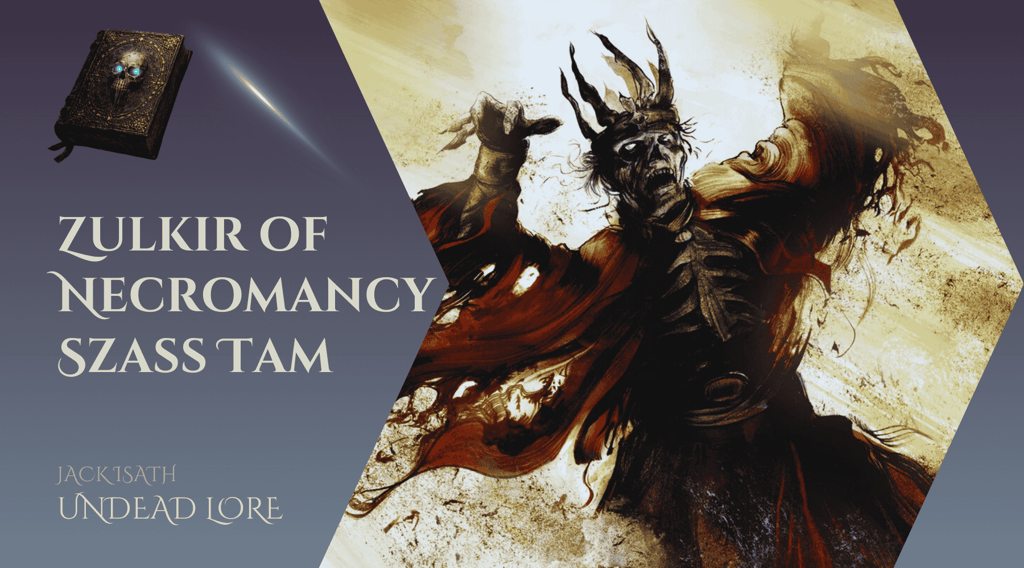
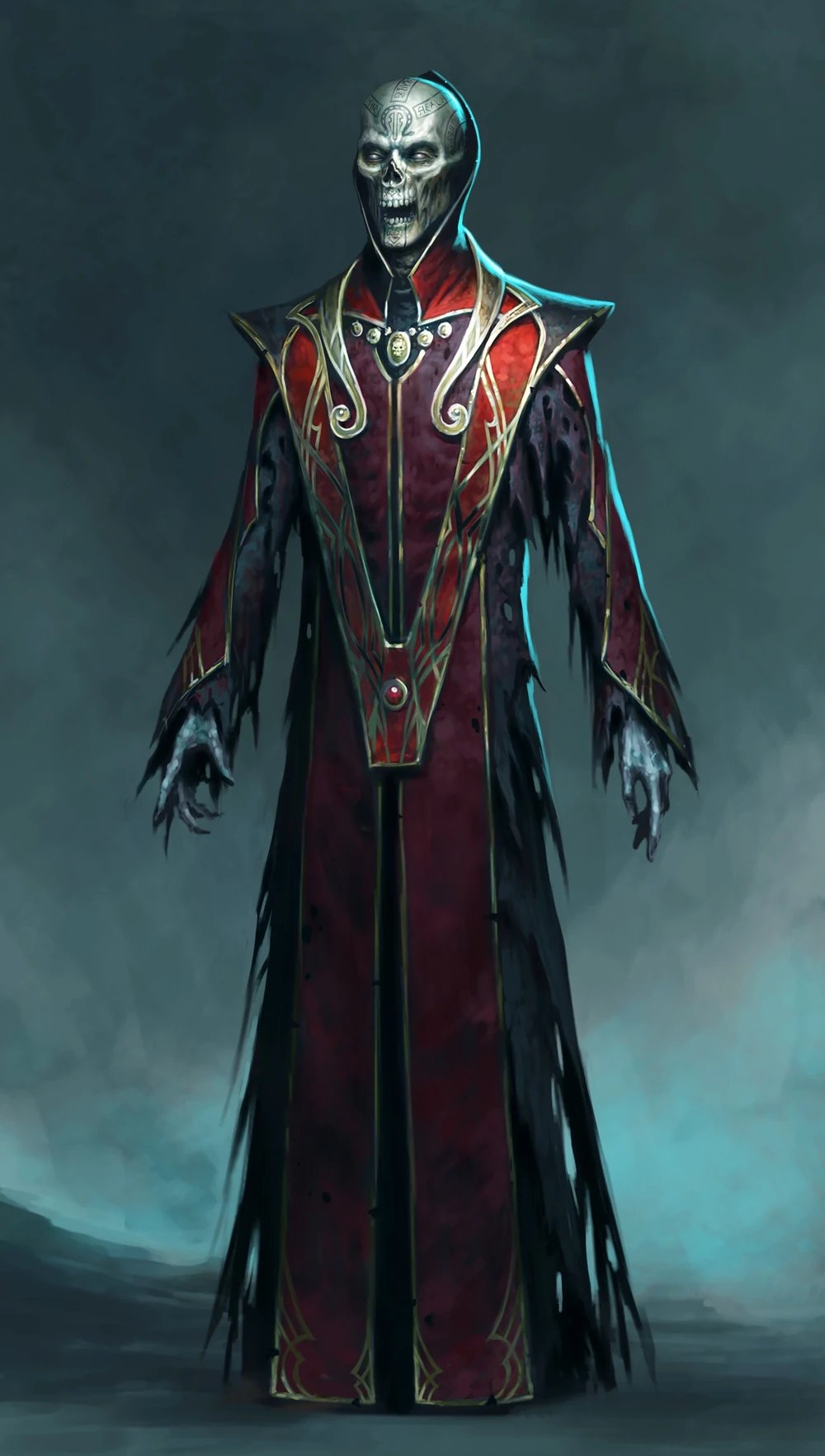
Szass Tam is a powerful undead spellcaster of the Forgotten Realms, best known as the long-standing Zulkir of Necromancy and the dominant political force within the magocracy of Thay. He is a senior member of the Red Wizards of Thay, an organization composed of the most powerful arcane practitioners in the realm.
Szass Tam is an undead lich whose continued existence is sustained through necromantic means. He has held the title of Zulkir of Necromancy since before his transformation into undeath and has exercised de facto control over Thay for extended periods through political dominance, coercion, and the systematic removal or subjugation of rival Zulkirs.
Across multiple editions of Dungeons & Dragons, Szass Tam is depicted as active and extant. While individual schemes have been thwarted and periods of open rule have fluctuated, his survival, continued influence, and recurring presence in Thayan governance are consistently affirmed in canon sources.
Early Life and Mortal Career
Szass Tam was born a human in Thay during its early history as a land defined by arcane rule and internal competition among powerful wizards. Canon sources establish that he demonstrated exceptional magical aptitude at an early age, particularly in necromantic disciplines, which were culturally accepted and institutionally supported within Thay’s political structure.
He rose through the ranks of Thayan wizard society during a period when arcane power was the primary determinant of status and authority. Thay was governed by a council of Zulkirs, each representing a distinct school of magic, and advancement within this system was achieved through mastery, intrigue, and the elimination of rivals. Szass Tam entered this hierarchy as a necromancer aligned with these norms rather than in opposition to them.
By the time he attained the position of Zulkir of Necromancy, Szass Tam had already established himself as a formidable political operator. His ascent was enabled by the inherently unstable balance of power among the Zulkirs, the normalization of lethal rivalry, and the absence of moral or legal constraints on the use of necromancy. His early career reflects a seamless integration of magical specialization and political ambition within Thay’s ruling framework, rather than a radical departure from it.
Canon sources do not describe his early motivations in psychological terms, but his actions during this period consistently demonstrate calculated participation in Thay’s competitive magocratic system, culminating in his elevation to one of its highest offices while still mortal.
Ascension Within Thay
After attaining the position of Zulkir of Necromancy, Szass Tam became one of the most influential members of Thay’s ruling council. Canon sources describe his elevation as consistent with Thayan norms, in which Zulkirates were claimed and maintained through arcane supremacy, political maneuvering, and the neutralization of rivals. Whether through formal appointment or lethal succession, his control of the necromantic school was firmly established while he was still mortal.
During this period, Szass Tam engaged in sustained rivalries with other Zulkirs, particularly those whose schools posed strategic or ideological opposition to necromancy. These conflicts were not isolated personal feuds but manifestations of systemic competition within Thay’s magocracy. Necromancy, as practiced and expanded under Szass Tam, provided durable advantages in warfare, labor, and enforcement, allowing him to project power beyond the limits of living subordinates.
Szass Tam used necromancy as a political instrument, expanding its role within Thay’s military and administrative structures. Undead servitors reduced reliance on living troops, weakened the bargaining power of rival factions, and enabled prolonged campaigns without corresponding population loss. As his influence grew, internal purges and removals of opposition figures became increasingly common, conducted through legalistic decrees, covert assassinations, or open arcane conflict.
These developments contributed to a measurable shift in Thayan governance. Decision-making became more centralized, long-term strategic planning increasingly displaced short-term factional compromise, and the authority of individual Zulkirs became more unequal. By the end of Szass Tam’s mortal career, the Zulkirate system remained intact in name, but its internal balance had begun to erode under his expanding dominance.

Transformation Into Lichdom
Szass Tam’s transformation into a lich occurred after his establishment as Zulkir of Necromancy and during a period of escalating internal conflict within Thay. Canon sources identify the act as a deliberate and prepared transition rather than an accidental or externally imposed condition. The timing is presented as a strategic decision aligned with his long-term objectives within Thayan politics.
The process of lichdom is described in Forgotten Realms sources as involving complex necromantic rituals designed to preserve consciousness beyond physical death through the use of a phylactery. While specific procedural details are not exhaustively documented, Szass Tam is consistently depicted as having successfully completed the transformation according to established arcane principles.
Motivations attributed to this transformation are functional and explicitly supported by canon. Lichdom removed biological constraints, ensured continuity of command, and protected accumulated knowledge and authority from succession crises. The immediate political consequence of this transformation was not removal from office but consolidation. His status as an undead spellcaster did not disqualify him from rule within Thay, where necromancy was institutionally sanctioned.
Following his transformation, Szass Tam’s autonomy increased. Dependence on allies and compromises diminished, and his capacity to endure setbacks without permanent loss of influence expanded. Canon sources consistently present lichdom as enhancing his ability to persist within Thay’s volatile political environment rather than altering its fundamental structure.
Rule as the De Facto Power of Thay
In the centuries following his transformation, Szass Tam emerged as the dominant force within Thay, exercising authority that increasingly surpassed that of the Zulkir council as a collective body. Canon sources document a gradual but sustained reduction in the independence of rival Zulkirs through assassination, exile, magical coercion, or political marginalization.
Control over the Red Wizards was maintained through layered mechanisms rather than singular authority. Szass Tam employed fear, patronage, indoctrination, and structural dependency, ensuring that advancement within Thay increasingly required alignment with his interests. Necromantic assets, including undead legions and bound entities, became integral to both internal security and external military campaigns.
Undead infrastructure expanded under his influence, serving not only as battlefield forces but also as labor, enforcement, and symbolic reinforcement of centralized power. This reduced reliance on living populations and allowed Thay to pursue aggressive policies with minimal internal resistance.
Externally, Thay’s relations with neighboring regions shifted in response to Szass Tam’s rule. The nation became more overtly expansionist, more reliant on intimidation and arcane projection, and less constrained by diplomatic reciprocity. Trade, warfare, and proxy conflicts were increasingly conducted in ways that reflected long-term strategic continuity rather than short-lived political cycles.
Canon sources distinguish between periods of overt rule, during which Szass Tam openly dominated Thayan governance, and intervals of indirect control, where formal structures were preserved while substantive authority remained concentrated in his hands. Across these variations, his position as the enduring center of power within Thay is consistently maintained.
Major Conflicts and Campaigns
Szass Tam has been involved in multiple large-scale conflicts that extend beyond Thay and into the wider political and metaphysical landscape of the Forgotten Realms. Canon sources consistently place him at the center of Thayan military expansion, necromantic experimentation, and long-term strategic initiatives designed to increase his autonomy and reach.
Among the most significant of these efforts were campaigns involving the mass creation and deployment of undead forces on a scale unprecedented in Thay’s history. These included attempts to reshape the nation’s military doctrine around necromantic sustainability, reducing dependence on living soldiers and enabling prolonged warfare. Several such initiatives culminated in regional destabilization, drawing the attention of neighboring powers and adventuring factions.
Szass Tam’s activities also brought him into indirect or adversarial contact with deities, divine agents, and Chosen figures whose interests conflicted with his expansion of necromantic influence. Canon sources describe interactions and interventions that disrupted or limited some of his more ambitious plans, particularly those that threatened planar balance or divine prerogatives. These encounters did not result in his permanent removal but did impose constraints on the scope and timing of his actions.
Not all of Szass Tam’s undertakings were successful. Certain large-scale rituals and political maneuvers were thwarted through external interference, internal resistance, or unforeseen complications. These setbacks resulted in temporary losses of territory, influence, or resources, but canon sources consistently depict them as partial reversals rather than terminal defeats. In several cases, the outcomes of these conflicts remain unresolved, with lingering consequences embedded in Thayan politics and regional instability.
Overall, Szass Tam’s major conflicts are characterized by long planning horizons, willingness to absorb losses, and an emphasis on structural endurance over immediate victory.

Philosophy and Strategic Doctrine
Canon material presents Szass Tam as operating according to a coherent and consistent strategic doctrine rather than impulsive or ideologically driven behavior. His actions demonstrate a functional view of death as a controllable state and necromancy as a practical extension of governance, warfare, and labor management. Death is treated as a logistical condition rather than a terminal boundary.
Across sources, Szass Tam exhibits a preference for centralized authority, redundancy of control, and the minimization of unpredictable human variables. Loyalty within his domain is not based on personal allegiance but on enforceable dependency, enforced compliance, and structural incentives. Advancement is granted selectively and is often coupled with mechanisms that limit independence.
Succession is treated as a systemic problem to be neutralized rather than resolved. Canon sources do not depict Szass Tam preparing heirs in a conventional sense. Instead, continuity is achieved through undeath, contingency planning, and the degradation of rival power centers. This approach reduces the importance of individual subordinates and elevates the persistence of the system itself.
Thay, under Szass Tam’s influence, is consistently depicted not as a cultural or national project but as an administrative and arcane apparatus. Territory, population, and institutions are treated as components to be optimized or replaced. This systemic view underlies his repeated efforts to restructure Thayan society around necromantic infrastructure and long-term stability.
The Nature of Szass Tam’s Undeath
Szass Tam’s lichdom has direct and documented consequences for his agency, durability, and political behavior. As an undead being, he is no longer subject to aging, disease, or biological exhaustion, allowing uninterrupted pursuit of long-term objectives across centuries. This continuity is a central factor in his sustained dominance within Thay’s volatile political environment.
Canon sources establish his reliance on a phylactery as the anchor of his continued existence. This necessitates extensive protective measures, redundancies, and misdirection, shaping his preference for layered defenses and indirect engagement. The risk associated with the phylactery imposes operational limits, requiring caution in direct confrontation and encouraging the use of intermediaries.
Lichdom introduces constraints alongside advantages. Szass Tam’s physical presence can be destroyed, resulting in periods of reduced direct influence while reconstitution occurs. These interruptions do not eliminate his authority but can create temporary power vacuums or shifts in Thayan governance. Canon sources depict him as compensating for this vulnerability through contingency planning and distributed control mechanisms.
Identity continuity is maintained across these disruptions. Szass Tam is consistently depicted as retaining memory, strategic intent, and command authority following destruction and return. This persistence reinforces his emphasis on long-term planning and reduces the strategic cost of tactical losses.
Undeath, as presented in canon, functions as a stabilizing factor in his rule rather than a transformative ideological shift, reinforcing preexisting strategies rather than redefining them.
Depictions Across Editions and Media
Szass Tam has appeared across multiple editions of Dungeons & Dragons and in a variety of Forgotten Realms sourcebooks and novels such as The Haunted Lands series by Richard Lee Byers. While core elements of his characterization remain consistent, emphasis and scope vary by medium and edition.
Early editions present him primarily as a powerful Zulkir and regional antagonist, with lichdom serving as a defining but not always foregrounded trait. Later editions expand his role into that of a central geopolitical threat, highlighting large-scale necromantic projects and near-sovereign control over Thay.
Novel portrayals tend to emphasize narrative continuity and long-term plotting, often focusing on the consequences of his schemes rather than their internal mechanics. Sourcebooks and campaign guides provide more detailed accounts of his institutional control, military assets, and political strategies. Differences in depiction occasionally result in apparent contradictions regarding the extent of his power or the success of specific plans.
When conflicts arise between portrayals, canon hierarchy generally prioritizes later edition sourcebooks and setting guides over earlier or novelized interpretations. Despite these variations, Szass Tam’s status as an extant, influential lich and central figure in Thayan governance is consistently maintained across media.
Narrative Function Within the Forgotten Realms
Within the Forgotten Realms setting, Szass Tam functions as an enduring antagonist whose role is defined less by isolated confrontations and more by sustained structural presence. He is not positioned as a singular threat to be conclusively defeated, but as a recurring force whose actions generate prolonged instability and ongoing narrative pressure.
Szass Tam serves as a representation of necromantic state power, demonstrating how undeath operates not merely as a personal condition but as a governing principle. His rule presents necromancy as an administrative, military, and economic foundation rather than an aberrant practice. This framing distinguishes him from other necromantic figures whose influence is limited to cults, isolated domains, or personal ambition.
As a long-term geopolitical threat, Szass Tam anchors Thay as a persistent source of tension within the setting. Thay’s policies, military posture, and diplomatic relationships are repeatedly shaped by his continued existence and strategic priorities. Through him, Thay remains identifiable as a centralized arcane power whose internal politics and external actions retain continuity across eras.
Lessons for Character Construction
Szass Tam’s durability as a character across editions and narrative resets derives from his integration into institutional structures rather than reliance on singular acts of dominance. His authority is distributed across offices, armies, and administrative systems that persist independently of any single storyline outcome.
Undeath contributes directly to this longevity by removing biological finality while preserving continuity of intent and memory. Canon sources consistently depict his defeats as interruptions rather than endpoints, allowing narrative setbacks to coexist with ongoing relevance. This balance enables repeated use of the character without requiring escalation beyond established boundaries.
The emphasis on institutions, including the Zulkirate, the Red Wizards, and necromantic infrastructure, allows Szass Tam to remain influential even when not personally present. His characterization demonstrates how power embedded in systems can outlast individual conflicts and adapt to changing narrative frameworks.
A Practical Observation About Power and Control
Szass Tam’s depiction reflects a broader pattern in which authoritarian control is maintained through depersonalized systems rather than personal loyalty or charisma. Authority is enforced through mechanisms that reduce reliance on individual agents and emphasize replaceability, redundancy, and compliance.
The consolidation of power depicted in his rule follows recognizable dynamics of centralization, where decision-making authority is concentrated while operational functions are distributed across controlled institutions. Persistence is achieved through infrastructure, legal frameworks, and enforcement bodies rather than continual personal intervention.
This pattern illustrates how long-term control can be sustained by minimizing variability, suppressing autonomous actors, and prioritizing continuity of function over adaptability or reform.
Final Reflection
Szass Tam occupies a stable position within the Forgotten Realms as an extant lich, political architect, and enduring source of conflict. His role is defined by continuity rather than culmination, with each disruption reinforcing rather than resolving his presence within the setting.
Across editions and narratives, his status remains deliberately unresolved. This open-endedness allows Thay, necromancy, and arcane state power to persist as active elements of the world, anchored by a figure whose removal is repeatedly deferred rather than concluded.
Undead Lore Mission
Introduce Undead Lore as a scholarly exploration of death, undeath, necromancy, and their role in myth, media, games, and culture.
© 2026. All rights reserved. Created by Nectagrity LLC