Vecna, the Whispered One
A complete biography of Vecna, the Whispered One, tracing his rise from mortal king to lich and god across Dungeons & Dragons and the Forgotten Realms.
CHARACTERS
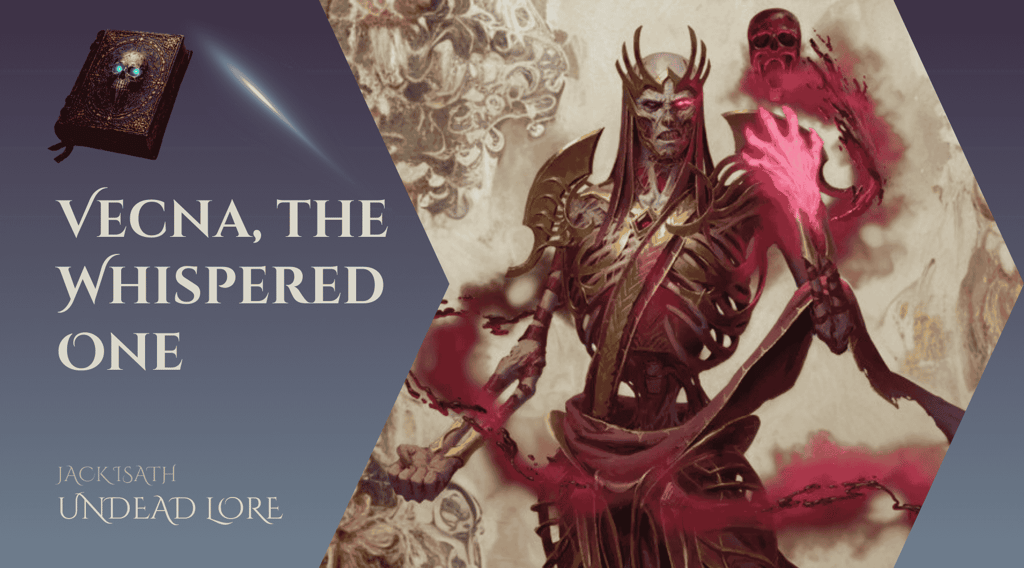
Vecna is a fictional character in Dungeons & Dragons, appearing across multiple campaign settings, including the Forgotten Realms. He is depicted as a former mortal king and archmage who achieved lichdom and later ascended to divinity.
Vecna is primarily associated with secrets, forbidden knowledge, undeath, and manipulation through hidden influence. His most common and widely recognized title is Vecna, the Whispered One.
Canonical Overview
Vecna originated as a powerful human spellcaster who ruled as a king in an ancient and unnamed realm. His reign was characterized by centralized authority, magical surveillance, and the systematic suppression of dissent.
Over time, Vecna pursued immortality through necromancy, transforming himself into a lich. Following his apparent destruction and subsequent return through surviving relics, Vecna ultimately attained divine status. In later canon, he is established as a lesser god whose influence extends into the Forgotten Realms and beyond.
Vecna’s ontological status has shifted over time, appearing variously as a mortal ruler, lich, demigod, and god. Across all iterations, he is consistently portrayed as an entity whose power is rooted in secrecy rather than overt dominion.
The Story as It Unfolds
Vecna’s early life is described as that of a mortal human who combined exceptional arcane talent with political ambition. He rose to power not only as a wizard but as a king, ruling through fear, espionage, and magical coercion. His court and administration are depicted as extensions of his will, with knowledge tightly controlled and opposition eliminated through both mundane and supernatural means.
Central to Vecna’s reign was his lieutenant Kas, a powerful warrior entrusted with enforcing Vecna’s authority. As Vecna’s power grew, so did his paranoia. Canon sources consistently depict him as hoarding secrets, researching increasingly dangerous forms of magic, and isolating himself from potential rivals.
Vecna’s transformation into a lich marked a decisive break from mortal constraints. By binding his soul to a phylactery, he achieved a form of immortality that allowed him to continue his work without concern for physical death. However, this transition did not stabilize his rule. Instead, it intensified existing tensions. Kas ultimately betrayed Vecna, leading to a catastrophic confrontation that destroyed Vecna’s corporeal form and much of his empire.
Despite this apparent defeat, Vecna did not cease to exist. His severed hand and eye endured as powerful magical artifacts, allowing his influence to persist indirectly. Through these relics and the cult activity surrounding them, Vecna gradually reasserted himself.
Over time, his accumulated power and worship elevated him to divine status, transforming him from an undead ruler into a god whose presence was defined by absence and concealment.

Philosophy and Motivation
Vecna is consistently depicted as valuing knowledge above all other forms of power. His actions suggest a belief that information, once obtained and controlled, is more enduring than territory, armies, or even physical form. Secrecy functions not merely as a tactic, but as an ideology. Knowledge is to be hoarded, weaponized, and denied to others.
His pursuit of lichdom aligns with this philosophy. Immortality provided Vecna with uninterrupted time to accumulate lore, secrets, and magical insight. His later pursuit of divinity reflects the same logic. Godhood offered a broader informational reach and a more resilient form of existence, rather than a desire for worship in the traditional sense.
Vecna’s interactions with mortals and other deities reinforce this pattern. He rarely seeks open confrontation, preferring manipulation through intermediaries, cults, artifacts, and hidden bargains.
The Nature of His Undeath and Ascension
As a lich, Vecna retained full intelligence, memory, and spellcasting ability. His physical form, however, was incomplete, particularly after his conflict with Kas. The loss of his left hand and left eye became a defining feature of his mythology. These remnants were transformed into the Hand of Vecna and the Eye of Vecna, artifacts that carried fragments of his essence and will.
These artifacts functioned as both anchors and conduits, enabling Vecna’s continued influence after the destruction of his body. Their existence blurred the boundary between Vecna as an individual undead entity and Vecna as a distributed presence embedded within the world.
Vecna’s eventual ascension to godhood did not erase his lich origins. Instead, it reframed them. He is presented as a deity whose divinity is inseparable from undeath, secrecy, and fragmentation.
Role Within the Forgotten Realms
In the Forgotten Realms, Vecna does not rule a nation or maintain a visible empire. His influence is exercised through hidden cult networks, corrupted scholars, necromancers, and individuals who seek forbidden knowledge. He is often positioned as a rival to gods concerned with knowledge, death, or fate, though he rarely engages them directly.
Vecna’s presence in the setting functions as a destabilizing force. He introduces uncertainty, erodes institutional trust, and rewards secrecy over transparency. His cult activity often intersects with political intrigue, magical conspiracies, and lost or suppressed histories.
Cultural and Narrative Significance
Vecna persists across editions and settings because of his structural flexibility. He can be used as a distant god, a resurrecting lich, a patron of villains, or an abstract threat embodied in artifacts. His power does not depend on physical proximity or narrative resolution.
Within Dungeons & Dragons lore, Vecna represents the endpoint of the lich archetype. He demonstrates how undeath can evolve from a personal survival strategy into a cosmological force. His story emphasizes continuity rather than conclusion, with each apparent defeat serving as a transition rather than an ending.
Legacy
Vecna remains one of the most enduring antagonistic figures in the Dungeons & Dragons canon. His influence spans multiple worlds, editions, and narrative roles. The absence of a definitive end to his story reinforces his association with secrecy and unfinished knowledge.
As both lich and god, Vecna occupies a unique position within undead lore. He is not merely an immortal ruler, but a system of influence built on concealment, memory, and control.
Undead Lore Mission
Introduce Undead Lore as a scholarly exploration of death, undeath, necromancy, and their role in myth, media, games, and culture.
© 2026. All rights reserved. Created by Nectagrity LLC