
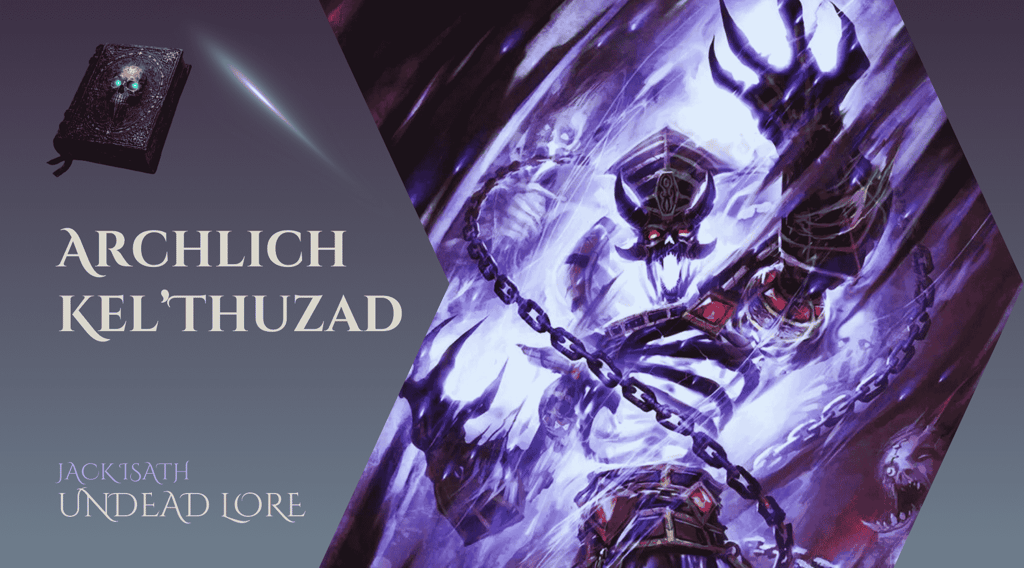
Archlich Kel'Thuzad
Canonical biography of Kel’Thuzad, the lich necromancer of Warcraft, detailing his rise, undeath, and role within the Scourge and Naxxramas.
CHARACTERS
Canonical Overview
Kel’Thuzad, Archlich of Naxxramas; High Necromancer of the Cult of the Damned; Lieutenant of the Lich King.
Origin and setting
Kel’Thuzad originated as a human mage within the Kirin Tor of Dalaran. His story unfolds primarily across the Eastern Kingdoms and Northrend during the events of Warcraft III: Reign of Chaos, The Frozen Throne, and World of Warcraft, particularly during the Naxxramas campaigns.
Affiliation or faction
Kel’Thuzad was formerly affiliated with the Kirin Tor. After his exile, he founded and led the Cult of the Damned and served as a senior operative of the Scourge under the Lich King.
Ontological status
Undead. Lich. Destroyed.
Key canonical events defining his arc
Kel’Thuzad’s expulsion from Dalaran for practicing necromancy, his pact with the Lich King, the founding of the Cult of the Damned, his orchestration of the Plague of Undeath in Lordaeron, his death and transformation into a lich, his role in Arthas Menethil’s ascent, the summoning of Archimonde, and his final defeat in Naxxramas.

The Story as It Unfolds
Kel’Thuzad began his career as a respected mage of the Kirin Tor, distinguished by intellectual ambition and an interest in branches of magic considered forbidden by Dalaran’s ruling council. Over time, his studies increasingly focused on necromancy and the manipulation of death, placing him in direct opposition to the Kirin Tor’s doctrines. His refusal to abandon this research led to his expulsion from Dalaran, severing his ties with Azeroth’s most powerful magical institution.
Following his exile, Kel’Thuzad established contact with the Lich King, whose consciousness was bound within the Frozen Throne in Northrend. Through direct communication, the Lich King offered Kel’Thuzad access to knowledge and power beyond mortal limitations. Kel’Thuzad accepted this offer willingly and aligned himself fully with the Lich King’s objectives.
Acting as the Lich King’s primary mortal agent, Kel’Thuzad founded the Cult of the Damned, a widespread necromantic organization operating throughout Lordaeron. Under his leadership, the cult distributed plague-infested grain to population centers, initiating the Plague of Undeath that decimated the human kingdoms and transformed their populations into Scourge forces. During this period, Kel’Thuzad served as an intermediary between the Lich King and Prince Arthas Menethil, guiding Arthas toward increasingly irreversible actions.
Kel’Thuzad’s death at Arthas’s hands was deliberate and anticipated. Prior to his execution, he prepared a phylactery, ensuring the preservation of his soul. After Arthas’s campaign in Northrend, Kel’Thuzad was resurrected as a lich, restoring his consciousness and granting functional immortality.
As an undead necromancer, Kel’Thuzad became one of the Lich King’s most trusted lieutenants. He guided Arthas toward Frostmourne, assisted in stabilizing the Lich King’s power, and orchestrated the summoning of Archimonde into Azeroth. Following Archimonde’s defeat, Kel’Thuzad remained loyal to the Lich King during the subsequent conflicts involving Illidan Stormrage and the fractured Scourge.
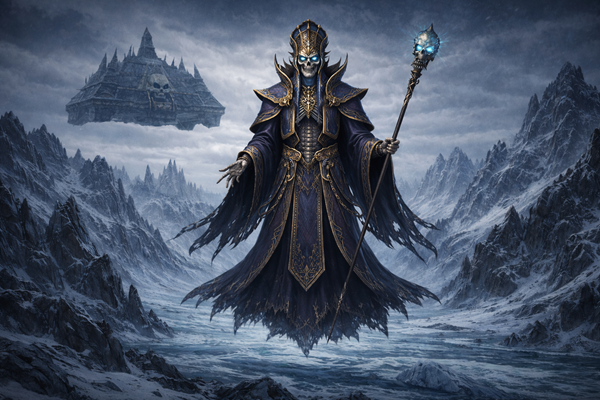
Kel’Thuzad later established Naxxramas as a floating necropolis and necromantic research center. There, he continued to refine Scourge operations until he was confronted and defeated by adventurers. The destruction of his phylactery ended his existence permanently.
Philosophy and Motivation
Kel’Thuzad is consistently presented as an ideologically committed necromancer whose actions are guided by intellectual conviction rather than emotional impulse. Canon sources depict him as viewing death as a manipulable state rather than a terminal condition, and necromancy as a legitimate and necessary extension of magical study.
His rejection of the Kirin Tor’s restrictions reflects a broader belief that fear and moral hesitation impede progress. Kel’Thuzad repeatedly demonstrates a preference for structured hierarchies, long-term planning, and systemic solutions. His loyalty to the Lich King is rooted in shared priorities concerning order, control, and the instrumental use of undeath, rather than personal attachment.
Unlike many servants of the Scourge, Kel’Thuzad’s alignment is voluntary and sustained. He does not seek redemption, nor does he exhibit doubt regarding the legitimacy of his methods.


The Nature of His Undeath
Kel’Thuzad’s transformation into a lich preserves his memory, intellect, and agency. His undeath is depicted as an enhancement of operational capacity rather than a degradation of identity. Through lichdom, he gains independence from physical mortality while maintaining strategic continuity.
The phylactery functions as both a safeguard and a limitation. While it allows survival beyond bodily destruction, it also introduces a single point of vulnerability. Canon portrays Kel’Thuzad as fully aware of this trade-off and accepting of the risk.
Undeath alters Kel’Thuzad’s role from mortal organizer to immortal administrator. His actions become less constrained by time, personal survival, or political legitimacy, enabling sustained long-term execution of the Lich King’s objectives.
What This Character Communicates to Us
Kel’Thuzad occupies a distinct position within Warcraft’s undead hierarchy as an example of voluntary, rational undeath. His narrative challenges the assumption that corruption is always the result of coercion or emotional weakness.
The character functions as a representation of necromancy as an organized discipline rather than chaotic transgression. Through Kel’Thuzad, undeath is framed as infrastructure, logistics, and governance, not merely horror.
His persistence across multiple narrative phases reinforces the idea that systems of power often outlast individual rulers. Kel’Thuzad remains operationally consistent regardless of shifts in leadership or circumstance.
Lessons for Character Creation
Kel’Thuzad demonstrates the effectiveness of aligning transformation with preexisting ideology. His lichdom emerges naturally from his established beliefs and actions rather than as a sudden escalation.
The character’s durability is reinforced by his role as an organizer rather than a singular focal antagonist. By functioning as an architect of systems rather than a lone villain, Kel’Thuzad integrates seamlessly into large-scale narrative and mechanical frameworks.
His design shows how characters gain longevity when their motivations are stable, explicit, and supported by consistent behavior over time.
A Practical Lesson About Life
Kel’Thuzad’s arc reflects a pattern in which individuals who prioritize efficiency and control may increasingly justify extreme measures when institutional limits obstruct their objectives. When authority structures are perceived as restrictive rather than protective, separation from those systems can become self-reinforcing.
The narrative illustrates how ideological certainty can replace moral deliberation, especially when results appear to validate methodology.
Final Reflection
Kel’Thuzad’s story is defined by continuity rather than transformation. His progression from mortal mage to lich follows a consistent intellectual trajectory rooted in rejection of constraint and pursuit of systemic power.
His destruction marks the end of an individual, but not the end of the principles he embodied. Within Warcraft’s canon, Kel’Thuzad remains a definitive example of undeath chosen, maintained, and executed with deliberate intent.
Undead Lore Mission
Introduce Undead Lore as a scholarly exploration of death, undeath, necromancy, and their role in myth, media, games, and culture.
© 2026. All rights reserved. Created by Nectagrity LLC