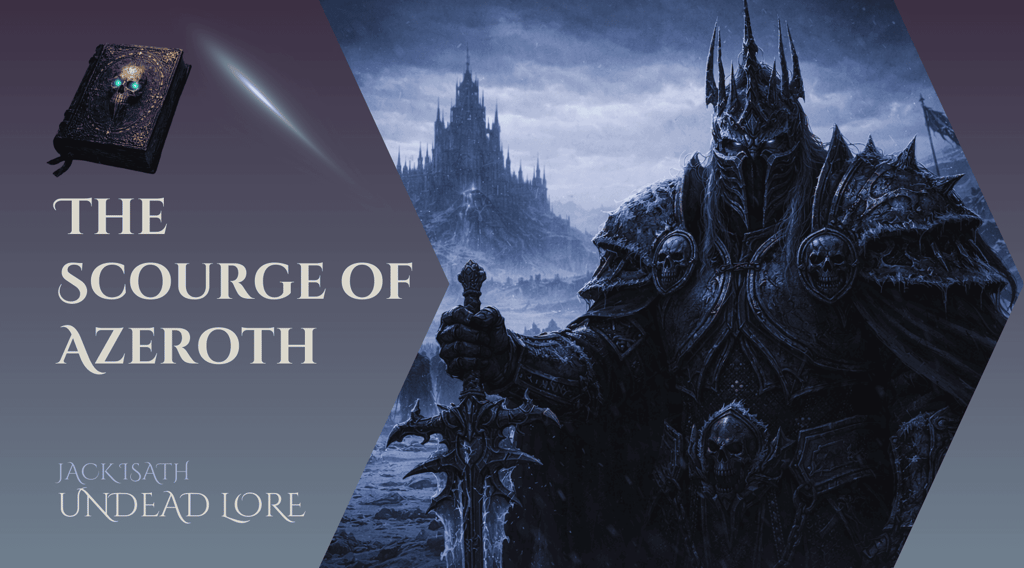
The Scourge of Azeroth
Explore the tragic story of the Lich King, Arthas, and the Scourge in Warcraft’s most compelling tale of undeath, power, and loss.
LORE
The Undead of Azeroth
Undeath in Azeroth is no mere army of monsters but the story about a brutal philosophy of control, sacrifice, and the lie of eternal life. The saga of the Lich King weaves this philosophy into a coherent myth: death repurposed as a tool, immortality revealed as imprisonment, and power bought only with surrender of self.
Long before Arthas Menethil crowned himself the Lich King, the orc shaman Ner’zhul sought refuge from death on Draenor, and it was Kil’jaeden who twisted that desperate yearning into torment. This “first lie” of salvation through undeath promised deliverance but became the architecture of a new tyranny.
When Ner’zhul was reborn as the Lich King on Draenor and later bound into the Frozen Throne, he traded one prison (his fading life) for another (an eternity of spectral imprisonment). In each step, life became an excuse for control, and death the path to dominion.
Mortal sorcerers like Kel’Thuzad answered that call with scholarly curiosity; they chased the promise of forbidden knowledge, only to find their free will ensnared by necromantic oath. Kel’Thuzad, once a wizard of Dalaran, answered the call and became the first member of the Cult of the Damned, a cult of scholars damned by their own ambition.
In this way, the lichcraft of Azeroth emerged not as random evil but as a dark order: each risen corpse was a cog in the Lich King’s machine, every chant a command cementing the Scourge’s system.
The Binding of Will
Arthas Menethil’s plunge into darkness was capped by a single moment of irrevocable choice. In the haunted chambers atop Icecrown Glacier, the dying spirit of Ner’zhul whispered through the ice: “Return the blade… complete the circle… release me from this prison!”.
At that cry, Arthas used his sword 'Frostmourne' to shatter the block of ice imprisoning Ner’zhul. When the shattered crown fell to his hands, he spoke no words of mercy or lament – only the cold acceptance of fusion: “Now,” the Lich King’s echoing voice declared as Arthas donned the Helm of Domination, “we are one.”.
In that instant, Arthas Menethil ceased to exist. His agency, his humanity, and all hope of redemption froze over with the cavern. Frostmourne had delivered the ultimate bargain: immeasurable power at the cost of the bearer’s soul. In practice it meant complete surrender. The new Lich King’s will became Arthas’s will, and vice versa.
Within weeks, the Lich King’s voice was no longer a distant whisper. His orders rang out from Icecrown with terrifying clarity. When he raised new death knights to command Scourge battalions, his summons betrayed neither pride nor sorrow, only resolve and vindication. “All that I am – anger, cruelty, vengeance – I bestow upon you, my chosen knight."
The Lich King’s boon of undying life was not a gift but a sentence: a fresh vessel of retribution with eternal devotion coded into its bones. This was the true binding of will: to become powerless engines of someone else’s war. His commands continued, “They must all be shown the price of their defiance.”
The Scourge’s purpose was no longer defensive or merciful. They existed to impose the Lich King’s order through indiscriminate death.

Kel’Thuzad and the Scholar’s Damnation
In Azeroth’s grand library, nothing was forbidden in theory except, ultimately, loyalty to life itself. Kel’Thuzad embodied the scholar’s tragedy. Obsessed with arcane lore and impatient for power over death, he sought to peer beyond normal limits.
The Lich King’s voice had reached him too, promising secrets of immortality in exchange for fealty. Kel’Thuzad abandoned his humanity on the promise of such “knowledge beyond the veil,” unaware of the price.
As a lich, his physical form crumbled but his hunger for answers grew. He became the “Scholar’s Damned,” whispering incantations from Frostwyrm autopsies and Drakkari crypts, translating necromantic runes that other mages barely whispered of.
Yet every lesson taught only stripped him further of self. Kel’Thuzad’s fellowship of the mind proved a cage: his memories blurred under the corruption, his laughter silent. He once haunted the halls of Scholomance as their teacher; now he walked its halls as a creature of ice, bending other dead to his will.
His ice-bound masters had cursed him with longevity so absolute that he could never find the peace he once dreamed of. He craved the power he thought might let him cheat death, but instead paid with conscience and kinship. By Naxxramas’ end, Kel’Thuzad’s final words were not a lament, but a pledge of fealty.
In death as in life, he was nothing more than another chapter in the Lich King’s ledger.


The Scourge
The undead legions of Lordaeron and Northrend are fundamentally different from living armies. They lack desire, loyalty, even pain – save as systems of obedience. The Lich King’s mind was the heart of this regime.
Every ghoul and death knight functioned like a machine, calibrated to respond to the Lich King's call. Their blades struck at once across continents, their magics replicated mechanically. A glance at the world reveals no corpse standing idle: in every battle, fallen Scourge warriors pushed from graves by telepathic command.
The Lich King’s summoners epitomize this order. From Icecrown he called forth new Death Knights with cold efficiency. As one helm-clad sentinel recited, “Gaze now upon the lands below us… They must all be shown the price of their defiance.”
There is no hesitation in such a summons, no room for pity. Even Sylvanas Windrunner’s grudge was powerless against that signal: as she collapsed to Frostmourne, Arthas spat, “After all you’ve put me through… the last thing I’ll give you is the peace of death!”, and with a single spell twisted her spirit into bondage. Her cries fell silent, replaced by the Lich King’s will in her ear.
Once turned, Sylvanas herself became the first banshee-bound specter of Arthas, then later a freed shadow calling the others to revolt.
The Forsaken and the Cost of Freedom
Even under the Lich King’s yoke, death was no escape. The hoarfrost of Icecrown gave way to a harsher truth: to walk free of the Scourge was itself a double-edged freedom.
In Lordaeron’s ruined capital, Sylvanas Windrunner and a handful of banished undead found their chains broken by Ner’zhul’s sudden weakness. They reclaimed the city and named themselves the Forsaken – “those who refuse.” It was a defiance of the Scourge, but hardly a release. Their price of freedom proved as steep as their master’s bargain.
Every Forsaken is, by design, only half a soul. Sylvanas learned that the moment she was raised: “After all you’ve put me through… the last thing I’ll give you is the peace of death!”
Sylvanas could not rest in death and could not live truly in life. In reclaimed Lordaeron she rallied kin to hers — yet they all shared her curse of absence. The Forsaken’s emotions are muted, their memories faded. They age not, but neither do they heal. Life is no longer theirs; a handful of faith in Sylvanas’s cause or the hope of revolt is all that keeps them going when commanded heartlessly by remnants of the Scourge.
Even then, they must constantly prove their free will against the dying Magus who shaped them. They fight living enemies without stain of allegiance but also without divine hope. Tyrion Fordring proclaimed they had their own destinies, yet what destiny can a slain soldier pursue when every concept of home, family, or reward has been obliterated?
In Sylvanas’s own words, the Forsaken have been “given a fate worse than death.” They live as cold certainty in the Lich King’s absence, knowing that were he gone and anarchy to reign, the Scourge would scatter truly uncontrollable but at the cost of themselves trailing into oblivion.

What Remains When the Crown Shatters
In the final reckoning, even the Lich King’s own seat proved temporary. When Arthas fell atop Icecrown’s spire, Bolvar Fordragon, once the mightiest paladin of the Alliance, sealed his life to the throne so that no other soul would have to bear the cost. “Place the crown upon my head… Forevermore I will be the jailer of the damned,” he, accepting the frostbitten prison so that his people might live unafraid.
In his voice echoed one final cruel irony: to save the world, Bolvar would never escape the Lich King’s fate. When the heroes of Icecrown tried to destroy the Helm, Bolvar’s will held firm. “Tell them only that the Lich King is dead… and that Bolvar Fordragon died with him,” he insisted. Order remained, but at the great cost of one more guardian behind the bars of iced steel.
Years later even Bolvar’s vigil ended: the Helm of Domination was shattered by one who dared to break the cycle. The shattering of the helm and with it the Great Ossuary of Azeroth’s death reverberated across the Shadowlands beyond. It proved the ultimate truth behind the Lich King’s promise: immortality is a lie, and it always comes at the price of freedom. No throne could anchor the dead forever, nor could an undead ruler truly rule without endless sacrifice.
Through the tragedies of Ner’zhul, Kel’Thuzad, Arthas, Sylvanas, and Bolvar, the World of Warcraft tells a singular story of undeath. It is a myth of unfailing internal logic, where every resurrection rings like a tolling bell of consequence. Death was no escape, because each escape spawned a new jailer and a new system.
When the Lich King’s crown fell, the veil between life and death was rent wide, showing that absolute power over death is both torment and farce. In Azeroth’s grand narrative, undeath stands not out of darkness for darkness’ sake, but as an architectural design: a “functional, tragic, and precise” revelation of what it truly costs to cheat oblivion and, ultimately, that nothing ever dies untouched by its own price.
Undead Lore Mission
Introduce Undead Lore as a scholarly exploration of death, undeath, necromancy, and their role in myth, media, games, and culture.
© 2026. All rights reserved. Created by Nectagrity LLC