Kas the Bloody-Handed
Kas the Bloody-Handed is a legendary death knight in Dungeons & Dragons, known for betraying Vecna and destroying the lich-king’s original empire.
CHARACTERS
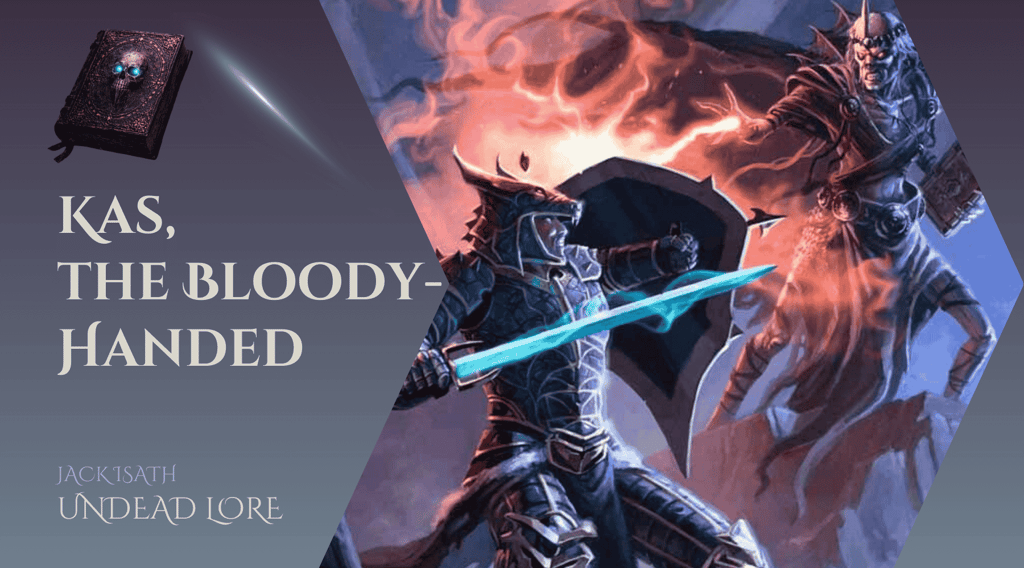
Kas the Bloody-Handed is a fictional character in Dungeons & Dragons, depicted as a legendary warrior, death knight, and former lieutenant of Vecna.
He is best known for betraying Vecna, destroying the lich’s original corporeal form, and precipitating the collapse of Vecna’s early empire. Kas occupies a central role in undead lore as a figure whose rebellion both ended a reign and enabled its transformation into something more enduring.
Canonical Overview
Kas originated as a mortal human warrior of exceptional martial ability who rose to prominence as the favored champion and enforcer of Vecna during Vecna’s rule as a lich-king.
He served as Vecna’s primary military asset and wielded the sentient artifact known as the Sword of Kas which was created by Vecna. Following a climactic confrontation between the two, Kas destroyed Vecna’s physical body, severing the lich’s hand and eye which eventually become the legendary artifacts known as the Hand of Vecna and the Eye of Vecna.
In the aftermath, Kas was transformed into a form of undead, most commonly depicted as a death knight. His ultimate status remains unresolved across canon sources.
The Story as It Unfolds
Kas’s early history is defined by his service to Vecna the Whispered One. While Vecna ruled through secrecy, arcane control, and information suppression, Kas functioned as the visible instrument of enforcement. He commanded armies, executed dissidents, and maintained order through direct violence. His authority derived entirely from Vecna’s favor, placing him in a position of immense power but absolute dependence.
The Sword of Kas became central to Kas’s rise and eventual fall. The weapon is described as intelligent and corrupting, reinforcing aggression, pride, and resentment in its wielder. Over time, Kas’s growing autonomy and Vecna’s increasing paranoia destabilized their relationship. Canon material consistently frames Vecna as intending to discard Kas once his usefulness diminished.
The conflict culminated in a direct confrontation between the two. During this battle, Kas struck down Vecna’s corporeal form, tearing free the hand and eye that would later become powerful magical artifacts. The destruction of Vecna’s body led to the collapse of his kingdom and the scattering of his forces.
Kas’s victory was incomplete. Rather than assuming rulership or escaping consequence, he was cast into undeath. Sources differ on the precise mechanism of his transformation, but he is consistently depicted as bound to a cursed existence defined by rage, duty, and unresolved conflict as a vampire.

Philosophy and Motivation
Kas is portrayed as valuing strength, hierarchy, and direct authority. Unlike Vecna, he does not pursue secrecy, knowledge accumulation, or long-term manipulation. His power is immediate and personal, expressed through combat and command rather than strategy or ideology.
After his betrayal, Kas’s motivations narrow significantly. Canon depictions emphasize a kind of fixation. He does not seek dominion, godhood, or legacy. His existence is structured around opposition to Vecna and the continuation of conflict rather than resolution or any kind of restoration.
The Nature of His Undeath
Kas’s undeath contrasts sharply with Vecna’s lichdom. Where Vecna preserved intellect and strategic reach, Kas retained martial identity and physical presence. As a death knight, Kas is typically depicted as a heavily armored undead vampire warrior bound by cursed oaths and sustained by hatred.
His undeath is not presented as a chosen transformation. It functions as a punishment or consequence, preserving his capacity for violence while denying him autonomy, rest, or closure. This form of undeath limits his ability to evolve beyond his final mortal role.
Relationship to Vecna
Kas and Vecna are structurally interdependent figures within Dungeons & Dragons lore. Kas serves as both the instrument of Vecna’s early dominance and the catalyst for his transformation into a god. Their conflict establishes a recurring pattern in undead narratives involving empowered lieutenants, inevitable betrayal, and the redistribution rather than elimination of power.
Kas’s rebellion ends Vecna’s rule as a lich-king but enables Vecna’s persistence through artifacts, cult activity, and eventual divinity. As a result, Kas’s actions strengthen the long-term threat he sought to eliminate.
Role Within Undead Lore
Kas functions as a counterpoint to the lich archetype. He represents undeath without transcendence. His story demonstrates a path in which power gained through service leads not to sovereignty, but to entrapment.
Within broader undead taxonomy, Kas exemplifies the death knight as a figure of enforced continuity. He remains bound to past conflict, unable to redefine purpose or escape consequence.
Cultural and Narrative Significance
Kas persists in Dungeons & Dragons lore because he embodies consequence rather than triumph. He is neither a successor nor a redeemer. His rebellion collapses an empire but produces no restoration.
Narratively, Kas serves as:
The executioner who becomes cursed
The lieutenant destroyed by proximity to absolute power
The visible cost of serving a lich
His continued presence reinforces Vecna’s legacy rather than erasing it.
Legacy
Kas the Bloody-Handed remains one of the most recognizable death knights in Dungeons & Dragons. His story endures due to its unresolved nature and its integral role in Vecna’s ascension.
Where Vecna adapts and expands, Kas stagnates. His undeath preserves function without growth, making him a persistent reminder that rebellion against tyranny does not guarantee freedom.
Undead Lore Mission
Introduce Undead Lore as a scholarly exploration of death, undeath, necromancy, and their role in myth, media, games, and culture.
© 2026. All rights reserved. Created by Nectagrity LLC