
Nagash, Supreme Lord of Undeath
Nagash, Warhammer’s god of death, from mortal necromancer to ruler of Shyish, exploring his undead empires, power, and philosophy.
CHARACTERS
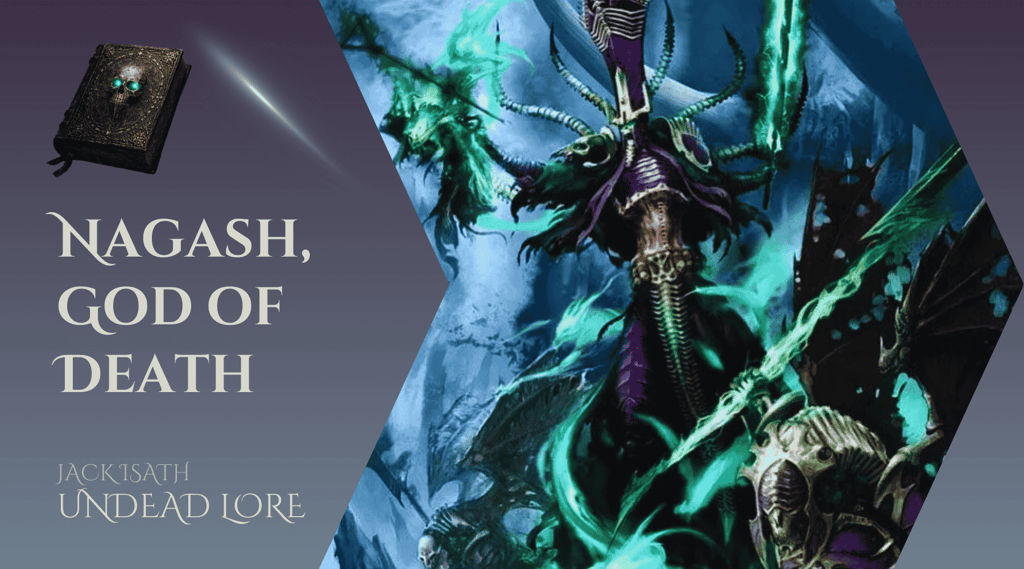
Canonical Overview
Nagash; known variously as the Great Necromancer, the Supreme Lord of Undeath, and the God of Death.
Origin and setting
Nagash originated in the ancient human civilization of Nehekhara in the Warhammer Fantasy setting. His story spans multiple historical eras, culminating in the End Times and continuing into the Age of Sigmar setting.
Affiliations or factions
Nagash is associated with necromantic cults, undead empires, and later the Grand Alliance of Death. His principal servants include the Mortarchs, most notably Arkhan the Black, Neferata, and Krell.
Ontological status
Undead god. Nagash exists as a composite being sustained through necromantic power, ritual reconstitution, and divine apotheosis.
Key canonical events defining his arc
Nagash’s arc includes his rise as a priest-king in Nehekhara, the invention of necromancy, the construction of Nagashizzar and the Black Pyramid, repeated defeats and resurrections, his role in the End Times, and his ascension as the ruling god of death in Shyish.
The Story as It Unfolds
Nagash was born into the ruling priesthood of Nehekhara, where religious authority and political power were closely linked. His early career was marked by rivalry, ambition, and the pursuit of knowledge beyond the accepted limits of funerary magic. While Nehekharan culture already emphasized preservation of the dead, Nagash pursued methods that actively reanimated corpses rather than merely sustaining them.
Through experimentation with dark rituals, alchemy, and the manipulation of souls, Nagash developed necromancy as a distinct and repeatable magical system. This innovation disrupted the metaphysical balance of Nehekhara and led to widespread catastrophe, including the corruption of burial rites and the animation of the dead on an unprecedented scale.
Nagash established his power base at Nagashizzar, where he constructed the Black Pyramid as a focal point for necromantic energy. His reign provoked sustained opposition from both mortal rulers and supernatural forces. Over successive centuries, Nagash was defeated multiple times, often through coordinated efforts involving living empires, divine intervention, or internal betrayal.
Despite these defeats, Nagash repeatedly returned. Each resurrection reduced his dependence on mortal form and increased his reliance on necromantic infrastructure and accumulated souls. By the time of the End Times, he had reassembled his essence sufficiently to challenge the gods themselves. His eventual ascension transformed him from a recurring tyrant into a foundational force within the cosmology of death.
In the Age of Sigmar, Nagash emerged as the dominant deity of Shyish, exerting authority over death magic, undead civilizations, and the afterlives of mortals across the Mortal Realms.

Philosophy and Motivation
Nagash is consistently depicted as pursuing control over death rather than destruction of life for its own sake. Canon sources present him as viewing mortality as an inefficient and disordered process. In his framework, souls represent a resource that should be cataloged, preserved, and governed.
His actions suggest a belief that death must be centralized under a single authority to prevent waste, chaos, or interference by rival powers. This belief places him in opposition to gods who rely on emotional worship, natural cycles, or entropy. Nagash’s philosophy prioritizes permanence, predictability, and hierarchical order.
Rather than seeking annihilation, Nagash repeatedly attempts consolidation. His campaigns focus on binding souls, raising structured undead armies, and absorbing rival death-aspects into his domain.
The Nature of His Undeath and Divinity
Nagash’s transformation from mortal to undead god occurred gradually through ritual fragmentation and reassembly. Unlike liches who preserve a single phylactery, Nagash dispersed his essence across artifacts, locations, and bound servants. This made him vulnerable to temporary defeat but resistant to permanent destruction.
As his divinity increased, his personal identity diminished in favor of function. Later depictions emphasize his role as an administrative and metaphysical authority rather than a personality-driven ruler. His physical form varies depending on his level of restoration and the concentration of death magic available.
The cost of this path is evident in his isolation. Nagash’s authority depends on domination rather than allegiance, resulting in frequent rebellion among his servants and persistent resistance from other gods.

What This Character Communicates to Us
Nagash functions as Warhammer’s most complete exploration of death as governance. He embodies the tension between inevitability and autonomy by asserting that death, as a universal condition, must be owned and regulated.
Within the setting, he represents the fear that systems designed to impose order can become oppressive when removed from ethical or relational constraints. His recurring defeats do not invalidate his logic but highlight the resistance of living and divine forces to total consolidation.
Nagash’s persistence reflects the durability of his premise rather than his success as a ruler.
Lessons for Character Creation
Nagash demonstrates how long-form antagonists can evolve from individual villains into structural forces. His arc shows the effectiveness of allowing repeated failure to deepen a character’s metaphysical role rather than diminish relevance.
The character’s durability arises from consistency of motivation paired with escalation of scale. Each return reframes prior defeats as steps in a broader process, allowing continuity across editions, timelines, and settings.
Nagash also illustrates how systems, artifacts, locations, and subordinates can function as extensions of a character’s identity, reducing reliance on personal presence.
A Practical Lesson About Life
Nagash’s story reflects a recognizable pattern in which attempts to eliminate uncertainty through absolute control generate ongoing resistance. Efforts to systematize complex processes often require increasing force to maintain authority, leading to instability rather than resolution.
The narrative highlights how accumulation of power can substitute for legitimacy, creating structures that persist through coercion rather than consent.
Final Reflection
Nagash occupies a singular position within Warhammer as both character and cosmological principle. His journey from mortal priest to god of death unfolds through accumulation rather than transformation, reinforcing continuity across eras.
Rather than resolving the problem of death, Nagash formalizes it such as with his elite army the Ossiarch Bonereapers. His presence ensures that death remains a contested domain, governed but never settled, and perpetually shaped by the struggle between order and autonomy.
Undead Lore Mission
Introduce Undead Lore as a scholarly exploration of death, undeath, necromancy, and their role in myth, media, games, and culture.
© 2026. All rights reserved. Created by Nectagrity LLC