The Death Factions in Warhammer Age of Sigmar
Explore the Death Grand Alliance in Age of Sigmar; its gods, legions, and undead systems shaping war, fate, and civilization across the Mortal Realms.
LORE
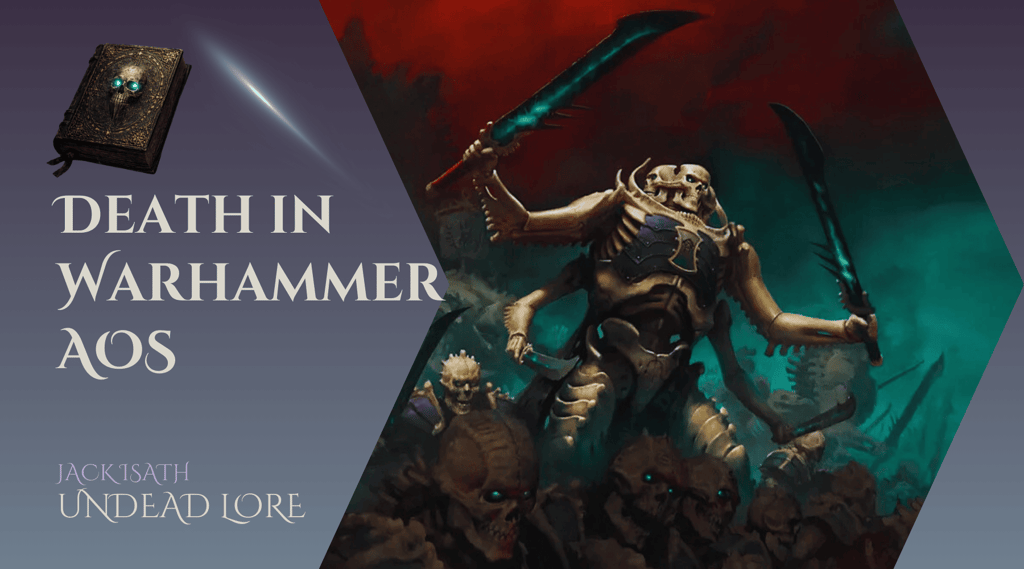
Warhammer Age of Sigmar is set in eight massive Mortal Realms, each a vast plane of magic. These realms formed long ago from cosmic debris and one of eight primal magical winds. They are shaped by the elemental force of their wind (for example, Aqshy is fire, Hysh is light, etc.), and are home to mortal races, divine pantheons, and the four Grand Alliances of Order, Chaos, Destruction, and Death. The armies of Death are not merely mindless monsters but a faction unified under a necromantic ethos. In AoS lore, Death is a Grand Alliance with its own structure and goals, led by the god-like necromancer Nagash, rather than a horde of random creatures.
AoS’s Death faction encompasses many undead armies and cultists who serve a single purpose: to usher the Mortal Realms under the dominion of the dead. As one summary explains, the Grand Alliance of Death is “the armies of undead and mortals that follow the dark commands of Nagash” – their purpose “to kill the living and impose the order of the dead upon all the mortal realms”. This article examines Death as a systemic force within AoS: its nature, structure, and narrative role across the world (not just isolated characters or battles).
What “Death” Means in Age of Sigmar
In Age of Sigmar, Death is first an elemental force. It is the influence of endings and finality in the cosmos. The Realm of Shyish is suffused with the wind of Death magic, and its lore is described as “the power of death… the magic of endings, of faltering cycles, of doom made manifest”. In this sense, Death is as fundamental as Chaos or Order – a universal current of magic governing decay and the final destiny of all things. It is felt in graveyards and battlefields, and it draws in the souls of the departed.
But Death in AoS is also organized. It is not random decay or simple entropy. Nagash, the Supreme Lord of the Undead, has centralized this force. All undead armies ultimately serve him. As a Warhammer article bluntly states: “Nagash controls all the armies of Death, from the deranged cannibals of the Flesh-eater Courts, through the sculpted perfection of the Ossiarch Bonereapers, to the endlessly quarreling but undeniably useful Soulblight Gravelords. The spectral ace up his sleeve… are the Nighthaunt, a legion of ethereal horrors… shackled in eternal service to the Supreme Lord of the Undead”. In practice, this means necromancy in AoS is highly directed: skilled mortal sorcerers and vampire lords raise the dead as tools of war, following Nagash’s grand design. Undeath is a weapon or tool, not a mere accident of nature. Even the many restless spirits and wraiths of Shyish are often bound into Nagash’s service, punished or constrained according to his dark will. This makes Death in AoS fundamentally different from typical fantasy undead: it is a cosmic inevitability wielded by a god-king, not aimless chaos.
Shyish: The Realm of Death
The Realm of Death, Shyish, is the eighth Mortal Realm, suffused with the amethyst wind of necromancy. It is “a still place of endings and silent decline, an amalgam of the underworlds for innumerable mortal species”. Shyish is literally built from the afterlife beliefs of all mortal races. Each culture’s vision of paradise or purgatory has manifested as regions within Shyish. The lore notes that “the concentrated beliefs of the various cultures… have begotten countless paradises and purgatories”, many of which have been invaded by Chaos or are now dominated by Nagash. In effect, every mythical underworld (whether pious heaven or horrific hell) coalesces into this one realm.
Within Shyish dwell endless sub-realms of death. Some are serene – for example, Athanasia, where souls peacefully reincarnate – while others are torturous arenas like Hallost, where dead heroes endlessly fight only to rise again by dawn. These underworlds are real and strange, but even they are subject to decay: Shyish is “above all… a realm of endings”. Over time the memories of these afterlives fade as their civilizations vanish, and eventually each underworld will disperse into nothingness.
Unlike a traditional heaven or hell with consistent moral judgment, Shyish simply is death’s domain. It is filled with the dead – not only ghosts and spirits but also living communities. In the “Prime Innerlands” at its heart, mortals eke out an existence in Shyish, even interacting with ancestral spirits. But as one Warhammer source stresses, Shyish is ultimately a place of deline: everything there, living or dead, is tainted by entropy. This makes Shyish very different from the cheerful Elysiums or fiery Hells of other fantasies. It is a melancholy amalgam – a paradise or purgatory shaped by belief, but one continually consumed by its own amethyst magic.
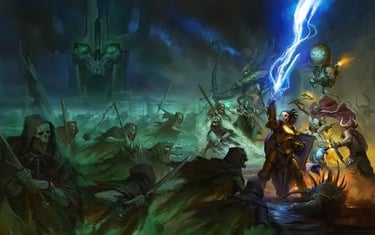
Origin and Authority of the Death Faction
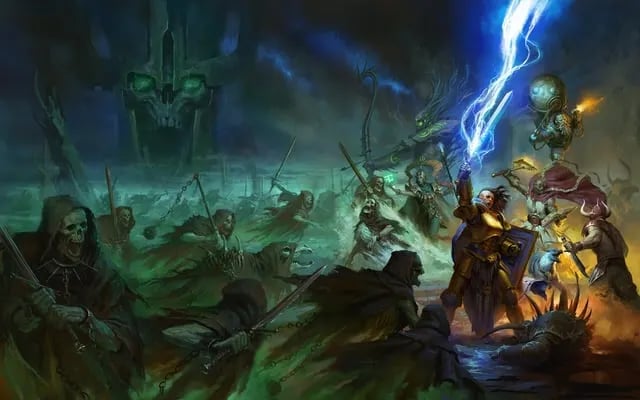
Death in AoS is personified and administered by Nagash, the god of undeath. Once a mortal sorcerer of the World-That-Was, Nagash mastered necromancy beyond any rival. He holds the title Supreme Lord of the Undead and claims dominion over every corpse and soul. As lore explains, Nagash “has haunted the realms for aeons… complete mastery over death. All lifeless things… chafe under his dominating will”. In effect, every skeleton and spirit ultimately belongs to Nagash, whether willingly or not.
This was not always so. In legend, the gods of Order once employed undead legions themselves – for instance, the God-King Sigmar briefly animated constructs and was even said to steal souls to create his Stormcast Eternals. But Nagash “schemed for sole domination” of death’s power. When he awoke from unlife, his first act was to claim all underworlds and all afterlives under his rule. The lore says he plotted to cast down the living and “raise an unchanging empire… solely under the control of the Great Necromancer”. He even bars the other deities from claiming souls – essentially trying to starve them of worship while he alone reigns. Unlike the capricious Chaos gods, Nagash is a single tyrant with a consistent, if cruel, purpose. He does not unleash death as an uncontrollable plague; he administers it.
Nagash’s authority is enforced through a hierarchy of Mortarchs and legions. He distributes scraps of his immense power to chosen lieutenants (the Mortarchs), who in turn command entire armies of undead. These Mortarchs – great vampires or spirit lords – oversee the Soulblight and Nighthaunt and other undead forces in Nagash’s name. Even they are extensions of his will: each commands undead through necromantic sorcery, but only Nagash can permanently grant unlife and ultimate power. In short, Death in AoS is not a force of nature or anarchy, but a divinely centralized system. It is Nagash’s institution, with him at its apex, setting it apart from chaotic or accidental undead in other settings.
How Undeath Is Created and Controlled
Undeath in the Mortal Realms is produced by necromantic rituals and soul-binding, not by spontaneous plague (with very few exceptions). Corpses are animated by necromancers who study the Lore of Death. Ordinary skeletons, zombies, and wights rise when a sorcerer calls upon death’s power at gravesites and battlefields. As one source notes, even a simple undead foot soldier is “animated through the power of necromancy”, becoming a permanent weapon of war until its master is slain. Vampire lords use a blood-curse (“the Blood Kiss”) to create new vampires from mortals, passing along undeath by feeding on blood. In every case, dark magic is required to snare and reassemble the soul and body into unlife.
A more extreme example is the Ossiarch Bonereapers: each of these bone constructs is created by ritualistically binding many souls. In hidden laboratories, morticians splice ghosts into newly-carved skeletons. As lore explains, the Mortisan priests “spliced and reconstituted” souls in ossea, fragmenting and blending them to match the needs of each soldier. The black soul-gems in a Kavalos rider’s chest, for instance, contain mixed soul-essences from hunters and cavalry. This soul-binding is exacting and brutal, ensuring each Bonereaper is stronger and more disciplined than an ordinary dead man.
Not all undeath is carefully engineered, however. Some mortals become undead by curse or accident. The Flesh-eater Courts originated from chaos-born cannibals struck by a vampiric curse. Similarly, the Nighthaunt are the souls of the guilty or unlucky – “warped wraiths moulded in the image of their mortal sins” – bound to eternal torment by Nagash’s dark judgment. Even a reckless death on the battlefield can send a spirit wandering into Shyish, where Nagash may ensnare it with fetters of bone. In general, though, undead in AoS are not random zombies; they are raised or sustained by necromantic will.
Control over the undead falls to those with necromantic power and Nagash’s favor. A vampire commands any skeletons and zombies he creates, but if that vampire lord is slain, his army is typically undone. Nagash’s Mortarchs grant authority to lesser necromancers, who in turn must manage their own troops. Crucially, every undead servants owes allegiance up the chain to Nagash himself. If a cohort of ghoulzombies revolts or a daemon reclaims a hellbound spirit, Nagash can usually reassert control – after all, every undead thing is, by right of the Great Necromancer, under his sway. In short, undeath is tightly managed; when control falters (for example, when Nagash’s own legions were scattered after his defeat by Teclis) the undead can break apart.
Functional Role of Death in the Setting
Death serves many functions in the Mortal Realms, often layered in complexity. Militarily, Death provides limitless armies. Any battleground can be a reserve of soldiers: fallen warriors rise as skeletons or zombies, and slaughtered villages can be reanimated as ghouls and Bonereapers. The Soulblight armies exemplify this: entire Rising Dead burst from graveyards to overwhelm foes. In any conflict, Death can replenish its forces endlessly.
Economically and politically, Death has its own infrastructure. Nagash enforces a morbid tax on the living. The Ossiarch Bonereapers, for example, conquer kingdoms and demand a bone-tithe – a quota of skeletons and ossified materials each year – to fuel their armies. Any society that fails to meet this grisly levy finds its sons and daughters dragged away by force. In other words, the living are literally resources for Nagash’s empire: “the living are nothing more than resources to be harvested, the grisly foundations of an endless paradise of undeath”. Bonereapers turn bone into coin; vampires of the Soulblight trade in blood and bloodlines, with dynastic intrigues shaping economies; even ghost ships of the Nighthaunt can terrorize trade by night. Souls themselves are a kind of currency: they are bound into weapons, power the warlock armies, or are used as energy in Bonereaper constructs.
Metaphysically, Death injects order into the narrative cosmos. Unlike Chaos, which brings unpredictable change, Death aims to impose a fixed order on reality. Nagash’s ultimate goal is a “still and lifeless necrotopia” – a clockwork empire of bone obeying only him. In this way, Death acts as a counterbalance: it represents the inevitability and finality that Chaos or Life alone do not. Yet this also makes Death a universal threat. By its nature it stabilizes and endangers simultaneously. It stabilizes by enforcing deterministic fate (all must eventually die and serve Nagash), but it threatens because it seeks to extinguish the living. This tension drives the narrative.
Meta-narrative role: Death reminds readers and characters that life’s consequences may outlive them. Violence in AoS comes with the specter of literal haunting. A warrior’s death might merely empower an enemy captain. Mortals can be subverted or bargained with by deathless forces. Conflict with Death is also not straightforwardly “good versus evil” – it is existential. Stormcast Eternals are reborn from death like the undead, and Order once relied on soul-stealing, blurring lines. Ultimately, Death’s presence forces the setting to reckon with questions of fate, sacrifice, and the price of immortality.
The Major Death Factions
There are 4 major Death factions in Warhammer: Age of Sigmar. These 4 factions are unique in their approach towards death and undeath.
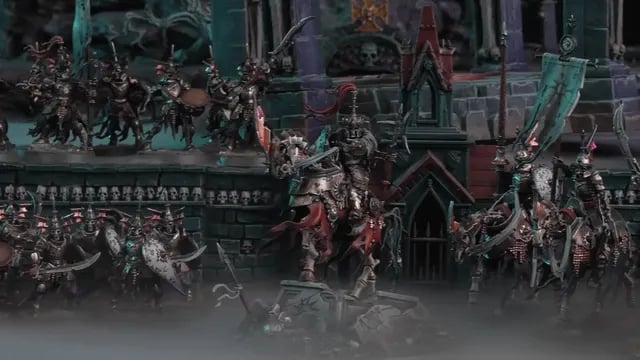
Soulblight Gravelords
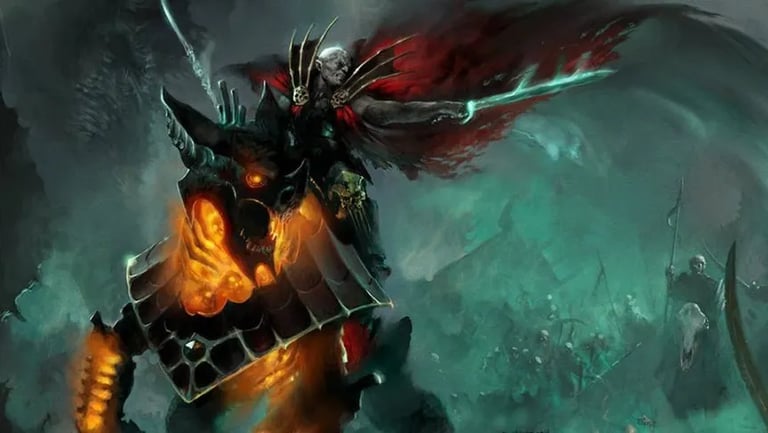
Soulblight Gravelords are the vampiric nobility of Death. Nagash created the first vampires to serve as generals and spies. He literally wove them from the Death Wind when he awoke in Shyish, birthing powerful lieutenants like Mannfred and Neferata from the ether. These vampires then spread their curse by making more of their kind. Soulblight vampires rule by blood and bureaucracy: they form dynasties and legions bound by fear and ancient bloodlines.
Their armies function through necromancy and dark oath. Noble families of vampires raise endless skeletons, death-rattle knights, and hordes of zombies. They feed on the living to sustain their unlife and magical power. As one description notes, they are “drawn to conquer and subjugate the living, using their innate necromantic powers to raise mighty undead armies”. In battle they summon the Rising Dead from tombs and reinforce their ranks with ghoul thralls and enchanted skeletons. Rivalries between dynasties (e.g. the Von Carsteins vs. Vyrkos vs. Nulahms) add political intrigue even within Death.
Philosophically, the Soulblight embody aristocratic domination and hunger. They are elegant and cunning, but hungry monsters underneath. Eternal life is a curse for them: the lore remarks that the Soulblight curse grants immortality “with a terrible cost” – a bestial, ravenous thirst for blood that threatens to overwhelm whatever shred of humanity remains. Thus they represent Death’s seductive allure (no fear of death) and its brutality (uncontrolled bloodlust), highlighting how personal ambition and appetite can become tools of the Death faction.
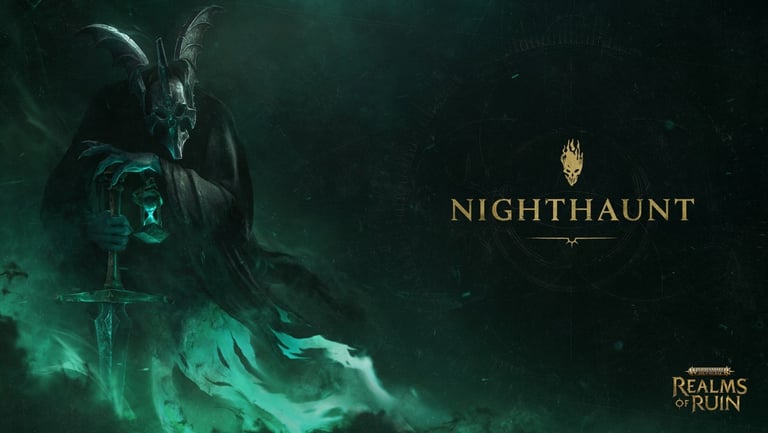
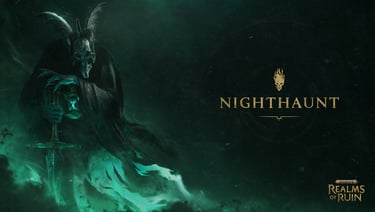
Nighthaunt
The Nighthaunt are the ghostly legions of Nagash. They consist of souls bound to undeath as punishment or consequence of violent death. As one source describes, Nighthaunt are “the wrathful gheists of the guilty, the sinful, and the damned” – twisted spectres forced to serve Nagash. Each spirit is literally shaped by its mortal sins. Nagash believes punishments must fit crimes, so when a person dies in a terrible way (cowardice, treachery, greed, or sheer misfortune), their spirit often rises as a Nighthaunt with a torment tied to that sins. They eternally hate the living for escape and walk in torment themselves.
Originally Nighthaunt were uncoordinated shades. However, Nagash unleashed them en masse during the Shyish Nadir (the great Necroquake), which poured death-magic out across the realms. Afterward, Nagash appointed leaders to give them purpose. Lady Olynder (Mortarch of Grief) and her consort Kurdoss Valentian imposed discipline on the spirits. Under their command, Nighthaunt armies move like dread phantoms led by chilling commanders. Some charge blindly into battle; others haunt battlefields with traps and terror.
The Nighthaunt philosophically represent inevitability and judgment. They constantly remind mortals that no death is final – Nagash can always recall a soul to do his bidding. They also embody the weight of guilt: a murder in Ulgu or a massacre in Ghyran can create horrors that rise to claim souls in retribution. Mechanically, they are ethereal and relentless, striking fear and draining life. Narrative-wise, they challenge heroes with their impassability – even the hardiest warrior “discovers the unforgiving truth – death comes for everyone”. In short, the Nighthaunt are Death’s agents of fate, punishing sins and ensuring that the dark hand of Nagash never rests.
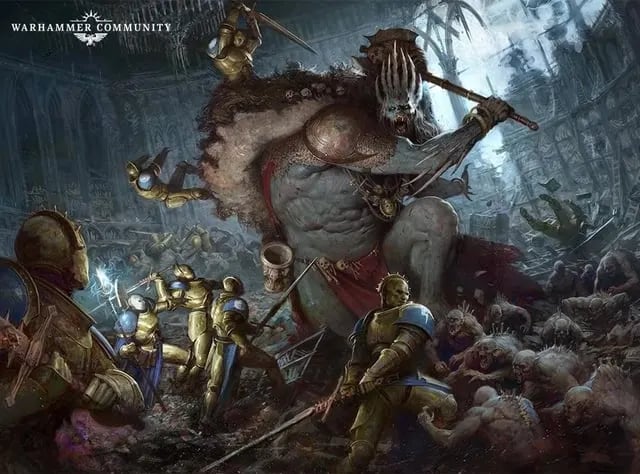
Flesh-eater Courts
The Flesh-eater Courts are cannibalistic nobles cursed by Nagash. They believe they are noble knights fighting evil, but in truth they are grotesque beasts. To outsiders, they are “sallow-skinned cannibals twisted by an ancient curse,” not virtuous knights. Their kingdoms are built on mass murder and feasting; they carry flayed flesh as banners and thirst for gore.
Their curse originated with Ushoran, the Mortarch of Delusion. Once perhaps a noble vampire, he was tormented by insanity. Nagash imprisoned Ushoran for some time, but when Ushoran escaped he spread a bloodborne curse. Vampires who drank from his blood fell into delusion: they constructed “royal courts ruled by abhorrants” (flesh-vampire overlords) and believed themselves living in a grand crusade. Thus were founded the Carrion Kingdoms. Each Flesh-eater Court is ultimately ruled by an Abhorrant Archregent – a monstrous vampire convinced of his own virtue – and legions of ghouls who think they are valorous retainers.
Philosophically, the Flesh-eaters represent madness and denial. Their most tragic aspect is that they were once mortal humans. Now, as the lore notes, “as their bodies atrophy, so too do their souls and minds, but the shared insanity of the Flesh-eater Courts provides a kind of solace”. Each court lives in a collective hallucinatory fantasy of nobility. In reality they are driven by feral hunger, killing for the sake of killing. In stories, they illustrate a dark mirror of knighthood: a lesson in how far devotion can twist into delusion under the aegis of Death.
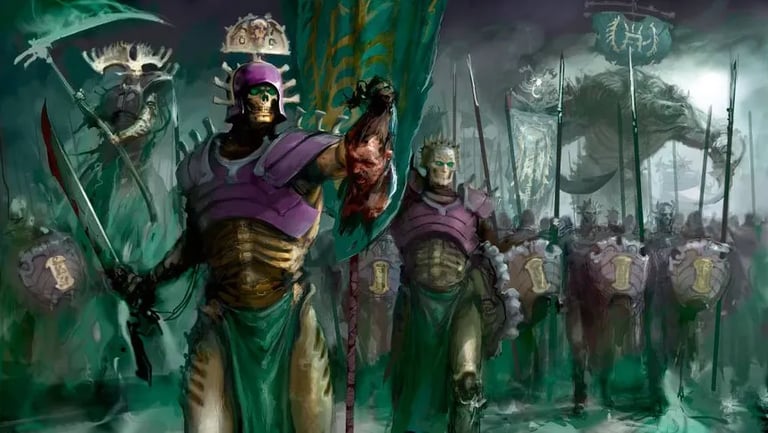
Ossiarch Bonereapers
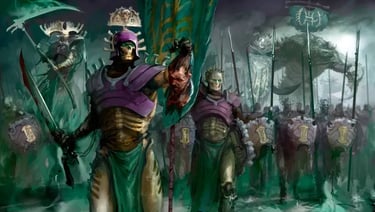
The Ossiarch Bonereapers are Nagash’s elite bone legions, created in secret as a precision army. They are walking statues of bone and armor, each constructed by arcane craft. In every Bonereaper soldier, “raw bone [is] reshaped by cunning magic into [a] macabre legionary, each animated by a careful blend of souls”. These constructs have no will of their own; they obey orders unhesitatingly. Their purpose is the Great Necromancer’s vision of a static, unchallengeable empire. As one summary states, Nagash wants to turn the realms into a “still and lifeless necrotopia, expunged entirely of all free will but his own”, and the Bonereapers are his perfect tool.
Functionally, the Bonereapers operate like an undead industrial machine. They march across the realms, conquering and collecting bone to fuel more soldiers. Every conquered lord must pay the bone-tithe: a quota of skulls and skeletons owed to Nagash’s empire. If a region fails its tribute, the tithe is seized by force. In battle, Bonereaper armies are rigorously disciplined. They include everything from rank-and-file skeleton infantry to siege engines built from ribcages and cauldron-constructs spitting necromantic fire. All their spirits are the remnants of warriors who gave their lives in service to Death – a kind of gestalt soulwork that aims to craft loyalty and valor into each bone.
Philosophically, the Ossiarch embody order and inevitability. They are organized to the last detail by Nagash and led by the Mortarch of the Necropolis, Orpheon Katakros, a once-living general deemed the perfect commander. The Bonereapers represent Death as an inexorable bureaucracy: their chains of command, maintenance ritual priesthoods, and harvest quotas make undeath into a terrifyingly efficient state. They contrast with the chaos of the Flesh-eaters or the scheming of vampires by showing that death can be as methodical as life. In narrative terms, they are unique as a skeletal “Roman legion” of horrors, a reminder that in Age of Sigmar the undead are not all wild hordes – some have the precision of a living army.
Rules, Limits, and Costs of Undeath
Despite its strength, Death in AoS is bounded by rules and steep costs. A major limitation is dependency on souls and bodies. Raising the dead requires resources: corpses to animate and souls to bind. If an area is hunted clean of life or bone, Death cannot conjure an army from nothing. Politically, Nagash’s lieutenants also have competing ambitions. Even his Mortarch council is described as “bickering, self-obsessed, and compromised by petty ambition”. This internal conflict once nearly ended Nagash’s dominion (his legions collapsed after his defeat by Teclis during the Soul Wars).
Each method of undeath carries its own price. For Soulblight vampires, immortality comes with eternal hunger: their blood-thirst is so ferocious it “threatens to overwhelm whatever scraps of humanity they still cling to”. A vampire must continually feed or become a feral monster. Flesh-eaters pay a worse toll: they lose their minds. The lore notes that these cannibals’ bodies and souls atrophy under Ushoran’s curse, leaving them both monstrous and pitiable. Even Bonereapers pay with their souls – literally. Their bodies may be unbreakable bone, but inside each marches a tormented amalgam of captured spirits. Mortisan priests torture and splice these souls to instill obedience. In all cases the undead are robbed of free will and identity.
There are also functional weaknesses. Typical skeletons or zombies are virtually mindless; without their necromancer they fall inert. Spirits like Nighthaunt, while immune to ordinary weapons, are fragile to certain magics – and they must be constantly maintained by Shyish’s energy or by Nagash’s command. Overarching this, Death’s ultimate weakness is absoluteness: if Nagash achieved his necrotopia (a dead realm of his own), there would be no life left to wage war. Thus the setting preserves tension by ensuring Death cannot simply erase everything. In story, Death often checks and balances life and Chaos, rather than crushing them outright.
Narrative Impact on Age of Sigmar
The existence of a structured Death faction profoundly shapes Age of Sigmar’s stories. It introduces moral and strategic ambiguity. Death is not simply “evil” like Chaos – it is unforgiving. Alliances with Death are possible when exigencies demand it. For example, Grand Alliances of Order have sometimes pressed Nagash into uneasy pacts to face greater threats. The cataclysm of the Necroquake even forced Sigmar’s forces to deal with Death-powered phenomena (like the Rise of the Hunt). In short, heroes may fight alongside Death-or-death scenarios or need to parley with undead lords, because Nagash’s goals occasionally align against Chaos.
Because Death is an organized empire, it can oppose Chaos without being “good”. Death seeks dominion, not moral purity. As one Warhammer source observed, Nagash’s ultimate goal is to remake the realms into a single empire of bone – “an unchanging empire solely under the control of the Great Necromancer”. This makes him as terrifying to other powers as any Chaos lord. Indeed, Nagash is “just as dangerous as the warlords of Chaos” according to Morathi, a dark elf goddess. In practice, Death can find common cause against Chaos because both cannot tolerate unbound Chaos run amok. But Death’s victories bring their own consequences (e.g. the Necroquake spread undeath further).
For storytelling, Undeath reframes violence and consequence. When warriors know death might simply fuel their enemies, battles become more desperate and moral. Fallen heroes may return as tragic foes or strange allies. Characters must confront that death is not the end but a transition – and that battling the undead means confronting this certainty. Death’s presence forces the setting to ask hard questions: if every death simply reshapes conflict, what is victory? These questions give authors dramatic leverage. A tale may revolve around redeeming a vampire’s lost soul, thwarting an undead empire’s expansion, or merely surviving a landslide of bone. Thus Death serves as a tool for narratives about fate, sacrifice, and the true price of undying life.
What Makes Age of Sigmar’s Death Unique
Age of Sigmar’s vision of Death is unusual compared to most fantasy undead. There is a scale and unity to it that is rare. Rather than mindless zombies or a lone lich, AoS imagines an undead empire spanning entire realms. Nagash doesn’t just raise monsters; he builds civilizations of bones and souls. This is captured in the description of his aim: to reduce the cosmos to a “clockwork machine of bone, sinew and magic that only obeys him”. The very word “necrotopia” is used: an undead utopia (for Nagash) enveloping the world. Most fantasy presents undead as small-scale horrors. In AoS, they are a cosmic force.
Another unique element is systemization. Other settings rarely depict undead as organized bureaucrats. In AoS we see the living taxed by bone-levies, undead armies manufactured in factories, and soul-gems coded by purpose. For example, the Ossiarch Bonereapers function like an industrial empire: they harvest bones, blend souls, and deploy regimented armies. Likewise, even Soulblight vampires operate an aristocratic system of dynasties and leagues. This bureaucratic flavor – undead civil engineering – is not common in lore.
Philosophically, AoS’s Death explores themes of inevitability and corruption on an epic scale. It asks: what if the last immortal says “enough lives, none shall be free except under me”? It also blends gothic horror (vampires and ghosts) with grand fantasy (realm-spanning pantheons). The result is that Age of Sigmar’s undead are both familiar and alien. They draw on zombie, vampire, and ghost tropes, but reframe them under Nagash’s will. In that sense, Death in AoS is greater than the sum of its parts: a faith-driven bureaucracy of inevitability rather than just another monster army.
Lessons for Creating Undead in New Worlds
From examining AoS’s Death system we can extract broader patterns. Centralization vs. autonomy is a major axis. In AoS, Nagash tries to centralize all undeath, but elements remain semi-independent (vampire courts, lost souls). This creates internal conflict that keeps Death fallible. In designing a new world, deciding who organizes the undead (a singular master or many factions) changes the tone.
Bureaucracy and infrastructure also change how undead feel. The bone-tithe is a vivid example: undead forces often need resources, which in AoS are drawn from the living. This makes undeath a systemic cycle rather than spontaneous. One can create tension by tying undead growth to tangible costs (like Nagash’s bone levy) or limitations on magic (e.g. requiring special reagents or faith). Without such costs, undead armies become unstoppable and dull.
Finally, behold the human (or inhuman) cost. AoS shows that linking undeath to personal sacrifice (vampires must feed, souls lose identity) adds depth. Every fragment of lore suggests a price: loss of self, endless suffering, cosmic balance. For narrative tension, leaving consequences to undeath (whether loss of morality or decay of the world) is key. These design insights – bureaucracy, resource limits, personal cost – keep an undead faction in check and story-rich.
Synthesis and Closing Analysis
In Age of Sigmar, Death ultimately represents inevitability given form. It embodies the idea that every life ends and that death can be harnessed into an immutable order. As a grand power, Death confronts the Mortal Realms with their ultimate fate: no matter how mighty, all beings end up in Shyish under Nagash’s gaze. This is why Death remains compelling as a theme. It forces characters and readers to grapple with mortality itself. What worth is life if it is fleeting and can be dominated forever? What meaning is there in victory if death only arms new enemies?
In AoS’s narrative tapestry, Death is the canvas on which fate is painted. It brings the question: if the gears of destiny grind on undisturbed by gods or heroes, who truly controls the world? The Grand Alliance of Death doesn’t answer that finally – instead it underlines the mystery. It compels the setting to ponder whether true freedom can exist under an undying regime, and whether hope can survive the endless march of bones. In this way, Death in Age of Sigmar is not merely an army or a category of monster – it is a profound statement about endings, power, and the questions that come with both
Undead Lore Mission
Introduce Undead Lore as a scholarly exploration of death, undeath, necromancy, and their role in myth, media, games, and culture.
© 2026. All rights reserved. Created by Nectagrity LLC