
What is a Death Knight
A comprehensive guide to death knights across fantasy, horror, and games, exploring origins, powers, variants, and their role in undead lore.
LORE
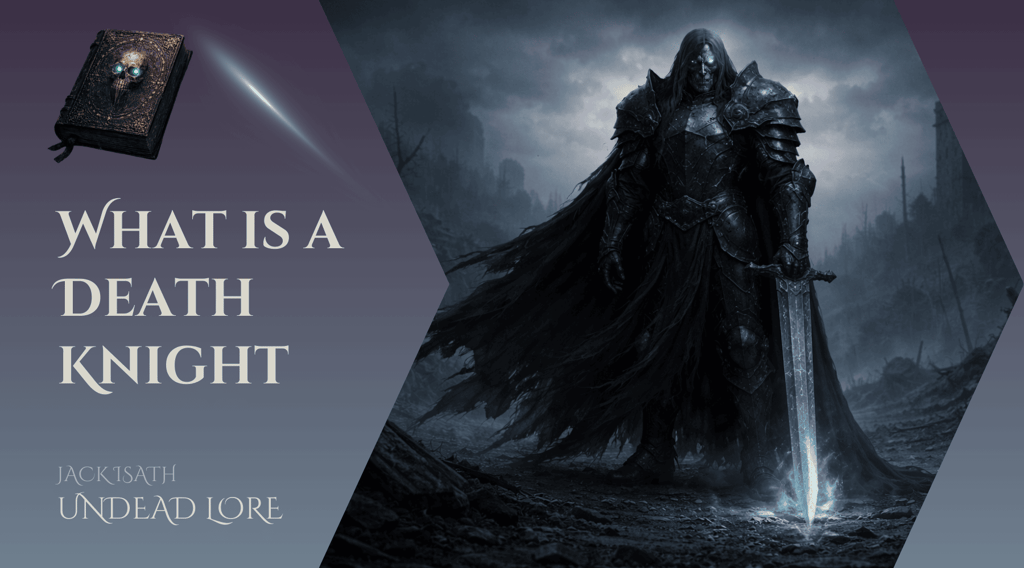
A death knight is a recurring fantasy and horror archetype: a heavily martial, knight-coded figure whose identity is bound to death, undeath, or a death-aligned power source, and whose role centers on elite violence, dread, and command.
Across media, the term can denote an undead monster, a player class or hero archetype, a template applied to other creatures, a title within a setting’s military or religious hierarchy, or a metaphorical label applied to a living warrior whose methods and symbolism align with death.
Despite the variation, most interpretations converge on four pillars.
First, the death knight is presented as a martial elite (armor, weapons, battlefield discipline) rather than as a purely occult scholar.
Second, it draws power from death-adjacent forces (necromancy, soul-binding, “unholy” rites, demonic patronage, or a death deity’s sanction).
Third, it carries a moral or metaphysical stain that matters to the fiction, commonly framed as an oath broken, a sacred duty perverted, or a life spent as a champion now repurposed as a weapon.
Fourth, it exerts social pressure on the setting: a death knight is rarely just a strong enemy, but a symbol of corrupted authority, militarized grave-power, or duty continuing beyond death.
Because “death knight” functions as a shared label across unrelated canons, a single definition is best treated as a family resemblance rather than a universal taxonomy. Some franchises hard-code “death knight” as undead; others use it as a military title for living troops in intimidating armor; still others use it as a class fantasy that blends melee combat with disease, curses, or corpse-magic.
Terminology and taxonomy
Etymology and usage
The phrase is transparently compositional: “death” + “knight.”
In practice, it operates less like a literal role description and more like a semantic fuse of two ideas: legitimate or at least recognizable martial nobility (knighthood) and the authority of the grave (death). This fuse is why the term remains useful even in settings that do not use medieval knighthood in a historical sense; it signals “armored champion” plus “death power” with minimal exposition.
Across published works, “death knight” tends to appear in five primary ways:
Creature type or unique monster: the death knight is an encounter entity with defined abilities and lore, commonly positioned as an apex undead warrior.
Class or hero archetype: the death knight is playable, most famously as a melee class flavored by runes, diseases, or unholy rites.
Template or upgrade layer: the death knight is a transformation applied to an existing character/creature, expressing “elevation into undead knighthood.”
Title within a faction: “Death Knight” is a rank, order, or special-operations designation, sometimes in non-fantasy contexts.
Narrative epithet: “Death Knight” functions as a story label for a feared rider or masked enforcer, without requiring literal undeath.
Adjacent terms and overlaps
The term overlaps with neighboring archetypes that vary by system and setting:
Blackguard / anti-paladin / fallen paladin commonly describes a corrupted holy warrior, not necessarily undead, but often positioned as the moral precursor to a death knight in “virtue weaponized into horror” narratives.
Revenant describes the returning dead driven by unfinished business or compulsion. Many death knights are effectively revenants wearing a knightly social role, even when the setting avoids the word “revenant.” Scholarship on medieval “restless dead” traditions emphasizes how narratives of return often hinge on unresolved sin, violent death, or disrupted social order, themes that strongly map onto later fictional death-knight logic.
Haunted armor / spirit-in-armor is a frequent mechanical and narrative model. Pathfinder’s graveknight explicitly binds its enduring essence to armor rather than to flesh, functioning as a knightly analogue to a lich’s phylactery concept.
Dread knight / doom knight appears in multiple franchises as a near-synonym or adjacent label for an undead or death-themed armored warrior, which can create confusion about whether a specific canon uses “death knight” as a creature, a title, or a unit upgrade.
Practical taxonomy
For cross-setting clarity, death knights can be classified by binding principle (what anchors them) and operational role (what they do). This taxonomy is designed to fit multiple canons without flattening their differences:
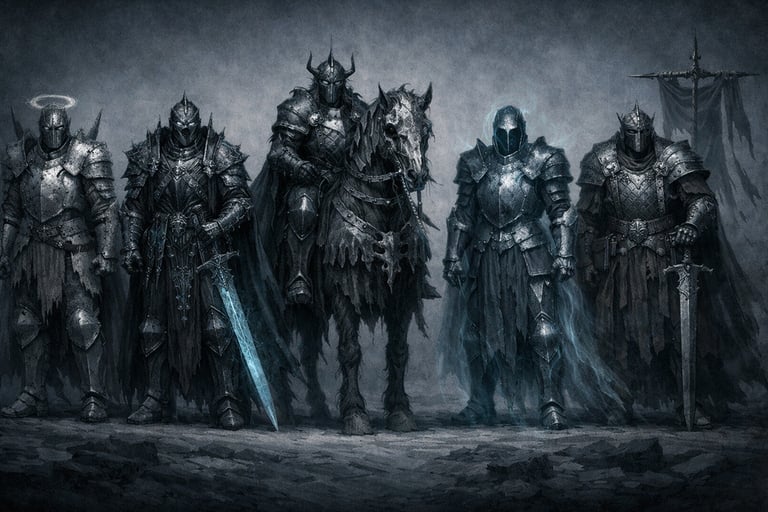
A death knight may be:
Oathbound (anchored to an oath, curse, or condemnation)
Forged (made by necromantic engineering or ritual elevation)
Possessive (spirit bound to armor/weapon)
Command-linked (sustained by a master authority such as a lich-king figure)
Institutional (a rank/title that can apply to living or undead troops).
Core concept, traits, and origins
Core concept and defining traits
In a setting-agnostic sense, a death knight is best understood as an armed node of death authority: a figure whose personal combat capability is inseparable from an external death-aligned mandate (curse, rune-magic, demonic patronage, or sanctioned violence against the living).
Where many undead are defined by hunger, plague, or mindlessness, the death knight is more often defined by discipline and by an ability to impose military structure on the supernatural.
Most depictions emphasize some combination of the following traits:
Martial mastery under a death theme: Blizzard’s official class framing describes death knights as empowering runeblades with dark magic and expending runes for attacks, explicitly pairing martial identity with a unique death-magic resource.
Elite status and scarcity: The death knight is commonly positioned as a high-tier threat or high-tier class fantasy. In Dungeons & Dragons discourse and analyses, death knights are repeatedly treated as rare, campaign-significant opponents.
Undead-friendly command aura: Many versions include command over lesser undead, or at least synergy with them. Third-party and rules-adjacent templates explicitly grant “command undead” style abilities; Pathfinder’s graveknight model instead makes resurrection contingent on the survival of armor, which supports the “boss that returns” pattern.
A moral or metaphysical wound: A common through-line is that the death knight is not merely dead, but condemned or repurposed. This is overt in D&D-oriented interpretations that tie the condition to a corrupted holy identity and failure to make amends, and in Warcraft’s framing of death knights as raised champions bound to a martial death-culture.
Ontology
The death knight’s “body” varies widely, but tends to fall into a few stable ontological models of varied types of undead:
A reanimated corpse model presents the death knight as a dead warrior whose body is animated by external necromancy, often retaining skills and memories.
A bound-soul model treats the death knight as a soul harnessed to a vessel (armor, weapon, or designated anchor), with destruction requiring disruption of that anchor. Pathfinder’s graveknight makes this explicit: the life force lingers in armor similar to how a lich's soul is held in a phylactery, permitting rejuvenation unless the armor is ruined.
A command-linked champion model ties the death knight to a sovereign of death. Warcraft’s expansion framing repeatedly associates death knights with being raised to serve the Lich King, embedding obedience and militarized undeath into the class fantasy.
A title-first model uses “death knight” as an intimidating institutional label rather than an undead category. In Palladium’s Rifts line, for example, “Death Knight” appears as a Coalition military demon-slayer concept with associated power armor, anchoring the term to militarism and demon warfare rather than medieval necromancy.
Agency and intellect
In most major implementations, a death knight is not a mindless undead laborer. It is typically autonomous or semi-autonomous, and it is frequently intelligent enough to command troops, judge threats, and pursue strategic objectives.
This is strongly implied by the role it plays in Warcraft III as a key support hero for an undead army and by World of Warcraft’s framing of death knights as a full player class with a distinct resource system and identity.
Where compulsion is emphasized, it is often framed as duty without life: not hunger but mandate. D&D tactical commentary explicitly describes undead motivation in terms of compulsion rather than survival, and uses the death knight as a prime example of that logic.
Origins and precedents
“Death knight” as a term is modern, but its imaginative lineage overlaps older ideas of restless armed dead, spectral riders, and dead who return due to moral disorder.
Medieval and early modern traditions across Europe include motifs of the dead returning to disturb the living, as well as organized spectral processions. Scholarship on medieval English sources and revenant belief addresses “walking dead” narratives and their social meaning, including the way such stories encode anxiety about disorder, sin, and communal boundaries.
The Wild Hunt motif, while not a death knight template, contributes to the iconography of death-coded riders and supernatural processions, often led by a named mythic figure and accompanied by ghostly company. This motif supplies a cultural grammar for “mounted doom” imagery that later fantasy readily translates into “death riders” and mounted death-knight variants.
Modern role-playing game lore also shaped the archetype’s consolidation. The AD&D Fiend Folio (1981) is documented as a monster collection whose first-edition material largely drew from White Dwarf’s “Fiend Factory” submissions, reflecting a period when “named undead elites” were crystallizing into gameable categories.
Transformation pathways
A death knight is rarely “born.” It is usually made, and the making is part of the horror. The following pathways recur across systems and canons, even when terminology differs.
Curse and condemnation
In the curse-and-condemnation model, the death knight is created because the individual’s moral failure is treated as metaphysically weighty, often bound to the betrayal of a sacred charge.
D&D commentary commonly describes death knights as former paladins who die without atoning and are raised into an undead state still tethered to a “former divine link,” implying that what they were persists as a twisted remainder.
This model tends to produce death knights with strong themes of irony and perversion: holy oaths inverted, honor repurposed as cruelty, and discipline turned into a mechanism for relentless pursuit rather than protection.
Necromantic elevation
In necromantic elevation, a death knight is created through deliberate ritual by an external actor: necromancer, lich, cult, demon lord, or state apparatus. It is “promotion into undeath,” in which martial competence is preserved as the core asset, while death magic is added as a force multiplier.
This is the conceptual space occupied by many template-style implementations and third-party bestiaries that treat “death knight” as a scalable upgrade: a system for turning an already-threatening warrior into a commander of undead and debuff-based warfare.
Dark patronage
This pathway binds the knightly figure to a patron power whose theology or metaphysics is aligned with death, corruption, or the underworld.
In game settings, patronage may be framed as demonic sponsorship, a death deity’s mark, or an unholy covenant. Historically adjacent belief systems about demons and restless dead in medieval culture emphasize how agency can be distributed between the dead and malign external forces, a conceptual frame that later fiction recasts as patron-driven undead champions.
Battlefield revenancy
Battlefield revenancy emphasizes the dead warrior returning because duty remains incomplete. This is less about punishment and more about unfinished mandate: the dead continue because they cannot stop.
Scholarship on revenant conceptions highlights how sudden or violent death, unresolved sin, and disrupted “good death” conditions are linked to return narratives even as doctrines evolved over time. That pattern translates readily into “soldier who returns with armor still on.”
Soul-binding to armor or weapon
Soul-binding places the death knight’s persistence in an object rather than in flesh. Pathfinder’s graveknight provides a clear, rules-explicit version: its life force lingers in armor “in much the same way” a lich’s essence is bound, and the creature can rejuvenate unless the armor is ruined.
This model is especially productive for storytelling and encounter design because it creates a physical investigative thread: to end the death knight, the binding object must be found, broken, purified, or otherwise neutralized.
Institutional manufacture
Some settings treat “death knight” as an institutional role that can be produced through training, equipment, and doctrine, without requiring literal necromancy. Palladium’s Rifts material, as shown in preview table-of-contents entries, includes a “Death Knight” Coalition demon-slayer concept paired with “CS Death Knight Power Armor,” making “death knight” an identity manufactured by a militarized faction in a demon-war context.
Powers, limitations, and counters
Common powers
Across media, death knights are designed to feel like a synthesis of frontline durability, burst threat, and battlefield control, often expressed through a package of mechanics that make them “more than a knight” without turning them into a purely spellcasting lich analogue.
A frequent cluster includes:
Death-inflected melee offense: In World of Warcraft’s official class description, the death knight’s identity is explicitly tied to runeblades empowered with dark magic and rune expenditure for attacks, a direct mapping of “martial core, death-fueled augmentation.”
Self-sustain and “negative healing”: Warcraft III material and derivative descriptions commonly emphasize the death knight’s support and healing interactions with undead forces, reinforcing the archetype’s role as both killer and anchor for an undead formation.
Command or synergy with undead: Many implementations grant direct control abilities or aura-based advantages. A third-party “death knight” template example explicitly includes an at-will control mechanic over undead within a defined range, with different persistence rules for unintelligent versus intelligent undead.
Fear and morale pressure: The death knight is commonly associated with terror effects, dread auras, and debuffs, consistent with its narrative position as a walking violation of life-order.
Disease, blight, and attrition: World of Warcraft’s death knight identity is frequently framed in broader franchise discourse as disease and plague adjacent, and third-party descriptions likewise lean on “plague” or “necromantic” mechanics as a signature.
Costs and constraints
Death knights remain interesting when their power is conditional. Common constraints include:
Binding conditions: If the death knight’s persistence is anchored to armor or a phylactery-like mechanism, destroying the body is insufficient; the anchor must be ruined. Pathfinder’s graveknight is explicit about this dependency and the rejuvenation consequence.
Political or institutional limitations: “Death knight” as a title often implies scarcity enforced by logistics and doctrine rather than by metaphysics. In Rifts, the association with specific power armor and a demon-slayer occupational concept implies a constrained, military-industrial bottleneck.
Identity constraints: In curse-and-condemnation models, the death knight is often narratively bound to a sin, oath, or compulsion, which operates as a behavioral limiter even when the creature is extremely dangerous.
Counters and defeat conditions
Because death knights are designed as apex threats, their defeat conditions often emphasize ritual, investigation, or moral leverage, not only damage.
A common “hard counter” family targets the death knight’s binding principle. If the principle is object-binding, the armor or weapon must be destroyed. If the principle is a curse, redemption or absolution may be framed as the true release. If the principle is command-linkage, severing that link can destabilize the death knight’s agency or cohesion.
Holy or consecration-based counters are common in fantasy systems broadly, but details vary by ruleset. In practice, most settings use “holy power” less as an instant solution and more as a thematic category: consecration can weaken, repel, or reveal, but the death knight typically remains dangerous until the underlying mandate is broken.
Role in worldbuilding, narrative, and games
Role in worldbuilding
Death knights concentrate several setting functions into one entity:
They provide an elite capstone for undead factions. An undead army becomes more than a swarm when it has a disciplined commander who can coordinate troops and impose tactics, which is exactly how Warcraft III positions the death knight as a central support hero for undead strategy.
They function as political myth made flesh: a walking sign that authority can be corrupted, that the dead can wear the symbols of lawful violence, and that institutions may weaponize sacred forms. Palladium’s “Death Knight” demon-slayer framing places the term into militarized storytelling, while D&D-oriented interpretations place it into the moral universe of fallen champions.
They compress history into an antagonist. The armor, heraldry, and discipline of a death knight often serve as a portable historical artifact: a ruined order’s legacy, a punished saint, a conquered kingdom’s last commander. These functions map onto broader medieval and cultural studies accounts of how the dead are used to negotiate communal boundaries and meaning.
Role in narrative and theme
The archetype persists because it reliably expresses three themes:
Corrupted honor: The death knight is rarely a random corpse. It is someone who once carried legitimacy, now inverted. D&D tactical commentary frames death knights as corrupted paladins whose undeath retains a “tenuous connection” to what they were, which makes the horror legible: virtue was not erased, it was weaponized.
Punishment that looks like power: The death knight is often a figure who appears empowered but is in fact trapped: bound to a curse, an oath, or an external sovereign. That aligns with scholarly treatments of restless-dead narratives that connect return to disorder, unresolved sin, and moral accounting rather than to simple monstrosity.
Duty without life: The death knight embodies obligation stripped of human warmth. It marches because it must. This framing is consistent with both revenant scholarship and game depictions that emphasize compulsion over survival instincts.
Death knights in games
Game design frequently uses death knights to occupy a space between “undead wizard” and “undead brute.”
In tabletop RPG encounter design
They often function as a martial counterpart to the lich: an intelligent undead that threatens the party primarily through frontline dominance, auras, and command rather than through pure spellcasting. Practical DM-facing commentary explicitly frames the death knight as compulsion-driven and ties its identity to a fallen-paladin origin, reinforcing both tactics and theme.
In MMORPG class design
The death knight supports a resource identity that distinguishes it from generic “dark warrior.” Blizzard’s official World of Warcraft class page emphasizes runeforging and rune-powered attacks, while the Legion-era class preview explains changes that preserve rune identity while simplifying rune types, demonstrating a deliberate attempt to keep the fantasy legible at the mechanical level.
In strategy and tactics games
"Death knight” frequently acts as a force-multiplying commander whose value is not raw damage alone but sustain, aura benefits, and raising or preserving undead forces. Warcraft III’s unit framing and community competitive summaries repeatedly treat the death knight as essential due to support capacity.
In systems that use templates or transformation layers
The death knight becomes a tool for escalating stakes: an existing villain can be “promoted” into a death knight to signal a new phase of threat. The presence of template-style treatments, including third-party implementations, shows how the label functions as a modular design pattern rather than as a single creature definition.
Notable interpretations across media
The following are representative rather than exhaustive, selected to show distinct implementations without collapsing incompatible canon.
Dungeons & Dragons
Within D&D discourse, the death knight is typically treated as a rare, high-threat undead warrior strongly associated with the “fallen champion” idea and with compulsion-shaped behavior rather than survival behavior.
Kas the Bloody-Handed is a well-known death knight from the Forgotten Realms. This framing is reinforced in modern tactical commentary, even when edition details vary.
Dragonlance: Lord Soth
Lord Soth is widely described as a prominent death knight figure within the Dragonlance franchise, illustrating how one character can anchor the archetype’s cultural position inside a setting.
Warcraft III
Warcraft III treats the death knight as an undead hero associated with powerful support capabilities for undead forces, including the use of Death Coil for healing undead allies, making the archetype a tactical cornerstone rather than a purely narrative monster.
World of Warcraft
World of Warcraft introduced the death knight as its first “hero class,” with official materials emphasizing rune-empowered runeblades and a distinct rune resource system; later official design commentary describes how rune mechanics were unified to reduce complexity while preserving identity.
Pathfinder
Pathfinder’s graveknight is effectively a death-knight cousin that centers its immortality on cursed armor, explicitly phylactery-like in function. This interpretation is notable because it makes the “how to truly end it” condition rules-explicit and object-focused.
Rifts
In Rifts, “Death Knight” appears in preview content as a Coalition demon-slayer concept with dedicated power armor, demonstrating how the label can migrate into a techno-military context where “knight” is a prestige combat identity rather than a medieval social class.
Common confusions and misclassifications
A frequent error is treating “death knight” as synonymous with “lich.” In many systems, liches are defined primarily by spellcasting mastery and object-bound immortality, while death knights are defined primarily by martial dominance and command presence, even when both share undead status.
Pathfinder’s graveknight explicitly mirrors lich-like anchoring logic but does so through armor, reinforcing that “knightly undead” can borrow lich mechanics without becoming a lich in role or feel.
Another common confusion is treating the death knight as simply “any undead wearing armor.” The archetype usually implies a specific combination of rank, agency, and mandate. “Armored undead” can be a visual; “death knight” is typically a social and metaphysical role.
A third confusion is assuming that the term always implies literal undead status. Some franchises and settings use it as a title for living or institutionally created warriors, including hybrid and science-fantasy materials where “death knight” labels a militarized role or platform instead of an undead creature type.
See also
Related archetypes and terms frequently used alongside or in place of “death knight” include revenant, wight, lich, haunted armor, blackguard/anti-paladin, doom knight, dread knight, and death rider or harbinger rider motifs.
Sources
Primary and official
Blizzard Entertainment. “Death Knight” class overview (World of Warcraft official site).
Blizzard Entertainment. “Legion Class Preview Series: Death Knight” (developer design notes on rune system changes).
Blizzard Entertainment. “Wrath of the Lich King Classic arrives September 26” (official recap referencing the Rise of Death Knights and hero-class framing).
Palladium Books (preview PDF). Secrets of the Coalition States: Heroes of Humanity sample file (table of contents referencing “Death Knight” concept and “CS Death Knight Power Armor”).
Palladium Books forums. Discussions referencing the “Death-Knight Assault Robot” in Rifts: Mercenaries (institutional usage and platform association).
Reference works and encyclopedic sources
Wikipedia. “Fiend Folio” (publication context and White Dwarf “Fiend Factory” sourcing for first-edition material).
Wikipedia. “World of Warcraft: Wrath of the Lich King” (expansion release date and introduction of death knight as first hero class).
Wikipedia. “Wild Hunt” (overview of a spectral procession motif relevant to mounted-doom imagery).
Wikipedia. “Lord Soth” (character described as a death knight within Dragonlance-related media).
Scholarly and academic
Gordon, Stephen. “Social monsters and the walking dead in William of Newburgh.” (Journal article on medieval England’s walking-dead narratives and social meaning).
Gordon, Stephen. Supernatural Encounters: Demons and the Restless Dead in Medieval England, c. 1050–1450 (academic treatment of revenant belief; cited here via formal review PDF).
Schmitt, Jean-Claude. Ghosts in the Middle Ages: The Living and the Dead in Medieval Society (scholarly study of medieval ghost belief and religious culture).
Springer Reference entry. “The Revenant in Europe: Medieval England” (summary of common themes in medieval revenant stories and conditions linked to return).
Critical commentary and system-adjacent references
“The Monsters Know What They’re Doing.” “Death Knight Tactics” (interpretive, DM-facing analysis of death knight motivation and origin framing).
Archives of Nethys (Paizo-licensed rules reference). “Graveknight” template/monster entries for Pathfinder (explicit armor-bound persistence model).
Undead Lore Mission
Introduce Undead Lore as a scholarly exploration of death, undeath, necromancy, and their role in myth, media, games, and culture.
© 2026. All rights reserved. Created by Nectagrity LLC