
The Types of Vampires
A structured guide to the types of vampires, explaining revenants, nobles, feral, psychic, and viral vampires and their roles across media.
PHILOSOPHY
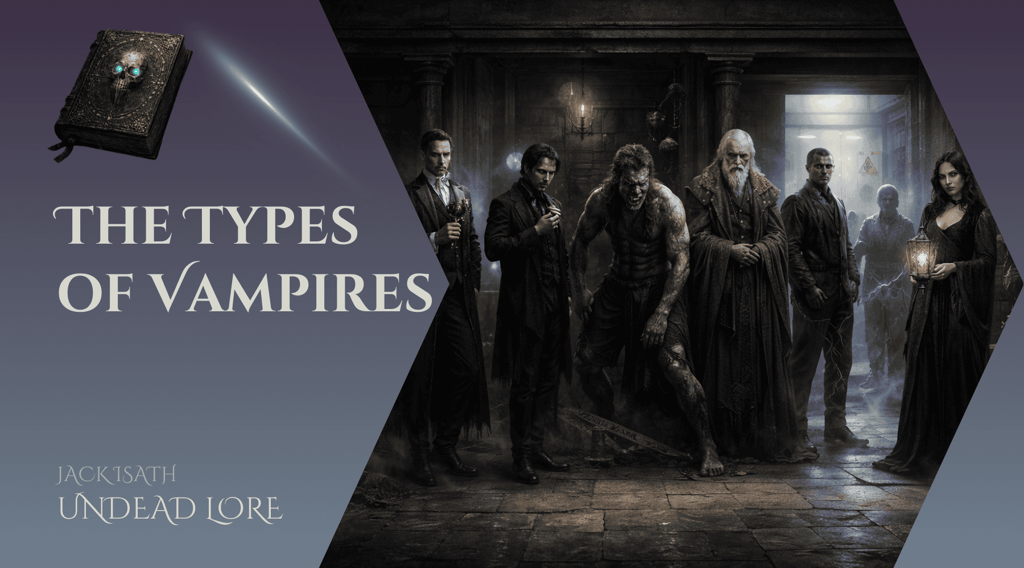
A vampire is a sentient undead or post-mortem being that sustains continued existence by extracting life force from the living, most often symbolized through blood. Unlike mindless undead, vampires typically retain memory, identity, and intentional agency.
Across media, vampirism functions as a system, not a single monster type. It is governed by three pressures:
Hunger (a recurring dependency that forces contact with the living)
Constraint (rules and weaknesses that prevent unlimited power)
Social consequence (secrecy, stigma, hierarchy, or predation shaping society)
This taxonomy defines the most common vampire types by how they function in stories, games, and worldbuilding systems.
Classical Revenant Vampire
A corpse that returns from death to drain vitality from the living, often without charm, romance, or refined intelligence.
What people ask
Is this the “original” vampire?
This is the closest structural match to many early folk beliefs. It is less “immortal aristocrat” and more “restless dead that harms its community.”
Does it drink blood?
Often yes, but “blood” can mean life force, breath, health, or a draining presence. The exact mechanism shifts by setting.
Core traits
Corpse-like appearance
Nocturnal activity
Limited intelligence or narrow intent
Strong ties to burial rites, family lines, and a specific place
How it works as a system
Origin trigger: improper burial, taboo death, curse, or social suspicion
Targeting logic: family members, neighbors, or those within the same settlement
Containment logic: local rites, exhumation, staking, burning, reburial, or religious intervention
Role in media
This type externalizes fear of disease, improper death, and social contamination. It is common in folklore-rooted horror where the village is the battlefield and the grave is the source.
Nosferatu or Monstrous Vampire
A fully undead predator whose vampirism is physically deforming and socially isolating.
What people ask
What makes a monstrous vampire different from a revenant?
A revenant is often tied to community and ritual cause. A monstrous vampire is built for predation, secrecy, and fear. It is a stable “species” or condition in many modern portrayals.
Why is it often harmed by sunlight?
Sunlight acts as a hard constraint. It forces the vampire into nocturnal behavior, creates safe times for humans, and keeps the predator from owning the entire world by default.
Core traits
Inhuman or grotesque appearance
Strong sunlight vulnerability
Predatory behavior over social interaction
How it works as a system
Hunting model: stalking, ambush, lair behavior, territorial patterns
Power trade: high strength and resilience, low social access
World impact: a hidden predator ecology rather than public society
Role in media
Used to reinforce vampires as monsters rather than metaphors for desire. Often anchors horror-first narratives where vampirism is a curse without compensation.
Aristocratic or Noble Vampire
A vampire integrated into hierarchy, wealth, or inherited power structures.
What people ask
Why are so many vampires portrayed as nobles?
Because immortality amplifies what hierarchy already rewards: patience, accumulation, and influence. A vampire can wait out rivals, buy systems, and shape institutions.
Do noble vampires have “rules”?
Yes, usually social rules. Feeding becomes ritual, entitlement, or governance. The rules protect stability and prevent chaotic exposure.
Core traits
Long lifespan enabling accumulation of influence
Refined or courtly demeanor
Feeding framed as entitlement, tradition, or tax
How it works as a system
Political structure: courts, houses, bloodlines, patronage
Feeding structure: controlled sourcing, permission systems, or prey management
Enforcement: punishments for breaking secrecy or violating hierarchy
Role in media
Represents exploitation, class imbalance, and stagnation. Common in gothic fiction and political fantasy where vampires function as ruling elites, not lone predators.
Romantic or Tragic Vampire
A vampire defined by emotional continuity with their former human life, with hunger treated as burden rather than triumph.
What people ask
Are romantic vampires still “monsters”?
Yes, structurally. The difference is the story’s focus. This type centers internal conflict: desire, guilt, restraint, attachment, and loss.
What makes it tragic instead of romantic?
Tragedy comes from the mismatch between human needs and undead reality. Immortality distorts time, relationships, and moral stability.
Core traits
Retained empathy and moral conflict
Hunger as burden, shame, or responsibility
Focus on relationships, memory, and loss
How it works as a system
Ethical rule set: “only feed in certain ways,” “do no harm,” or “control the appetite”
Social cost: isolation, secrecy, and periodic identity collapse
Narrative engine: love versus survival, restraint versus relapse
Role in media
Used to explore immortality, regret, and identity erosion. Common in literary fiction and character-driven drama where vampirism intensifies human themes rather than replacing them.
Bestial or Feral Vampire
A vampire whose hunger overwhelms identity, reducing agency over time or under stress.
What people ask
Is this basically a zombie?
It can be. This type often bridges vampires and zombies by emphasizing contagion and loss of self. The difference is usually the feeding motive and the remnants of predatory intelligence.
Why do creators use feral vampires?
Because it makes vampirism scalable. One vampire becomes many. The threat becomes outbreak, not duel.
Core traits
Diminished speech or cognition
Rapid spread through contagion
Short-term survival focus
How it works as a system
Transmission: bite, blood exposure, infection, or parasitic conversion
Failure state: the vampire loses personhood and becomes appetite
Containment: quarantine, cure quests, extermination, or hard borders
Role in media
Used in outbreak narratives to emphasize loss of control and the cost of unchecked hunger. It also reframes vampirism as ecological pressure that can collapse societies.
Ancient or Elder Vampire
A vampire whose age grants disproportionate power, knowledge, or detachment.
What people ask
Why are elder vampires so powerful?
Because long time horizons create mastery. Their power often comes from accumulated feeding, arcane learning, political shaping, and ruthless selection.
Do elders still feel hunger?
Usually yes, but it can change form. Some portrayals show refined control. Others show a deeper, colder appetite that never ends.
Core traits
Extreme longevity
Reduced emotional range or altered morality
Influence exerted indirectly through agents and systems
How it works as a system
Power ceiling: elders define what vampires can become
Threat model: not constant violence, but long strategy and inevitability
World function: mythology, origin stories, and hidden governance
Role in media
Functions as a background force or ultimate threat. Establishes historical depth and gives vampire society a spine: founders, laws, taboos, and bloodline politics.
Psychic or Energy Vampire
A vampire that feeds on emotion, vitality, attention, or consciousness rather than blood.
What people ask
Is an energy vampire “real” vampirism in fiction terms?
Yes, when the setting defines life force as something that can be extracted without blood. It shifts vampirism from biology to psychology and social dynamics.
How does feeding work without violence?
Feeding can occur through proximity, manipulation, obsession loops, or psychic contact. The harm is often exhaustion, despair, or identity erosion.
Core traits
Minimal physical violence
Feeding through proximity, influence, or manipulation
Often difficult to detect
How it works as a system
Predation method: social engineering, psychic draining, emotional dependency
Defense: boundaries, wards, awareness, or community support
World use: makes vampirism possible in daylight and public spaces
Role in media
Common in urban fantasy and allegorical fiction. It translates vampirism into modern anxieties: coercion, exploitation, and the feeling of being consumed without a visible bite.
Scientific or Viral Vampire
A vampire explained through infection, mutation, parasite, or engineered biology rather than supernatural curse.
What people ask
Does this remove the mythic feel?
It can, but it replaces myth with systemic realism: containment, governance, adaptation, and bioethics. The vampire becomes a public crisis.
Why is this type common in apocalyptic settings?
Because it scales. Infection models support spread curves, societal collapse, and militarized responses.
Core traits
Pathogen-based transformation
Reduced supernatural framing
Emphasis on spread, symptoms, and containment
How it works as a system
Transmission model: bite, blood, airborne variants, vectors
Institutions: labs, militaries, quarantines, black sites
Progression: incubation, mutation, and “stages” of vampirism
Role in media
Reframes vampirism as systemic collapse rather than moral curse. Useful when the story wants procedures, logistics, and consequences more than gothic symbolism.
Hybrid or Cross-Genre Vampire
A vampire blended with other undead or supernatural systems, designed to serve a specific setting’s rules and tone.
What people ask
Why do hybrids exist at all?
Because creators often need vampirism to integrate with magic systems, divine cosmologies, or game mechanics. Hybrids let vampirism fit the world instead of fighting it.
How do you keep hybrids coherent?
By making feeding, constraints, and transformation rules consistent. If those three are stable, almost any hybrid reads as “real” inside its setting.
Core traits
Mixed origin rules
Variable weaknesses
Custom feeding mechanics and power sources
How it works as a system
Rule priority: decide what overrides what when systems conflict
Cost structure: what the vampire must pay to keep power
Balance: limits that keep the vampire from becoming a universal solution
Role in media
Common in games and shared universes. Allows tailored vampire design without strict adherence to tradition, while keeping the archetype recognizable.
Summary: Vampires as a System
Across media, vampires persist because they balance power with dependency. They offer immortality without freedom, strength without sustainability, and identity without resolution.
Read: The Best Vampire Books
Each vampire type emphasizes a different tension:
Monster vs. person
Hunger vs. control
Immortality vs. stagnation
That flexibility makes vampires one of the most durable undead archetypes in fiction. They can operate as horror predator, romantic antihero, political elite, outbreak pathogen, or hidden psychic parasite without losing structural coherence.
Quick FAQ On Vampires
What are the main types of vampires?
Classical revenant, monstrous, aristocratic, romantic, feral, elder, psychic, scientific, and hybrid vampires are the most common functional categories.
What is the most common vampire type in modern media?
Aristocratic, romantic, and hybrid vampires dominate modern mainstream portrayals because they support long character arcs and social structures.
Are vampires undead in every setting?
Not always. Some settings treat vampirism as a curse, infection, or parasitic transformation. Functionally, the vampire still operates as a life-force dependent predator with constraints.
What is the difference between a vampire and a revenant?
A revenant is a returned dead driven by a narrow purpose, often local and ritual-based. A vampire is usually a stable condition with feeding dependency, recurring rules, and potential social structure.
Undead Lore Mission
Introduce Undead Lore as a scholarly exploration of death, undeath, necromancy, and their role in myth, media, games, and culture.
© 2026. All rights reserved. Created by Nectagrity LLC